

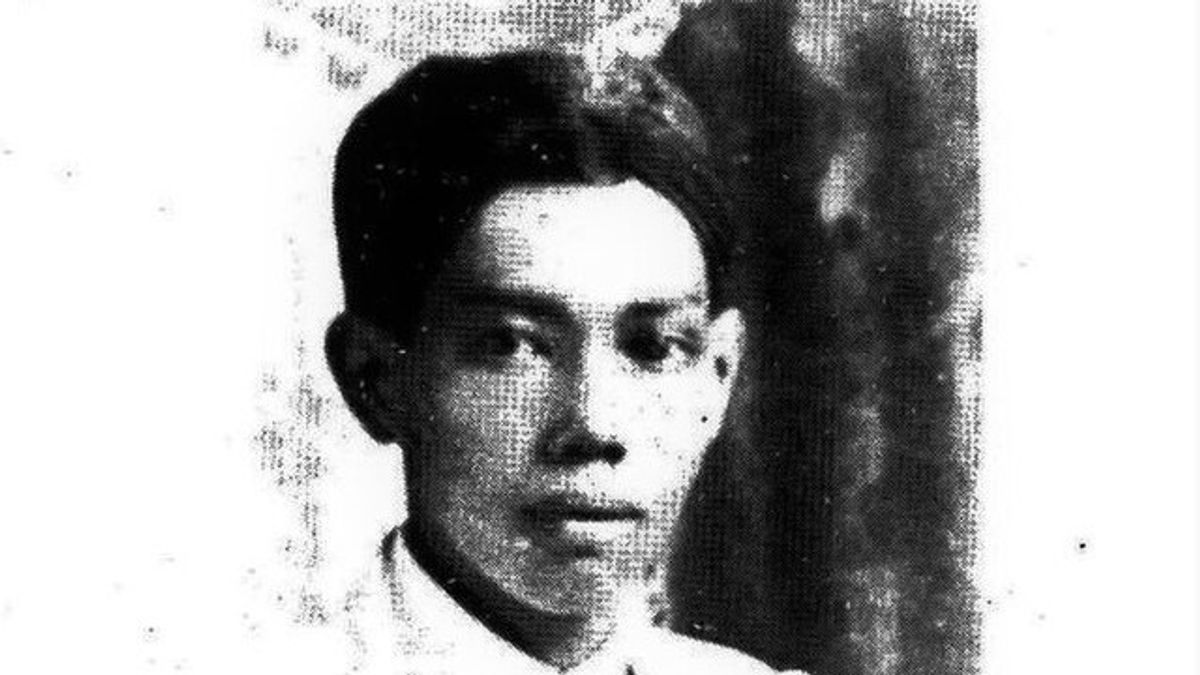


JAKARTA - There is no doubt about the existence of Wage Rudolf (WR) Soepratman in the stage of Indonesian national history. He is a figure who has ever made the Dutch colonialists disturbed. The narrative is because Soepratman's work is able to expose the bad colonialism in the archipelago.
He was able to ignite the spirit of youth nationalism with the song Indonesia Raya. He was also able to make the Dutch hot with his fictional book: Perawan Desa. The colonial government then considered the novel to be a forbidden reading and banned from being published.
Resistance against colonialism does not necessarily have to use weapons. Nor does it have to continue to be on the pulpit with fiery speeches to stir up the anger of the bumiputra against colonialism. The presence of WR Soepratman is proof of this.
He is the perfect embodiment of the fact that struggle can be in many ways. He tried to fight in his own way. He chose the medium of art as a tool for struggle. He created a song that inspired the youth.
Indonesia Raya, its name. The song was then played at the Second Youth Congress on October 28, 1928. The song was played on the same day as the emergence of the Youth Pledge - blood, nation, and language: Indonesia.
The song Indonesia Raya was accepted by the independence fighters. Soepratman did not stop. He just kept printing leaflets of the Indonesia Raya song score. Another big move he tried to present the song Indonesia Raya in the form of a black disc.
The presence of the black disc format made the Indonesian song listening room so wide that it reached the whole country. This condition disturbed the colonial government of the Dutch East Indies. The Indonesian song Rayasempat was banned from being broadcast.
Soepratman was asked to replace the word merdeka with mulia. The change was considered so that the song Indonesia Rayabisa would be accepted by many people and not a propaganda song. However, Soepratman continued.
He continued to spread and expand the influence of Indonesia Raya. At its peak, the song continued to be sung in every meeting of independence fighters.
"Indonesia Raya Soepratman also suffered. Like Ivan Susanin, Glinka can only be broadcast if the title is changed to the Tsar's Darling. Indonesia Raya at that time could only be broadcast if the word free was replaced with noble. As if the nobility was not independence," said Njoto as written by Fadrik Aziz Firdausi in the book Njoto: Biografi Pemikiran, 1951-1965 (2017).
Perawan DesaThe colonial government was often confused when Indonesia Raya began to spread everywhere. The song was considered able to incite the struggle of the bumiputra against the colonial government. On the other hand, the song also made Soepratman's popularity as a song creator and independence fighter also increased.
The journalist of the Sin Po newspaper was increasingly watched. The colonial government of the Dutch East Indies was often paranoid when Soepratman released his other works. Take for example when Soepratman made a book titled Perawan Desayang published between 1928 or 1929.
Roman by Soepratman tries to place social criticism related to colonialism. The book, which is said to be made from the profits of selling the Indonesia Raya score, cleverly exposes how the social gap between the rich and the poor in the Dutch East Indies era.
Soepratman spent 125 guilders to print 2 thousand copies of the book. Soepratman also advertised his book in various local newspapers. The results were amazing. Perawan Desabak's work was as awaited as the song Indonesia Raya.
They are curious. In fact, the colonial government was curious as well. They tried to order books. The goal is to find out the contents of Soepratman's head and its impact on readers.
The owner of the power also found that Perawan Des was considered a dangerous reading. This condition made the book Perawan Des by Soepratman's work banned from being published. All books that have been printed, confiscated and then burned.
The colonial government also threatened those who wanted to spread the Village Virgin. Whoever was caught possessing, distributing, to doubling the book Village Virgin would be subject to severe sanctions. The ban was a big blow to Soepratman.
Instead of relaxing the spirit, Soepratman continued to devote himself to the struggle against colonialism. He fought against colonialism with pen and violin. An instrument that made the Dutch afraid.
"In a short time, the assistants of the Procureur Generaal (colonial government) have concluded their research results on the social novel The Village Virgin, the conclusion states that the social novel written by Wage Rudolf Supratman is in essence a protest against the practices of colonialism and capitalism."
"Although it is only a fictional story, but if it is allowed to circulate and can be read by thousands of people, especially among students and political movement figures, then the book will bring great shame to the Dutch East Indies Government. It is recommended that the Procereur Generaald with his authority, immediately order the relevant agencies to prevent the circulation of the book Perawan Desadengan by confiscating and destroying all the books," said Bambang Sularto in the book Wage Rudolf Supratman (1980).
The English, Chinese, Japanese, Arabic, and French versions are automatically generated by the AI. So there may still be inaccuracies in translating, please always see Indonesian as our main language. (system supported by DigitalSiber.id)


