

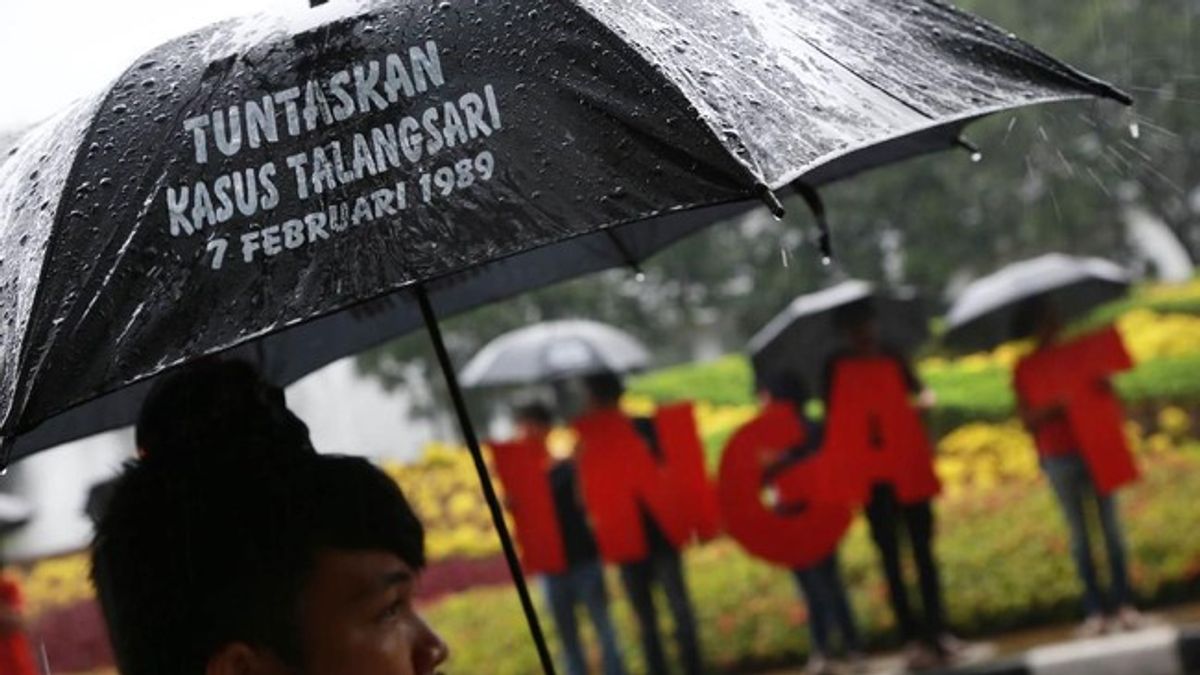


JAKARTA - The Soeharto government and the New Order (Orba) have used Pancasila as a political tool for power. Anyone who doubts Pancasila will be fought. This condition also applies to Islamic and political groups.
The Usroh group, for example. The group is considered far from Pancasila. That reason made its members hunted. At its peak, the hunt gave birth to a major humanitarian tragedy. The Talangsari tragedy, its name. Muslims become victims.
No one doubts the strong power of Suharto and the New Order. The resistance for the sake of resistance from political opponents was able to be extinguished. Instead of taking a calm position because it was at the helm of power, the New Order even more showed its repressive influence in the 1980s.
Suharto likes to deliberately use Pancasila to beat the critical group and its political opponents. He revealed that many groups refuse to make Pancasila a living philosophy. They want to replace it with a kind of understanding. Take for example someone who wants Indonesia to become an Islamic state.
The accusations were directed by the New Order to the Usroh Movement. The small Islamic group that developed in Central Java was deemed not in accordance with the government's ideology. The Usroh Movement was seen as an New Order that did not accept Pancasila.
This condition made the New Order furious. The owner of power moved to detain all Usroh followers. However, not all of them were able to be detained. Some of them fled to other areas. They were accommodated by Warsidi, who in fact local religious leaders in Umbul Cihideung, Talangsari Hamlet, Lampung.
Warsidi also moved to help. They are not only provided with a place to live. The Usroh movement that fled was accepted as a farmer. Negative issues developed. Warsidi is considered like building a subversive movement against the government.
Warsidi's teachings were also labeled as heretical teachings. The government then considered Warsidi and his followers a threat to national stability. The Usroh movement was also visited by the military. However, Warsidi's followers thought they would detain their leaders and carry out attacks.
SEE ALSO:
-
 | MEMORI
Sejarah Petrus: Cara Kontroversial Soeharto dan Orba Basmi Kejahatan
13 November 2025, 08:00 -
 | MEMORI
Mengenal Jan Pieterszoon Coen: Pahlawan bagi Belanda, Penjajah bagi Indonesia
10 November 2025, 22:30 -
 | MEMORI
Ratu Elizabeth II Hapus Gelar Kehormatan Predator Seksual Harvey Weinstein
07 November 2025, 08:00

The Commander of the Military Rayon (Koramil) Way Jepara, Captain Sutiman, died on February 6, 1989. This condition brought anger from the military.
The activist who managed to save himself was accommodated by Warsidi on his escape. Warsidi, a Koran teacher and farmer, together with Nur Hidayat built an Islamic village with Islamic law and founded an influential pesantren in Umbul Cihideung, Talangsari Hamlet.
"The existence of them is suspected by the government as a subversive movement under the pretext of teaching heretical teachings. Monitoring and reconnaissance of the Warsidi group will continue to be carried out during January and early February 1989," said Hermawan Sulistyo and Putri Ariza Kristimanta in the book The Inspector General and Power Suharto (2022).
Sutiman's death like a sign of resistance was carried out. The power of attorney did not remain silent. The 043 Black Garuda Korem force led by AM Hendropriyono attacked the Warsidi group on the dawn of February 7, 1989.
The Black Garuda Korem came with great strength. They brought four platoons of Mobile Brigade troops from the Garuda Hitam Resort Command, Central Lampung. They attacked Warsidi's follower ward indiscriminately in Umbul Cihideung, Talangsari Hamlet.
Men and adult women are victims. In fact, children too. They were bombarded with bullets. Their booths were burned. In fact, women are labeled as wives of sympathizers of the Indonesian Communist Party (PKI).
The cruelty claimed many lives. The military version of the victims was only 27 people. Another version of the victims reached 246 people. The cruelty did not stop there. The owner of power went down to chase members from the Warsidi group outside the area, some of whom were detained.
The Talangsari incident made the image of the New Order repressive and anti-Muslim even higher. Suharto was branded a gross human rights violator. However, this incident could only be voiced straightforwardly when Suharto and the New Order stepped down in 1998. Komnas HAM had investigated the case.
In June 2001, the National Human Rights Commission (Komnas HAM) formed an ad hoc team to investigate this case. The results are unclear. Later, Komnas formed an investigation team. This team took to the field to interview the victims, the families of the victims, and a number of perpetrators. The investigation was completed in mid-May 2006, "wrote in a Tempo magazine report entitled Dengue Fajr in Talangsari (2008).
The English, Chinese, Japanese, Arabic, and French versions are automatically generated by the AI. So there may still be inaccuracies in translating, please always see Indonesian as our main language. (system supported by DigitalSiber.id)
Most Popular Tags
#Prabowo Subianto #donald trump #firearm #8791 #giias 2026Popular


