

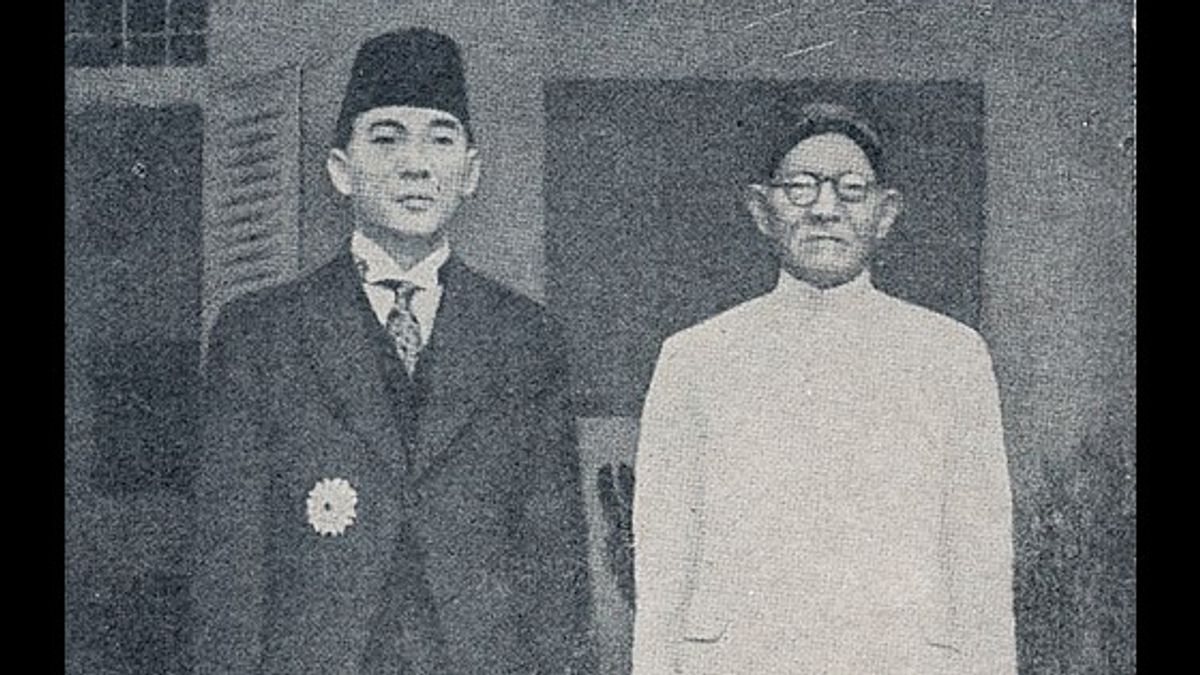


JAKARTA - Life as a native teacher during the Dutch East Indies era was not easy. Soekemi Sosrodihardjo experienced it. The father of national figure Soekarno, he witnessed the less prosperous—if not impoverished—life of native teachers.
His salary, used to educate the nation's children, was meager. Most of it was spent on rent. This was different from European teachers who received high salaries. However, Soekemi refused to give up. He was proud to be a teacher. He fought hard so that his children could pursue higher education and succeed.
The Dutch colonialists often looked down on natives. Their livelihoods were never considered. Those in power even treated natives as third-class citizens—lower than ethnic Chinese and Europeans.
Different treatment was inevitable. There was no justice in all aspects of life. Take the job of native teacher, for example. Native teachers and European teachers had vastly different lives.
While European teachers prospered, native teachers suffered misery. Their salaries were never equal. This situation was experienced firsthand by the son of a lowly aristocrat, Soekemi Sosrodihardjo. Born in Wirosari on June 15, 1873, he proudly chose a career as a teacher. He was a brilliant mind and intelligent too.

Soekemi then decided to enroll in the indigenous teacher's school (Kweekschool) in Probolinggo and graduated. This narrative inspired Soekemi to pursue a mission to educate the indigenous people. He worked as a teacher in several locations in East Java.
He was also assigned to Singaraja, Bali. This placement led Soekemi to meet the love of his life, Ida Ayu Nyoman Rai. The two began to enjoy life together. However, life wasn't always easy.
A teacher's salary was meager, while life's burdens continued to increase. Their life became even more difficult with the birth of two children: Soekarmini (Wardoyo's mother) and Soekarno—formerly known as Kusno.
Soekemi supported her family on a salary of only 25 guilders per month. This amount was insufficient to cover all the living expenses of Soekemi and her family.
"I was born in the midst of poverty and grew up in poverty. I have no shoes. I don't bathe in the water that comes from the tap. I don't know spoons and forks. Such outrageous absences can cause the little heart inside to become sad."
"With my older sister Sukarmini, who is two years older than me, we are a family consisting of four people. My father's salary is 25 guilders a month. Subtracting the rent for our house on Jalan Pahlawan 88, the balance becomes 15 guilders and with a comparison of the government exchange rate of 3.60 guilders for one dollar, you can estimate how low our family's level of living is," said Soekarno as written by Cindy Adams in the book "Bung Karno: Penyambung Lidah Rakyat Indonesia" (2019).
Struggling to Raise Soekarno
He and his family once lived in a destitute area of Mojokerto. This situation caused their sadness to be felt almost throughout the village. There was nothing to be proud of. Soekemi even had difficulty buying rice. This forced them to eat mostly cassava and ground corn.
All the hardships of life were indeed difficult to endure. However, Soekemi was not one to give up easily. Instead, he could see far into the future, especially for his children, Sukarno. He always sought the best education for Sukarno.
Money was hard to come by, but that didn't mean Soekemi had trouble making connections. He joined a theosophy group in Surabaya. He had many friends from the intellectual community. This group provided Soekemi with much assistance.
In fact, the theosophy group's library became a playground for Sukarno to explore the thoughts of many great world figures through books. Soekemi also enrolled Sukarno in the best school, the Hoogere Burgerschool (HBS) in Surabaya.
This school was instrumental in awakening Sukarno's awareness of the evils of colonialism. Soekemi's struggle was also noticed when she helped Bung Karno study at the Technische Hoogeschool te Bandoeng (now: Bandung Institute of Technology) and become a civil engineer.
Soekemi was not present at her son's graduation. However, Soekarno's success in becoming a graduate proved that even poor teachers could send their children to higher education. Later, as a leader, Bung Karno never forgot the contribution of his parents and teachers.
"In conversations with friends, he repeated the statement of his school rector, Professor Klopper, when my husband received his diploma. Ir. Soekarno, this diploma can be torn and crumbled to ashes at any moment. It is impermanent. Remember, the only power that can live on and last is a person's character. It will live on in the hearts of the people, even after death," said Soekarno's wife, Inggit Garnasih, as written by Ramadhan K.H. in the book Soekarno: Kuantar ke Gerbang (2014).
The English, Chinese, Japanese, Arabic, and French versions are automatically generated by the AI. So there may still be inaccuracies in translating, please always see Indonesian as our main language. (system supported by DigitalSiber.id)


