

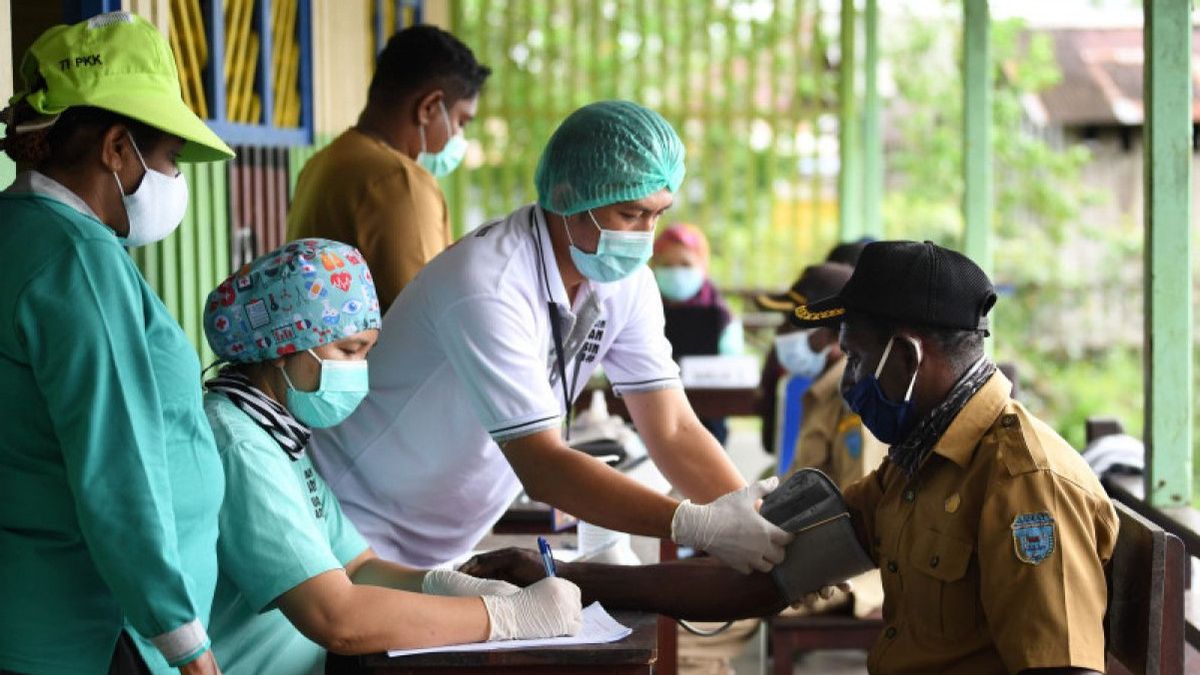


JAKARTA Memories today, three years ago, July 12, 2022, Minister of Health (Menkes), Budi Gunadi Sadikin emphasized that Indonesia was short of 160 thousand doctors. This view was revealed referring to the standards of the world health organization, WHO which emphasized that the ratio of doctors should be one per 1,000 population.
Previously, equitable distribution of Indonesian health human resources was an endless problem. The availability of health workers is only focused on big cities, in underprivileged villages. This narrative makes health services not optimal.
The COVID-19 pandemic can be a place to see the chaos of the health service system. The unequal business of health human resources can be seen easily when the corona virus is endemic. The easiest way to see it is to see the difference in handling between the city and the village.
The city is usually responsive. While the village handling the corona virus is like unpulsed. This condition makes the handling of the virus from Wuhan never maximized. The government's seriousness in breaking the chain of the spread of the corona virus is a question.
The spread of health workers between cities and other cities or villages has not been balanced. Sometimes also a city with abundant hospitals. There are also cities with limited hospitals. Instead of multiplying the distribution of doctors, in fact the existing doctors are quite limited.
SEE ALSO:
-
 | MEMORI
Ide Kontroversial Ali Sadikin: Proyek Tempat Parkir di Atas Sungai Ciliwung
12 Juli 2025, 06:30 -
 | MEMORI
Hagia Sophia Resmi Kembali Jadi Masjid dalam Memori Hari Ini, 10 Juli 2020
10 Juli 2025, 16:00



Take for example in eastern Indonesia. The conditions there are really far from expectations. Doctors are limited. Likewise with health facilities. This condition makes the Indonesian government have to work hard to make equity.
If the same narrative as the chaotic handling of COVID-19 does not happen again. Those in big cities get services. While those in the village find it difficult to access health facilities.
"The equitable distribution of health human resources in Indonesia is still within a limited number of human resources. With a doctor's graduation rate of 12 thousand per year, it is necessary to require 10 years to meet the ratio of doctors/populations equivalent to Asia because now the needs are approximately 140 thousand".
"Furthermore, 158 or 25.08 percent of district/city hospitals have not been met with seven specialist doctors. And the ratio of doctors 0.67 per 1,000 Indonesians is still low and specialist doctors 0.5 per 1,000 population are also still low," said Deputy Health Minister Dante Saksono Harbuwono as quoted by the Media Indonesia website, 18 December 2021.
The lack of doctors is a big problem for Indonesia. The Minister of Health, Budi Gunadi Sadikin, agreed to this problem. Budi himself admitted that Indonesia now lacks 160 thousand doctors on July 12, 2022.
Budi calculated this shortfall, according to WHO standards, which emphasized that the ratio of doctors must be one per 1,000 population. The current doctors reach 110 thousand people. This means that if the Indonesian population reaches 270 million, then Indonesia must have a total of 270 thousand doctors.
"In order to make humans healthy, said WHO, I need 1 per 1,000 population of doctors or 270,000 (doctors). I ask the health office, the figure is out 110,000 (the number of doctors currently available). The WHO standard is 270,000, meaning the lack of 160,000 doctors".
"The hospital must have seven standard specialist doctors. If you follow that standard, the lack of 2,200 (doctors). But if the hospital is big, for example (doctors) need two internal diseases, (needs) increase to 4,437 specialist doctors. This is only from nominal," Budi said as quoted by the COMPASS.com page, July 12, 2022.
The English, Chinese, Japanese, Arabic, and French versions are automatically generated by the AI. So there may still be inaccuracies in translating, please always see Indonesian as our main language. (system supported by DigitalSiber.id)


