

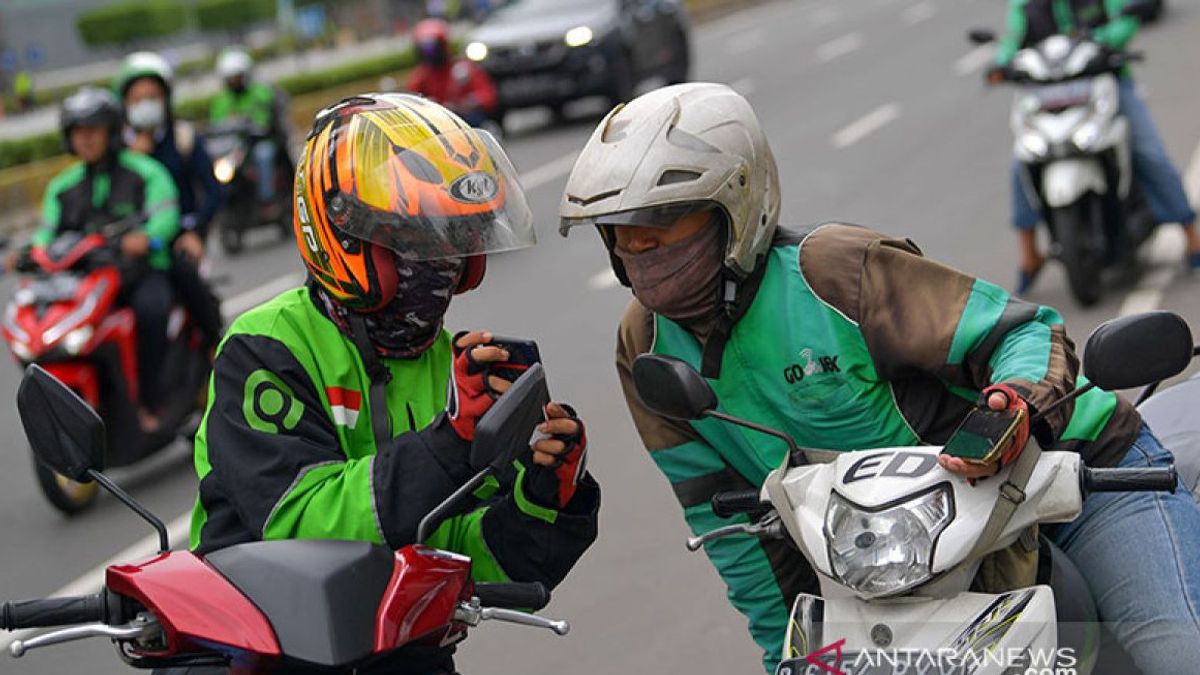


JAKARTA - Today, five years ago, June 8, 2020, the Governor of DKI Jakarta, Anies Baswedan allowed the online motorcycle taxi (ojol) to transport passengers. The policy was greeted with a commotion by motorcycle taxi drivers who were previously only allowed to carry goods.
Previously, the DKI Jakarta government was considered the most responsive to matters to prevent transmission of the corona virus. Various policies have been rolled out. The DKI Jakarta government even prohibits ojol carrying passengers.
Efforts to fight the COVID-19 pandemic have been quite heavy since 2020. All levels of government continue to struggle to break the chain of virus spread from Wuhan. However, breaking the chain of the virus is not an easy thing.
Uncertainty of preventive measures is the problem. The world health agency, WHO alone often fails to provide preventive information. The steps given often change. This condition makes countries in the world try to break the chain of spreading the virus themselves.
In Indonesia, especially. State leaders are required to respond quickly in carrying out orders from the central government. This condition can be seen when the government implements a Large-Scale Social Restriction (PSBB) policy.
PSBB is activated to reduce social activities, from school holidays to ban activities in public places. The regulation must be obeyed by regional leaders. Anies Baswedan also welcomed the PSBB policy.
SEE ALSO:
-
 | BERITA
Akhirnya, Plt Wali Kota Jakarta Timur Rasakan Dorong-dorongan saat Naik Angkot
30 April 2025, 08:51






The Governor of DKI Jakarta has begun to consider other steps so that PSBB is successful in its working area. Anies also initiated additional policies by collaborating on the use of personal transportation and ojol.
Anies revealed that ojol drivers are not allowed to carry passengers on April 9, 2020. Ojol can only carry goods. This condition is because COVID-19 is being violent in Jakarta.
"The freight expedition service, including online motorcycle taxis with the limit of only transporting goods, is not for transporting passengers. In talks with the Ministry of Transportation, we are of the view that it can be allowed, but because there has not been a change in the regulation of the Minister of Health and the Governor's Regulation must be in line with the reference to Permenkes Number 9 of 2020, we regulate motorcycle taxis in accordance with the guidelines on Permenkes Number 9," said Anies as quoted by the COMPASS.com page, April 9, 2020.
Recently, Anies began to see that his policy was too strict. He began to think about steps so that the people of Jakarta could move and not contract COVID-19. He sees the option of implementing the COVID-19 protocol to be effective, especially the use of masks.
This condition made Anies start loosening the policy. He allowed ojol to return to carrying passengers on June 8, 2020. He felt there was no need to worry anymore that ojol passengers or drivers could catch COVID-19.
"Non-mass public vehicles (ojek/mobil) operate (on June 8, 2020) with the Covid-19 protocol," Anies said, announcing that Ojek may operate on June 8, 2020, as quoted on the coil page, June 5, 2020.
Everything is because Anies thinks ojol will operate following the existing COVID-19 protocol. As a result, the option of people riding an ojol does not lead to new clusters of transmission.
Anies' policy of allowing ojol to transport passengers has also become a polemic. Many think that the policy can lead to disaster seeing the rising number of COVID-19 transmissions.
Illustration:
1.2. Portrait of ojol when the COVID-19 pandemic hit BETWEEN
The English, Chinese, Japanese, Arabic, and French versions are automatically generated by the AI. So there may still be inaccuracies in translating, please always see Indonesian as our main language. (system supported by DigitalSiber.id)
Most Popular Tags
#Prabowo Subianto #donald trump #firearm #8791 #giias 2026Popular


