


JAKARTA - English language skills are one of the increasingly important skills introduced early to children. However, for actress Tasya Kamila, the benefits of taking English lessons turn out to be much broader than just academic ability.
The actress and mother of two shared her experience accompanying her son, Arasha, to learn English since kindergarten age.
Tasya Kamila admitted that she started introducing English to Arrasya since Kindergarten (TK-B), and now, her son who is sitting in the 2nd grade of elementary school (elementary school), his English skills have developed quite rapidly after regularly attending a tutoring class.
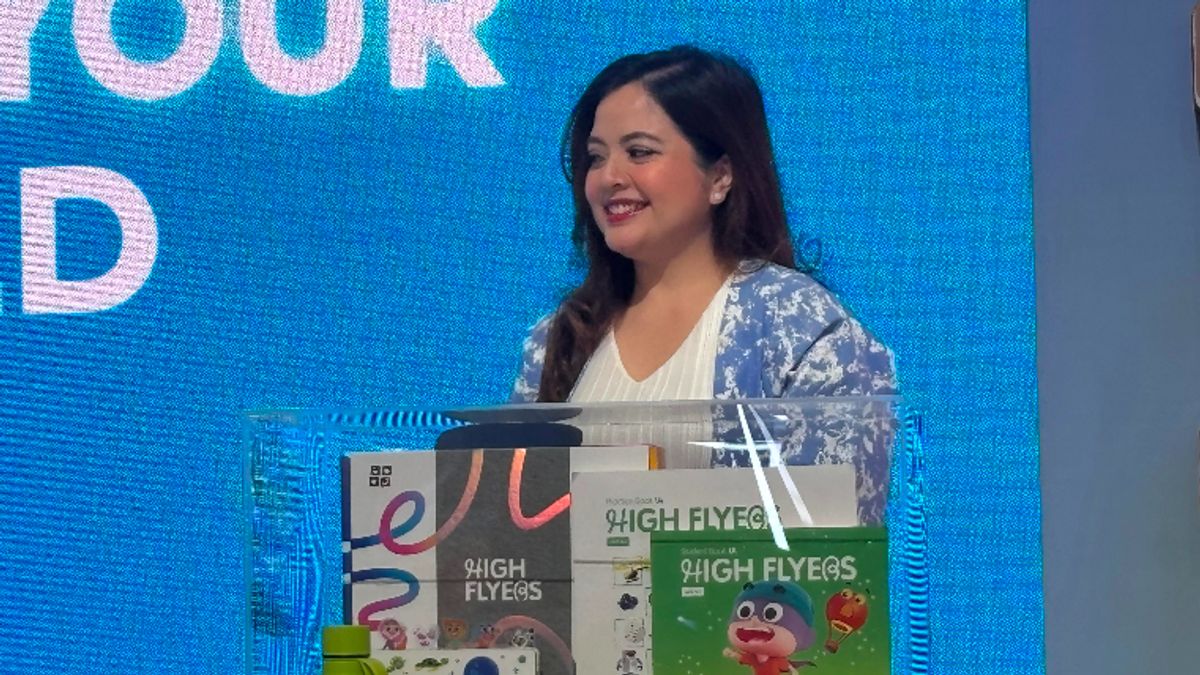
"Arrasya has been introduced to English from TK-B. Now he is in grade 2 and takes English lessons. From the initial level, it has now reached High Flyers," said Tasya in the High Flyers 4.0 press conference held by English1 in Kelapa Gading, Jakarta, Friday, May 29.
According to Tasya, the biggest change he saw was not only in terms of speaking ability or vocabulary addition, but also the child's confidence when communicating.
At the beginning of learning, Arrasya was a child who was not confident when it came to speaking English. He often felt afraid of being wrong and worried when trying to speak.
But slowly, the interactive learning approach made his eldest son start to enjoy the English learning process without feeling burdened as if he were studying in a formal class.
Tasya assessed that the learning method applied was more fun because the children were invited to actively interact through role playing, conversation practice with teachers and friends, to various visual activities that are close to the children's daily lives.
"In the class there is role playing, they learn conversation with the teacher and friends. So it doesn't feel like studying," he said.
Not only speaking, the learning material also includes reading to narrative reading which according to Tasya is very helpful in training children's critical thinking from an early age.
"There are many stories and stories to learn, it trains critical thinking," he said.
Another thing that impressed Tasya was the way of learning that did not emphasize memorization. Children are accustomed to understanding the language through an applied situation that is close to everyday life.
"Vocab increases, but it is not learned by memorizing. It is made in situations that are applicable in the real world, according to their routines," explained Tasya.
Now, after about a year of taking lessons, Tasya saw significant progress in Arasha, especially in the courage to speak and problem solving skills.
He also revealed that Arrasya really enjoyed the interactive learning atmosphere. The presence of visual displays, animations, and activities such as cartoons make children more enthusiastic about attending classes.
The benefits of learning English from an early age do not only impact self-confidence, the change is also seen in academic achievement at school. Tasya admitted that her child's English grades had improved quite drastically.
"Before, the English score was C, now after a year of lessons it's A," he said.
Meanwhile, English1 Academic Operations Manager, Kurniasari Anindita explained, the High Flyers 4.0 program is designed to help children be more ready to use English in real life.
According to him, children not only learn theory, but also directly practice everyday conversations, such as ordering food at a cafe, talking to a doctor when they are sick, to introducing themselves to new friends.
"Each lesson has a clear and measurable target. For example, after completing one unit, students are expected to be able to introduce themselves or tell a short story," explained Anindita.
He added that the learning method refers to the international standard Common European Framework of Reference (CEFR) and Cambridge English: Young Learners (YLE), so that students are also prepared to face international English certification.
"The simple question we use is: are these children really ready to speak English in the real world? We want the answer to always be 'yes'," he said.
In addition to the interactive learning method, High Flyers 4.0 is also equipped with a learning application that connects teachers, students, and parents in one digital ecosystem. Parents can monitor their child's progress directly through their mobile phone, while teachers can provide tasks and evaluations in a more practical way.
According to Anindita, the system allows learning to be more personalized according to the needs of each child.
"As a result, students become more independent in learning and teachers have more time to accompany each student directly," he concluded.
The English, Chinese, Japanese, Arabic, and French versions are automatically generated by the AI. So there may still be inaccuracies in translating, please always see Indonesian as our main language. (system supported by DigitalSiber.id)
Most Popular Tags
#Prabowo Subianto #donald trump #Febrie Adriansyah #8791 #giias 2026Popular


