


JAKARTA - Indonesia is known as one of the largest cocoa producing countries in the world. However, there are still many people who do not understand that cocoa is not only the basic material for chocolate, but also has great potential to be developed into value-added products, ranging from food, beverages, to creative business opportunities based on plantations.
In the midst of increasing public interest in premium chocolate products and cocoa-based beverages, education on the processing of cocoa is becoming increasingly important. Not only to introduce the quality of Indonesian cocoa, but also to open insights on how this commodity can become a new economic source, especially for young generations and small business actors.
Kakao itself comes from the plant Theobroma cacao, which means "food of god" or the food of the gods. This plant produces cocoa beans which are then processed into various products, including chocolate powder, cocoa paste, to the much-loved chocolate drink.
In the world of cocoa, there are several widely known main types, namely criollo, forastero, and trinitario. Each has a different taste and quality. One of the premium ones is criollo, because it has a more complex aroma and limited production.
According to Cokelatin Signature Co-Founder, Nugroho Surosoputra, the criollo type has superior quality compared to other varieties.
"Criollo is the most aromatic, the most fragrant, and the highest quality," explained Nugroho, quoted from the BPDP's official statement.
He assessed that Indonesia has a great opportunity to develop fine flavor cocoa or premium cocoa through good post-harvest processes, such as fermentation and drying.
"Indonesia's advantage is that we have varieties of cocoa that, if processed properly, can become fine flavor cocoa," he said.
Even though Indonesia is the largest producer of cocoa in Asia and has been in the third position in the world, the image of premium chocolate is still synonymous with European countries.
"If you go abroad, the souvenirs are always chocolate. Even though Switzerland doesn't have many cocoa plants," he said.
On the other hand, the development of the food and beverage industry opens up new opportunities for local cocoa to be processed into creative products with high selling value. Starting from chocolate-based drinks, desserts, to premium processed products targeting the lifestyle market.
In this context, education about the downstream processing of cocoa is important. Downstream processing itself is the process of processing raw materials into finished or semi-finished products so that they have a higher economic value. In other words, cocoa does not stop as a harvest, but can be turned into a more profitable product.
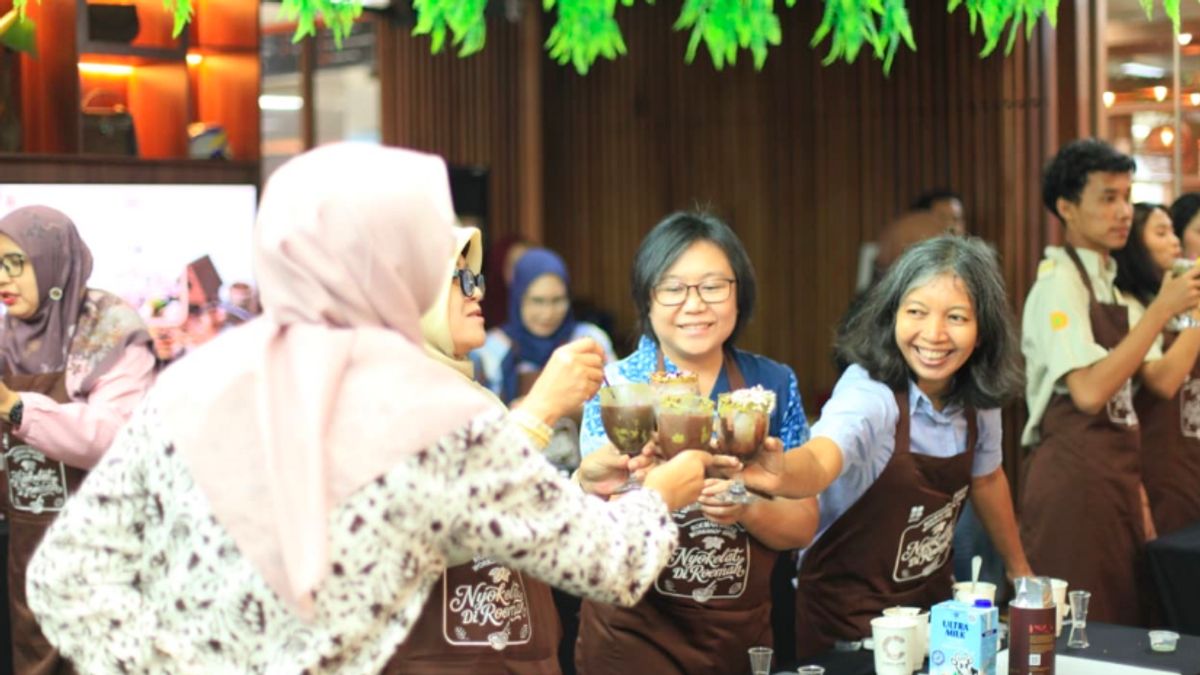
In the midst of efforts to encourage public understanding of this potential, a workshop entitled "Roemah Kreasi - Nyokelat di Roemah" was held by BPDP as part of public education related to plantation commodities. This activity took place at the BPDP UMKM Roemah @ SMESCO Indonesia, Jakarta on Tuesday, May 19, 2026, with an interactive concept that combines education, hands-on practice, and introduction of business opportunities based on cocoa.
In this activity, the local business actor Cokelatin Signature was present to share experiences regarding the development of Indonesian cocoa-based chocolate business. Participants were introduced to the history of cocoa, processing techniques, to the practice of making chocolate drinks using local raw materials.
Nugroho Surosoputra explained that the business he runs started from an interest in the quality of Indonesian cocoa.
"We are really in love with Indonesian chocolate and Indonesian cocoa. Initially we focused on making products, then we developed learning cocoa from the husk," he said.
During the practice session, participants tried to make various cocoa-based drink creations, including chocolate combinations with Earl Grey tea and pistachios inspired by modern drink trends.
In addition to taste, participants were also introduced to presentation techniques, beverage decoration, and the importance of visual appearance in the food and beverage industry.
Shana, who guided the mixology session, explained that the serving technique has an influence on the final quality of the product.
"The full ice is important so that the drink layer can be formed," explained Shana.
He also highlighted the details as one of the factors that increase the selling value of beverage products.
"Because it requires special techniques and details in its presentation," he said.
In addition to cocoa, participants were also introduced to the use of other plantation-derived materials, such as palm-based non-dairy creamer which is used to produce a more creamy beverage texture.
Cokelatin Signature founder, Irena Surosoputra, admitted that he was interested in the innovation of the material.
"Usually we use non-dairy creamer made from cassava. It turns out that this palm-based one is also delicious and can be developed," he said.
Not only about products, human resource development is also an important part of strengthening the plantation sector. Head of the Community Cooperation and MSME Division of BPDP, Helmi Muhansyah, said that plantation development was also carried out through education and support for business actors.
"The children of parents who have graduated from high school have the opportunity to study through the palm oil scholarship program. All costs are covered, including monthly allowances," said Helmi.
According to him, the opportunity is open not only for the families of palm oil plantation owners, but also workers in related sectors.
BPDP also continues to encourage the strengthening of commodity-based SMEs in plantations so that they are able to create value-added products.
"We want this not to be just a rumor. We want to be something real. Please take this opportunity to build networks and see what BPDP can support for the development of MSMEs," he concluded.
He hopes that more young generations will be interested in building local commodity-based businesses.
"Hopefully, from these students, there will be those who become entrepreneurs based on cocoa, coconut, or palm oil," he added.
Through this educational approach, the public is expected to understand that Indonesian cocoa has competitive quality and wide development opportunities. With proper processing, local commodities are not only raw materials, but can also grow into creative products that support MSMEs while strengthening the national downstream industry.
The English, Chinese, Japanese, Arabic, and French versions are automatically generated by the AI. So there may still be inaccuracies in translating, please always see Indonesian as our main language. (system supported by DigitalSiber.id)


