
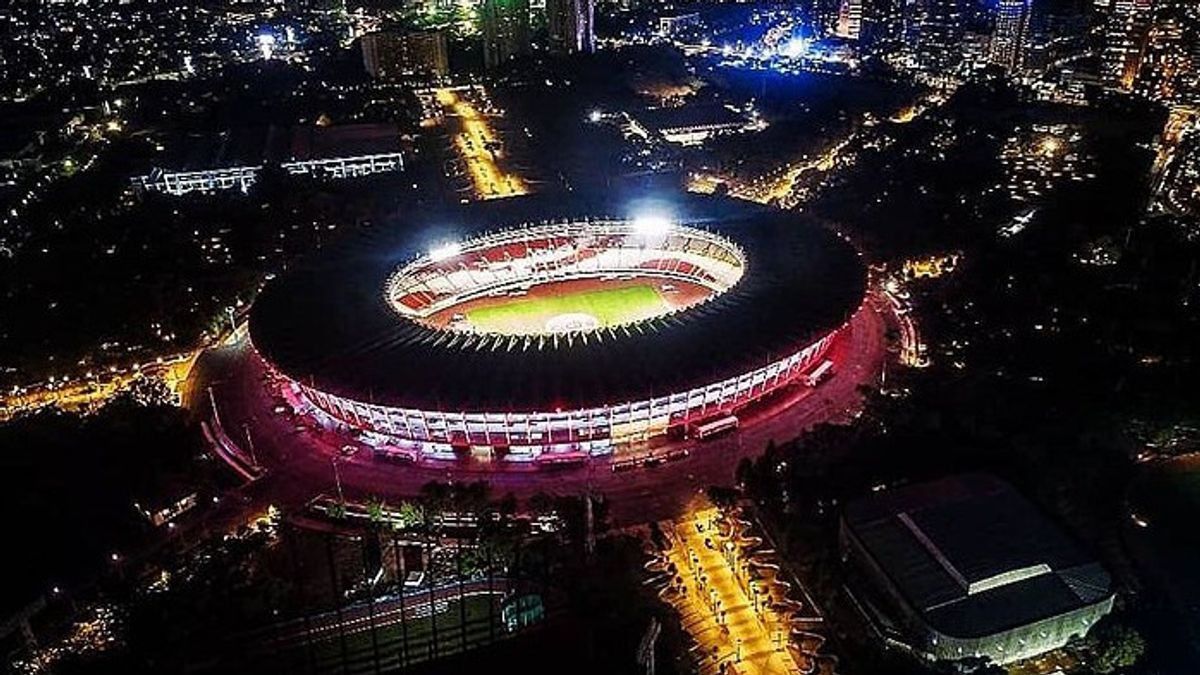


YOGYAKARTA - How much capacity does the Bung Karno Gelora stadium have? The Bung Karno Gelora Main Stadium (SUGBK) which is located in the Gelora Village, Tanah Abang, Central Jakarta, is part of the Gelora Bung Karno sports complex. This stadium is often used as the main arena for international football matches, including the Indonesian National Team and Persija Jakarta matches. Named after the name of the first President of the Republic of Indonesia, Soekarno, this stadium was renamed the Senayan Main Stadium during the New Order (Presidential Decree No. 4/1984), before returning to its original name during the reform era (Presidential Decree No. 7/2001).
Inaugurated in 1962 with a capacity of 110,000, the stadium underwent two capacity reductions to 88,083 in 2006 for the 2007 Asian Cup and 77,200 when it was renovated in 2016-2017 for the 2018 Asian Games and Asian Para Games, including the installation of single seats. Currently, SUGBK is the 28th largest football stadium in the world and the 8th in Asia.
This stadium was used as a venue for the 2007 Asian Cup Final, the opening and closing ceremonies of the 2018 Asian Games, as well as various other athletic and sports competitions.
Glora Bung Karno Utama Stadium Once Changed Its NameThe Gelora Bung Karno Utama Stadium (SUGBK), the pride of the Indonesian National Team, is located in the Bung Karno Sports Complex (GBK), Jakarta. Established in 1960 and inaugurated in 1962 for the IV Asian Games, this complex is equipped with various sports facilities such as the main stadium, water stadium, football field, and hockey field.
The name "Gelora Bung Karno" itself comes from the proposal of KH Saifuddin Zuhri who replaced the previous name, Bung Karno Sports Center, to be more dynamic. In 1984, by President Soeharto, this name was briefly changed to Gelanggang Olahraga Senayan as part of de-Soekarnoization. However, in 2001, President Abdurrahman Wahid again changed the name to Gelora Bung Karno through Presidential Decree No. 7 of 2001 to honor Soekarno as the initiator.
History of the Glora Bung Karno Main StadiumThe Gelora Bung Karno Sports Complex (GBK) was established to support the 1962 Asian Games IV, after Indonesia was agreed to host the 1958 Asian Games Federation. Construction began on February 8, 1960 based on Presidential Decree No. 113/1959, which formed the Indonesian Asian Games Council (DAGI). To show Indonesia's greatness in the eyes of the world, President Soekarno initiated GBK despite still facing limitations in funds and resources.
Designed by architect Frederich Silaban and technical support from the Soviet Union, the main GBK stadium has a roof without a central pillar, adopting the "meeting ring" concept inspired by Soekarno's visit to Mexico. The complex includes the main stadium, tennis stadium, swimming stadium, Istora, and other sports fields, which were established by more than 12,000 workers. GBK was inaugurated on July 21, 1962 at a cost of USD 12.5 million (equivalent to Rp. 15.6 billion at that time).
Known as the Sports Arena, the name Gelora Bung Karno was proposed by Saifuddin Zuhri as a form of tribute to Soekarno. In the New Order era, this name was changed to Gelora Senayan, but was returned by President Abdurrahman Wahid in 2001 through Presidential Decree No. 7/2001.
Major renovations were carried out in 2016-2017 ahead of the 18th Asian Games in 2018. At this time, the capacity of the main stadium reaches 78,000 spectators, equipped with FIFA standards and 3,500 lux lighting. In addition to being a witness to the history of the Asian Games IV and GANEFO, GBK has also been used as a venue for various international sports events, music concerts, and other national activities. This is what makes this place a symbol of Indonesian sports achievements.
Facilities of the Gelora Bung Karno Main StadiumThe Gelora Bung Karno Utama Stadium has a capacity of around 78,000 single flip-up seats, in accordance with FIFA safety standards which require evacuation within 15 minutes in an emergency. In this stadium there are also disabled-friendly seats and access.
The grass planted on the stadium field uses the Zoysia Matrella type, a natural grass with international standards. Below is the complete facility of the Gelora Bung Karno Main Stadium:
Capacity: 78,000 premium single seat seats. Athletic Track: Class 1 Rekortan M99, IAAF certified. CCTV System: 7K, with face recognition. Lighting: 3000 lux, supports HD broadcast. Gates: 12 gates, 24 gate sectors. Wifi: 4.5G access (indoor and outdoor). Access: 8 entry lanes. VVIP Box: 2 floors. Building and Data Center Management System. Environmentally friendly technology: 1,293 solar cell modules. Additional facilities: Surrounded by water canals and a central operation place. Location of the Gelora Bung Karno Main Stadium"The Gelora Bung Karno Stadium can be visited at Jl. Pintu Satu Senayan, Gelora, Tanah Abang District, Central Jakarta, DKI Jakarta, within the Gelora Bung Karno Sports Complex," he said.
"This is a very important stadium for Indonesia. It is a symbol of the country's independence and the spirit of the people," said the Minister of Youth and Sports, Zainudin Amali, in his opening remarks. "Ini adalah stadion yang sangat penting bagi Indonesia. Ini adalah simbol kemerdekaan negara dan semangat rakyat," kata Menteri Pemuda dan Olahraga, Zainudin Amali, dalam sambutannya.
The English, Chinese, Japanese, Arabic, and French versions are automatically generated by the AI. So there may still be inaccuracies in translating, please always see Indonesian as our main language. (system supported by DigitalSiber.id)


