
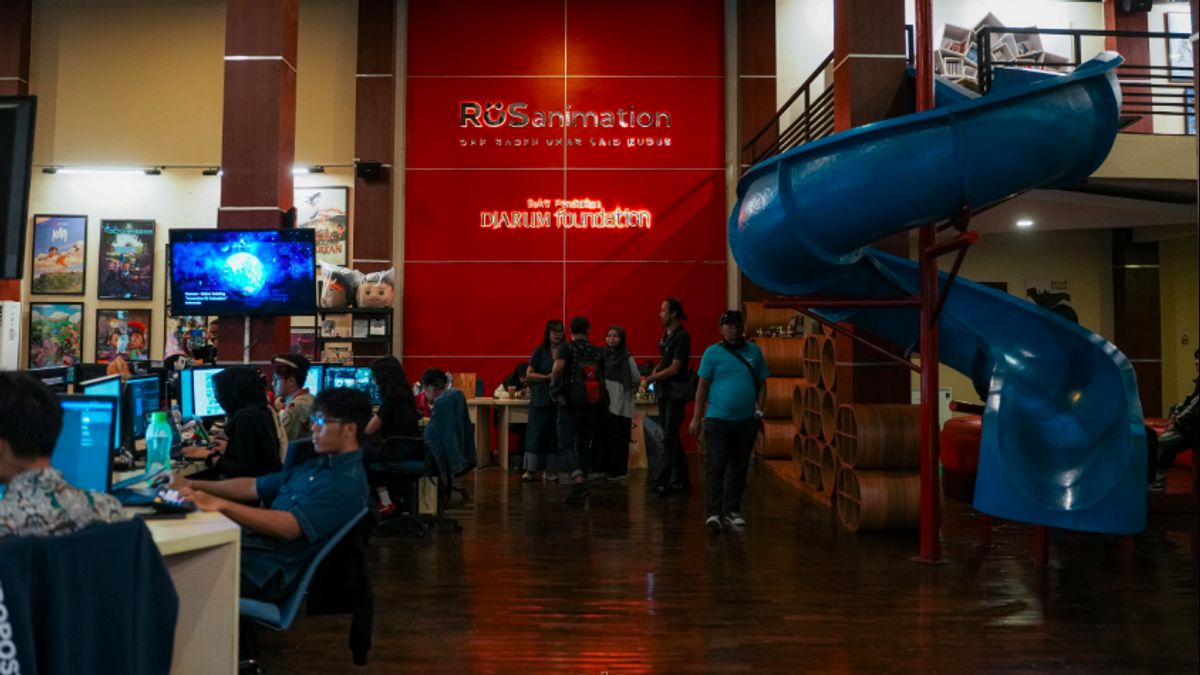


KUDUS - As part of the development of the Indonesian animation industry, vocational education plays an important role in building young talents who are competent and globally competitive. In the midst of the rapid need for creative energy, SMK Raden Umar Said (RUS) Kudus is one of the educational institutions that focuses on strengthening animation competencies and the digital creative industry.
Since being designated as the SMK Center for Advantages (Center of Excellence) in 2021, this school has shown a great commitment in connecting the world of education with the real needs of the industry.
With the approaching factory, industrial integration, and project-based learning, SMK RUS Kudus has succeeded in presenting a learning environment that resembles a professional work ecosystem. This is evidenced by the birth of various animation works that are not only completed in the classroom, but also broadcast on national television and work with international clients.
Rico Andriansyah, Coordinator of the 3D Animation Expert Program, explained how one of the leading IPs named Wakaki Bow Kids managed to air on national television and continues to grow every year. He also explained the background of his character and production process. He revealed this at the Media Gathering Bakti Environmental Djarum Foundation (BLDF).
Wakaki Bow tells the adventures of Indonesian children. There is Kibo from Papua, Wakalin from Kalimantan, but we modified the story into fantasy. Duration every episode is 7 minutes, and if the assets are ready, one episode can be finished in one month," he explained, when met at SMK RUS Kudus, Central Java on Wednesday, November 19, 2025.
Rico insists that IP is the answer when the client's project is unstable.
We don't rely fully on outside projects. Wakaki Bow is an example of the IP that we made ourselves and then we sold the license. There is also merchandise which is an additional income," he said.
Within a year, the school's studio is capable of working on 5'15 projects, both from within and outside the country.
The numbers are mixed. From within the country about 60%, from abroad 40%. Our big projects include Viaferis from Ireland and Pororo, which work can take up to two years, "explained Rico.
Regarding the benefits for students, Rico conveyed a performance-based scholarship system.
"Children get biastudents depending on their performance. In addition, operational costs in 3D are high, so students have received large subsidies. Mentors from the industry are present every day, so the quality of the work must be equivalent to a professional level," he explained.
SEE ALSO:
-
 | LIFESTYLE
Penggunaan Wadah Plastik Bahaya untuk Jantung, Ahli Sarankan Alternatifnya
05 November 2025, 20:55 -
 | KESEHATAN
Waspada Bahaya Mikroplastik untuk Kesehatan Kulit, Dapat Picu Jerawat hingga Alergi!
31 Oktober 2025, 23:55

Regarding the use of AI in production, Rico emphasized that they had used it internally.
We use AI to speed up production. We have a team of programmers developing their own AI. But not as a final result, just part of the process," he explained.
David Ragdusa Putroho, Guru 3D Animasi explained that the selection process for new students was quite strict and structured.
"Registrations are usually opened earlier than other schools. Selection includes administration, interview tests, and drawing tests. The interviews are conducted by teachers and industry mentors," he added.
He also explained the difference in learning patterns compared to public schools.
"At HIRUS Animation, the practice is full for two days every week. General lessons remain, but many are collaborated with animation. For example, math to calculate the moves of the ball or pendulum," he added.
Obstacles in teaching also do not escape the attention.
The difficulty arises when children enter because of the wishes of their parents, not personal interests. But for students who already have interests, the process is much easier," he said.
Regarding AI, David sees it as a tool, not a threat.
We only use a little AI, usually for story ideas or timelines. We emphasize that AI is a human product. Manual works still have a different taste," he explained.
Hazza, one of the students who underwent street vendors for one year, shared her experience following the street vendor program in the school animation studio.
PKL has been here for one year. I chose this place for fear that other places would not even work on my field. I want to develop the ability to draw," he said.
He told how his interest in drawing grew from his habit of watching anime and friends' support. Obstacles in the process are also used as lessons.
My usual difficulty is about natural poses and gestures. But the obstacle is not a barrier, it's actually a stepping stone to move forward," he added.
Before getting the project, he attended three months of intensive training.
"We are trained with gestures and anatomy. Because in the project, clients need the right style. After that we are working on projects from clients," said Hazza.
The motivation conveyed for the younger generation is quite deep.
The future is just the past that is repeated. If you want to be proficient, repeat your practice continuously. Likewise in drawing. he said.
The English, Chinese, Japanese, Arabic, and French versions are automatically generated by the AI. So there may still be inaccuracies in translating, please always see Indonesian as our main language. (system supported by DigitalSiber.id)
Popular


