

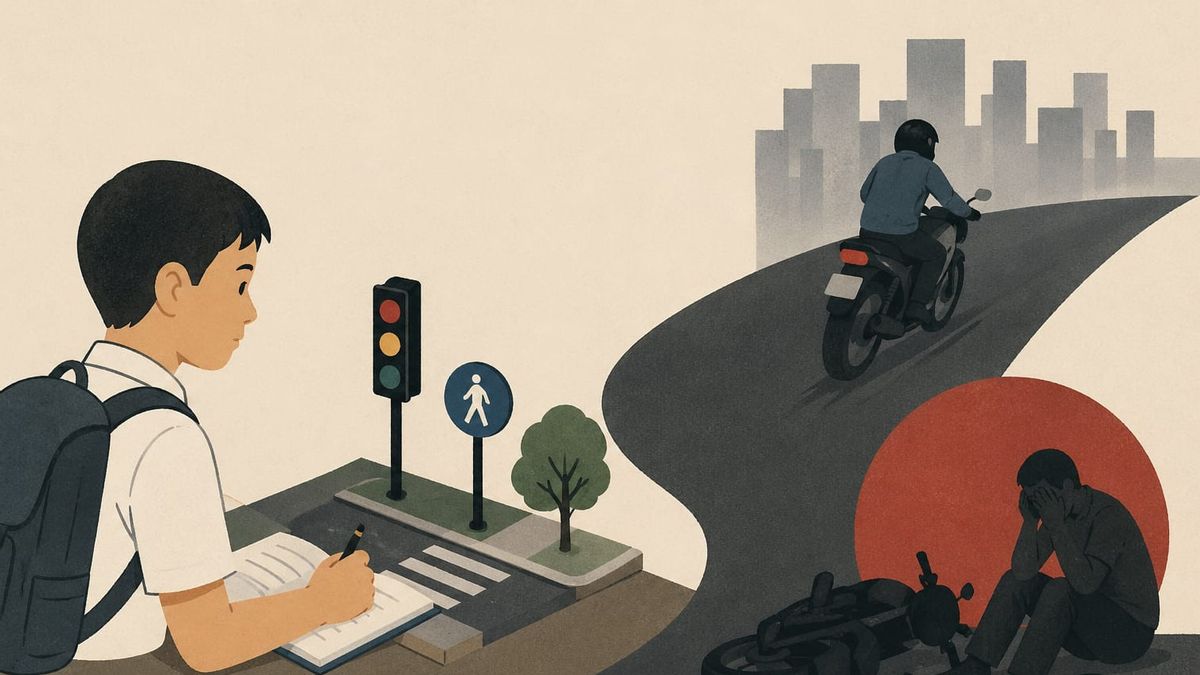


JAKARTA - The surge in accident victims from the productive age group has prompted calls for traffic safety education to be included in the school curriculum from an early age. Transportation observer Djoko Setijowarno assessed that the current approach is too dependent on enforcement on the road, without building behavior from the beginning.
According to Djoko, developed countries have changed their point of view first. Traffic education does not stop at memorizing signs, but is formed as a character. "Their approach is integrated with the curriculum, supported by practice, infrastructure, and law enforcement," he said.
The Indonesian Transportation Community Advisory Council (MTI) cited the Netherlands which requires a cycling exam for elementary school students through the Verkeersexamen program. The exam is carried out on the highway with police supervision. Japan instills the ethics of omoiyari or empathy, by getting children to walk to school from an early age. Meanwhile, Sweden implements the Vision Zero concept, which places safety as a system responsibility, not just individuals. Germany even involves the police entering schools for traffic simulations.
Djoko assessed that Indonesia was lagging behind in terms of cultural formation. Data from the National Police's Korlantas showed that the majority of accident victims were from the age of adolescence to young adulthood. Many students have been riding motorcycles before having a driver's license.
"This is not just a violation of the law, but a failure of the education system," said the lecturer of the Civil Engineering Program at Soegijapranata University.
He emphasized that including safety materials into the curriculum is not an administrative matter. There are three direct impacts. First, forming a safe habit from childhood. Second, reducing the fatality rate at the productive age which has an impact on the economy. Third, building ethics in the public space, including respecting pedestrians and cyclists.
Until now, traffic knowledge has been considered intermittent. Children learn from experience, not from the system. As a result, behavior on the road tends to be reactive and often triggers conflicts.
Djoko encourages national standards so that every student gets the same understanding, from how to cross the road to the use of helmets and seat belts. He also proposed a cross-curricular approach, such as calculating braking distance in mathematics or understanding friction in physics.
The implementation, said Djoko, must involve the Ministry of Education, the Ministry of Transportation, and the Police. Without it, road and infrastructure development will not be enough to reduce accidents.
"Human factors remain dominant. If it is not touched from school, the accident rate will repeat," he said.
He emphasized that safety education was not an additional burden on learning. "This is an investment in life. If it is ignored, what is lost is not only statistics, but the future," said Djoko.
The English, Chinese, Japanese, Arabic, and French versions are automatically generated by the AI. So there may still be inaccuracies in translating, please always see Indonesian as our main language. (system supported by DigitalSiber.id)
Most Popular Tags
#Prabowo Subianto #donald trump #2026 World Cup #Febrie Adriansyah #8791Popular


