
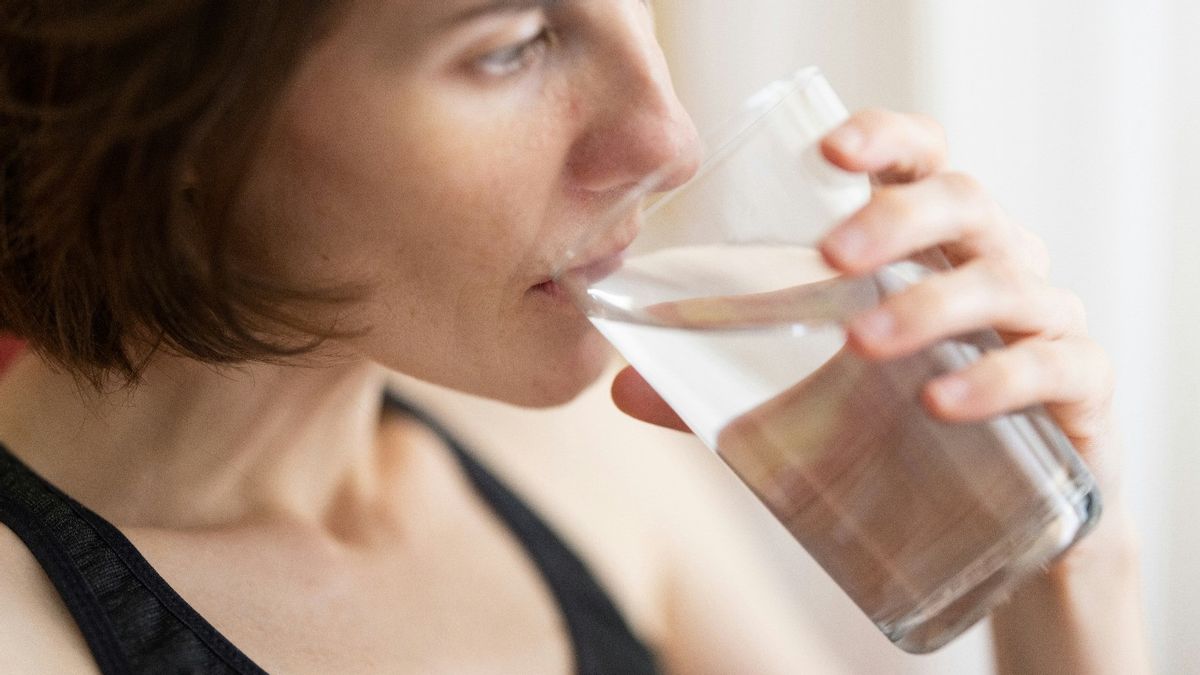


JAKARTA - In general, most people have to meet their needs to drink 8 glasses per day. However, a recent study actually found something surprising. Lack of drink can actually make stress much more difficult to deal with.
A recent study published in the Journal of Applied Physiology found that mild dehydration can actually make the body more susceptible to daily stress.
"These findings show that persistent mild dehydration can amplify stress responses in a way we are just starting to understand," the researchers said, quoted from the Science Alert page.
In the study, scientists tested a group of healthy young adults. They are divided into two groups:
- The first group used to drinking less than 1.5 liters of water per day.
- The second group met the recommendation of the liquid, which is about two liters for women and 2.5 liters for men.
After a week, the two groups were asked to undergo a stress test in the laboratory, in the form of speaking in public and a quick count test. The result, although both nervous, the less drinking group experienced a much higher spike in cortisol levels (the main stress hormone).
"The repeated spike in cortisols in the long term could increase the risk of heart disease, kidney disorders, to diabetes," the study said.
Another interesting thing is that participants who lack drink do not feel more thirsty than the group has enough fluids. However, their bodies give another sign, namely that urine is more concentrated and dark in color.
The thirst is not always reliable as an indicator of fluid needs, the researchers said.
This is why changing urine color can be a simple clue whether the body is hydrated enough or lacks fluids.
When the body lacks fluids, the brain releases the vasopression hormone to help the kidneys conserve water. However, this hormone also affects the stress system in the brain so that it makes the body more reactive.
"Vasoppression does protect water reserves, but at the same time it can increase the release of cortisol," explained the researcher.
This means that the body experiences double burden. On the one hand, maintaining fluids is easier to trigger stress on the other hand.
SEE ALSO:


Everyone has a different fluid need, depending on age, activity, to climate. However, there is a practical way to check daily hydration, namely seeing urine color. The simple way is:
- Yellow is pale - a sign of sufficient fluid.
- Dark or thick yellows - a sign that the body needs additional water.
"Good health comes from a consistent small habit, not a temporary big step," wrote the study.
The English, Chinese, Japanese, Arabic, and French versions are automatically generated by the AI. So there may still be inaccuracies in translating, please always see Indonesian as our main language. (system supported by DigitalSiber.id)


