
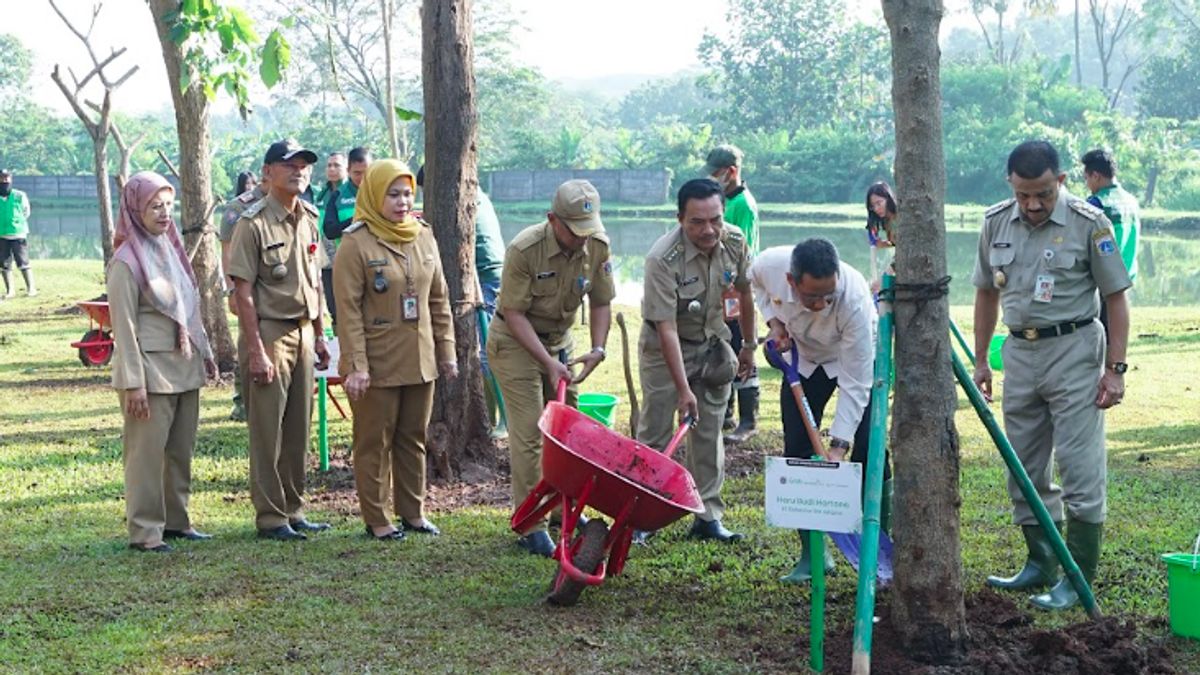


JAKARTA - World Environment Day which is celebrated every June 5 is an important reminder of the urgent need to act for the sustainability of the earth.
In the midst of increasingly massive climate change, pollution, and deforestation, various parties, including the government, the private sector, communities, and individuals, need to work hand in hand to create solutions that have a real and sustainable impact on nature.
Indonesia currently faces significant environmental challenges. Data recorded an increase in deforestation rate of 27% in 2023, an increase in plastic pollution that pollutes the sea and mangrove areas, as well as the deteriorating air quality due to fine particles (PM2.5), which has an impact on a decrease in average life expectancy of up to 1.4 years. This fact reinforces the importance of cross-sectoral collaboration to protect public ecosystems and health.
A number of technology companies in Southeast Asia have begun to implement sustainability programs targeting these crucial issues, ranging from reducing carbon emissions to preserving nature.
One of the approaches taken is the transition to low-emission transport, through the operation of large-scale electric vehicles and investment in environmental conservation.
In Indonesia alone, the electric vehicle fleet has contributed significantly to reducing carbon emissions and fuel consumption efficiency. Since 2019, two- and four-wheel electric vehicles have crossed more than 250 million kilometers, equivalent to nearly 7,000 times around the earth, reducing about 30,000 tons of carbon emissions and saving more than 11 million liters of fossil fuels.
Apart from the transportation sector, sustainability contributions are also manifested in the form of support for natural conservation projects. A number of micro funding initiatives from each consumer transaction are channeled to tree planting, degraded land restoration, and coastal area rehabilitation. Since 2021, more than 1.2 million trees have been planted in Southeast Asia.
"In Grab, sustainability is more than just technology or infrastructure. We want to build an ecosystem that can have a sustainable impact on Indonesia's nature, as well as to empower all parties in it, starting from partners, communities, users and the people of Indonesia," said Rivana Mezaya, Director of Digital & Sustainability, Grab Indonesia in a statement to VOI.
SEE ALSO:
-
 | INFO SEHAT
Bisa Pengaruhi Kesehatan Reproduksi, Waspada Perubahan Iklim dan Kerusakan Alam
09 November 2024, 16:55


In Indonesia, the ongoing action was also carried out in the coastal areas of Pati and Cilacap, as well as critical lands in Bandung, through partnerships with various local environmental organizations.
The conservation project in Central Kalimantan is also an important example. With a focus on tropical peat swamp forests, the project protects nearly 150,000 hectares of land and habitats of more than 40 species of animals, including the Borneo orangutan population. These efforts not only maintain biodiversity, but also prevent greenhouse gas emissions of up to 7.5 million tons per year.
More than that, the plastic waste management sector is also a concern. The plastic bottle recycling initiative using an automatic exchange machine (RVM) in strategic public locations managed to collect more than 4,000 kg of plastic.
This not only has an impact on reducing the carbon footprint by more than 20,000 kg of CO2e, but also educates thousands of individuals about the importance of the circular economy.
These efforts emphasize that sustainability is not just a slogan, but a shared responsibility that must be carried out consistently and collaboratively. From small steps such as recycling, to support for forest preservation and the use of environmentally friendly vehicles, every action is meaningful.
"We believe that efforts to protect the environment cannot be done alone. We need close collaboration between various parties ranging from business partners, local communities, to Grab service users throughout the country. Therefore, we invite all Indonesian people to take part in this movement," said Rivana Mezaya.
The English, Chinese, Japanese, Arabic, and French versions are automatically generated by the AI. So there may still be inaccuracies in translating, please always see Indonesian as our main language. (system supported by DigitalSiber.id)


