
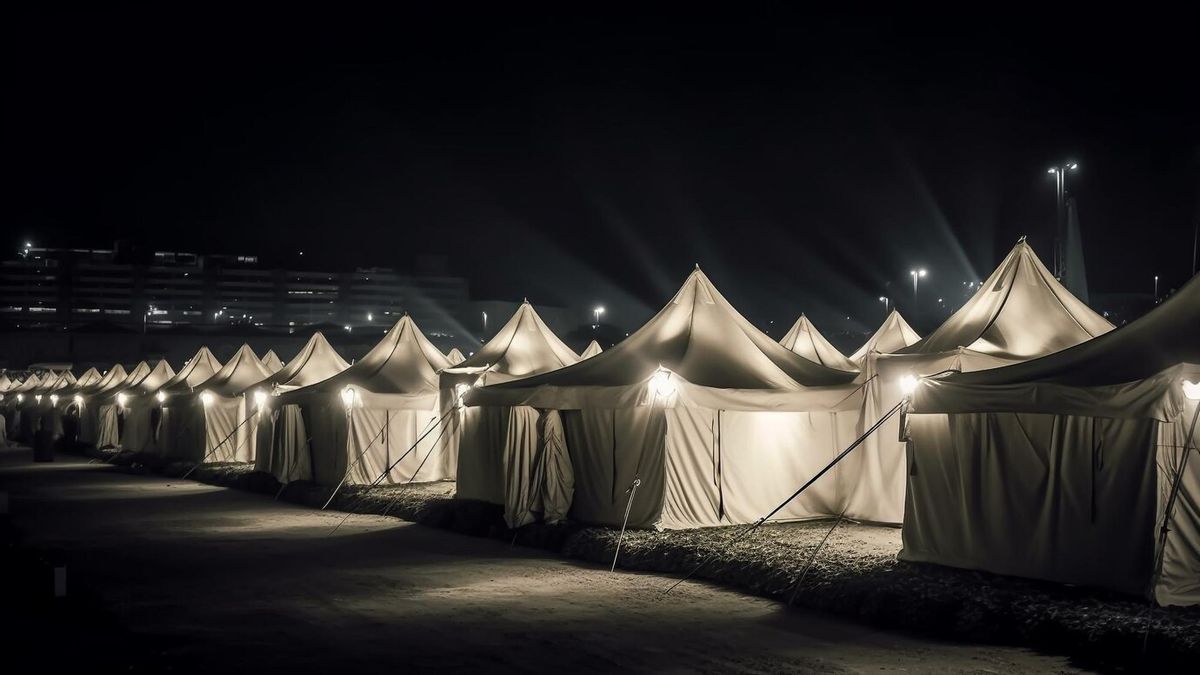


YOGYAKARTA - The i'tikaf tradition or staying in the mosque with the aim of worship, has now long been part of the religious practice of Muslims, especially in the month of Ramadan. So what about the itikaf phenomenon by setting up tents in mosques?
This itikaf phenomenon raises various questions and debates among the public, especially regarding the laws and ethics of its implementation. This article aims to thoroughly explore the i'tikaf phenomenon by setting up tents in mosques, reviewing its laws from an Islamic perspective.
Reporting from the NU Online page, in several history of hadith, it was stated that the Prophet Muhammad SAW had set up a tent while doing i'tikaf in the last ten days of the month of Ramadan.
One of the often quoted histories is the hadith narrated by Aisyah RA, which is listed in the Muslim Shahih book. The hadith tells the story that the Prophet SAW set up a tent when he was about to do i'tikaf, and his wives followed in his footsteps.
However, when the Prophet SAW the many tents that were erected, he ordered to dismantle them and postpone i'tikaf until the first ten days of Syawal.
Imam An-Nawawi, in the Sharia Shahih Muslim book, gave an explanation regarding this hadith. The establishment of a tent when i'tikaf is allowed, as long as it does not interfere with other pilgrims.
Tents should be established at the back of the mosque or in the courtyard of the mosque, so as not to obstruct other people's worship activities and provide more private space for people who give 'tikaf'.
Also read the article discussing 7 Charitys of the Prophet Before Eid Al-Fitr that Deserves to be Imitated
The Prophet Muhammad's order to dismantle the tent set up by his wives in the mosque, as recorded in the hadith, is closely related to potential disturbances to other worshipers.
Al-Qadhi 'Iyadh, whose opinion was quoted by Badruddin Al-'Aini in the book 'Umdatul Qari, explains that:
"The action of the Prophet SAW is a form of rejection of the actions of his wives. He is worried that their motivation in nature is not entirely based on sincerity, but rather a desire to show closeness to him... or because of the existence of these tents causes the narrowing of the mosque space and disrupts the activities inside." (Badruddin Al-'Aini, 'Umdatul Qari Syarhul Bukhari, [Lebanon: Darul Pole al-Ilmiyah, 2001], page 211).
SEE ALSO:
-
 | LIFESTYLE
Libur Lebaran Seru dengan Aktivitas Edukatif Bareng Keluarga di Bali Zoo
27 Maret 2025, 19:25 -
 | LIFESTYLE
Tren Balet Sneakers Memanas, Louis Vuitton Perkenalkan LV Sneakerina
27 Maret 2025, 19:07


This disturbance caused by the installation of tents is the main reason for the scholars to influence the practice during i'tikaf at the mosque.
Ibnu Rajab, in his book Fathul Bari, noted differences of opinion among the ulama regarding this matter. Imam Ahmad, for example, argues that setting up a tent or the like in the mosque for i'tikaf purposes is chaotic, except in very cold weather conditions.
The exception of allowing the installation of tents during the very cold weather is in line with the context of the installation of tents by the Prophet Muhammad SAW, namely during the rainy season. This is reflected in the history of Imam Al-Bukhari from Abu Sa'id Al-Khudri, which tells about Lailatul Qadar's dream and the condition of the mosque which is wet due to rain.
The condition of the mosque during the time of the Prophet Muhammad SAW which was still simple, with the roof of the pelepah and leaves of dates and floors from clay, caused rainwater to absorb easily and wet the floor. As-Samhudi's explanation in his book Khulashatul Wafa bi Aakhbari Daril Musthafa strengthens this picture.
Therefore, the installation of tents by the Prophet Muhammad SAW in rainy conditions cannot be used as a basis for justification for installing tents in normal weather conditions, especially in the modern era with a much better mosque building.
In addition to the itikaf phenomenon by setting up tents in mosques, follow other interesting articles too. Want to know other interesting information? Don't miss it, keep an eye on the updated news from VOI and follow all of its social media accounts!
The English, Chinese, Japanese, Arabic, and French versions are automatically generated by the AI. So there may still be inaccuracies in translating, please always see Indonesian as our main language. (system supported by DigitalSiber.id)
Most Popular Tags
#Prabowo Subianto #donald trump #firearm #8791 #giias 2026Popular


