
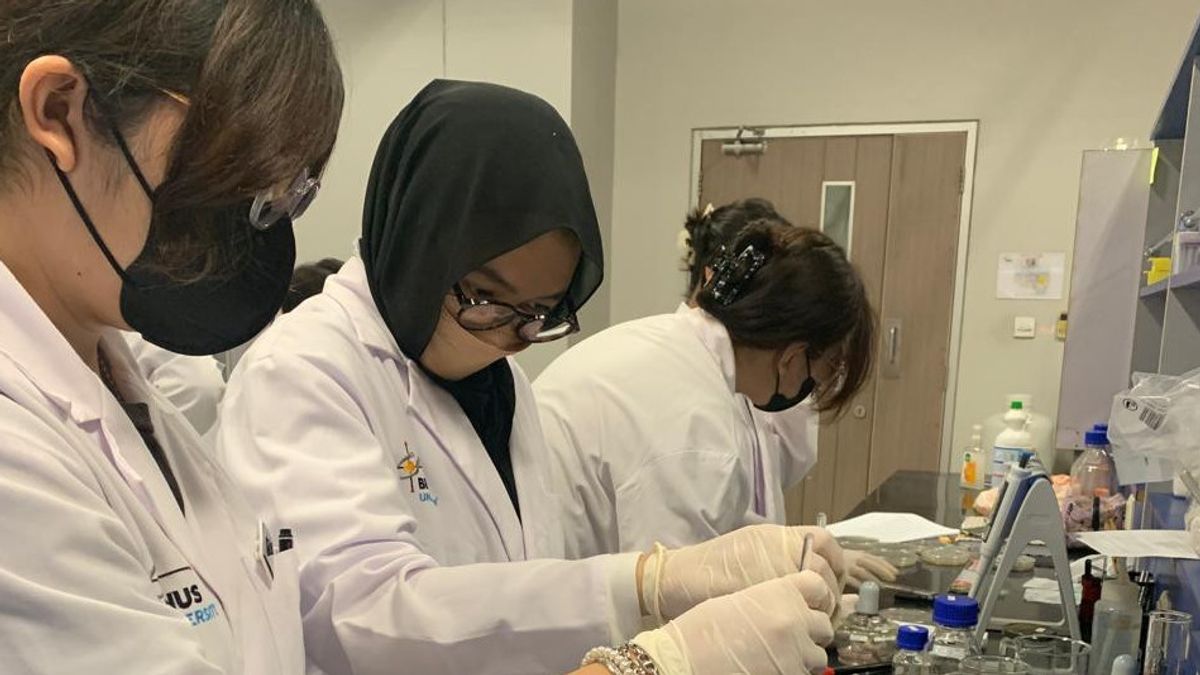


JAKARTA - Continuous development is no longer just a discourse, but an urgent need that must be realized through real action. The Sustainable Development Goals (SDGs) launched by the United Nations has become a global guide in responding to environmental, health, and energy challenges. One of the fields of science that plays a strategic role in supporting the achievement of SDGs is biotechnology.
Through innovation, biotechnology is able to provide practical solutions that are environmentally friendly and relevant to the needs of modern society. BINUS University, especially the Biotechnology Study Program, is taking active steps to integrate research, product development, and public education within the framework of SDG's. The main focus is directed at utilizing eco-enzyme and organizing innovation competitions for high school students.
Eco-Enzyme: From Organic Waste To Valuable Products
Eco-enzyme is a liquid fermented organic waste (such as fruit skin and vegetables) with sugar and water. This liquid has antibacterial, anti-famur, and natural cleaning properties so that it has the potential to be used in everyday life.
BINUS University's Biotechnology Study Program develops various eco-enzyme-based derivative products that are not only environmentally friendly, but also have commercial added value. These products include:
Personal care: natural hand washing soap with eco-enzyme content that is safe for the skin and provides a natural clean sensation.
Home care disinfectant: environmentally friendly dish washing soap, natural detergents, and multipurpose sprays that effectively kill bacteria without leaving any harmful chemical residue.
This eco-enzyme derivative product uses natural ingredients to support the circular economy concept: utilizing organic waste, reducing environmental pollution, as well as producing useful products.
Product Testing: Scientific Evidence Of Quality
Innovation does not stop at the product development stage. BINUS University biotechnology ensures that every eco-enzyme-based product is scientifically tested.
1. Disinfectant products are tested in terms of antibacterial capabilities to ensure their effectiveness in killing disease-causing bacteria.
2. Personal care products are tested through sensory analysis, involving the community to assess the texture, aroma, and cleaning feel aspects.
SEE ALSO:
-
 | LIFESTYLE
Hakim Nilai Vadel Badjideh Terbukti Lakukan Tipu Muslihat untuk Setubuhi LM
02 Oktober 2025, 10:10 -
 | LIFESTYLE
Budaya Kerja Sehat yang Bikin Karyawan Betah dan Semakin Produktif
28 Agustus 2025, 19:35

This approach confirms that innovation emphasizes not only sustainability, but also considers user comfort and security.
Biospheric Competition: Training Young Generation Cares For SDG's
Apart from product research, BINUS University Biotechnology is also actively encouraging the involvement of the younger generation in sustainability issues. This is realized through Biospheric Competition with the theme "Throughgoing Bioresources for a Sustainable Future."
This competition was attended by 82 high school student teams from various regions in Indonesia. Participants are challenged to create biotechnology innovation ideas relevant to SDG's, ranging from the fields of the environment, energy, health, new materials, to agriculture.
Some of the creative ideas that arise include:
Bioplastics of organic waste as a solution to the reduction of single-use plastics.
Chitosan to clean up rivers and deal with environmental pollution.
Cosmetics from fruit waste that combines natural beauty and sustainability concepts.
Not stopping in competitions, participants also receive biotechnology skills training so that they are more familiar with this potential science in real life. This activity not only builds creativity, but also forms awareness of the younger generation to participate in sustainability solutions.
Relevance with SDG's
Eco-enzyme innovation and competition programs initiated by Biotechnology BINUS University directly support several SDG's points, including:
SDG 3 (Good Health and Well-Being): presents safe, hygienic, and health-supporting products.
SDG 6 (Clean Water and Sanitation): through eco-enzyme which can help treat organic waste and maintain water quality.
SDG 12 (Responsible Consumption and Production): encourages the use of waste into valuable products.
SDG 13 (Climate Action): reduce carbon emissions by replacing industrial-based chemical products with environmentally friendly products.
SDG 17 (Partnerships for the Goals): build collaboration with communities, students, and the community to achieve common goals.
Thus, every step taken is not just academic activity, but part of a real contribution to the global agenda.
Biotechnology BINUS University As A Center For Innovation
Through product development, scientific research, to educational competitions, BINUS University Biotechnology places itself as a center of innovation that bridges science and society. Focusing on eco-enzyme is not only a strategic choice, but also a symbol of commitment to promoting an applicative, environmentally friendly, and broadly impacted science.
This program is also a means of branding that biotechnology is not just a laboratory, but science that is very close to everyday life. Starting from soap, detergent, to natural cosmetics, everything can be part of the transformation towards a sustainable future.
The Biotechnology Study Program has an important role through three main aspects, education, research, and community service to support sustainable development. We develop eco-enzyme derivative products as environmentally friendly disinfectants and cleaning detergents as well as promote the concept of circular waste. In addition, we are also actively organizing competitions and training for high school students as well as the public to raise awareness and skills in creating environmentally friendly innovations," said Dr. Dwiyantari Widyaningrum, Chair of BINUS University's Biotechnology Study Program.
The English, Chinese, Japanese, Arabic, and French versions are automatically generated by the AI. So there may still be inaccuracies in translating, please always see Indonesian as our main language. (system supported by DigitalSiber.id)
Most Popular Tags
#Prabowo Subianto #donald trump #2026 World Cup #bgn #konflik timur tengahPopular


