
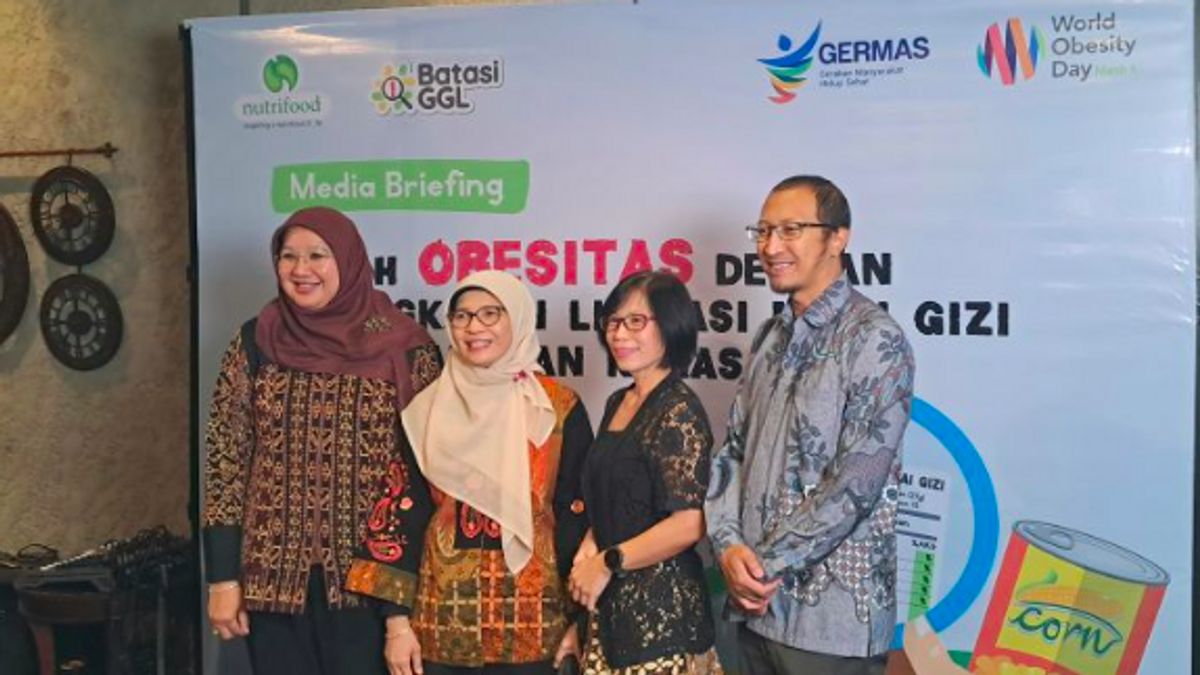


JAKARTA - The government is proposing a policy of labeling the content of sugar, salt, and fat (GGL) in food and beverage products to increase public awareness of healthy eating patterns.
This step is expected to help consumers in making better food choices and reduce the number of non-communicable diseases related to excessive consumption of these substances.
Currently, the Ministry of Health is drafting a Draft Regulation of the Minister of Health (RPMK) which regulates the labeling of nutri-grades for GGL content in various food products.
"The RPMK process is still ongoing, and we provide space for various parties to provide input regarding this regulation. However, this is not a mandatory rule, but rather an educational effort for the community," said Director of Disease Prevention and Control of the Ministry of Health, Siti Nadia Tarmizi, as quoted by ANTARA.
He added that the GGL-related campaign and education would soon be launched involving various parties, including the food industry.
"Initial socialization has been carried out, because the fast food industry needs time to adjust and attach labels to their products. Given the variety of products is very diverse, this process must be carried out in stages," he explained.
Nadia also explained that several forms of food labeling had been applied before. First, the labeling in the form of Nutrition Value Information, namely the inclusion of nutritional content in processed products that are usually listed on the back of the packaging.
Second, labeling with the logo "Healthyer Choice", which is only given to products that meet certain nutritional profile criteria.
For packaged sweetened foods (MBDK), the maximum limit for sugar content (monosakarida and disakaride) allowed is 6 grams per 100 mL. Currently, the regulation has only been applied to instant noodles and packaged drinks with the label listed on the back of the packaging.
In addition, products are also required to include health warnings, such as "Golds > 50 grams, Sodium > 200 mg, and Fat > 67 grams per person per day risk causing hypertension, diabetes, and heart disease."
BACA JUGA:
-
 | BERITA
Pemerintah Perkuat Pengendalian Konsumsi Garam dan Lemak Trans Cegah Penyakit Kardiovaskular
19 Februari 2025, 11:46 -
 | INFO SEHAT
Cek Kesehatan Gratis Dimulai Hari Ini, Begini Langkah Daftar dan Syaratnya
10 Februari 2025, 10:25

The government continues to promote education about the importance of reading labels on product packaging through various socialization and workshop programs involving stakeholders and the wider community.
"This is still a big challenge. Currently, socialization continues, and several fast food industries have begun to be involved. In fact, several digital applications have now provided information about the number of calories, sugar, salt, and fat in various foods," added Nadia.
Based on the Indonesian Health Survey (SKI) in 2023, it was recorded that 28.7 percent of people consumed sugar, salt, and fat exceeded the recommended limits.
The national average shows that 5.5 percent of people consume more than 50 grams of sugar per day (equivalent to four tablespoons), 53.5 percent consume more than one teaspoon of salt per day (2,000 mg of sodium), and 24 percent consume more than five tablespoons of fat per day (67 grams).
This condition also contributes to the increase in the obesity rate in Indonesia, where in 2023 23.40 percent of the population aged 18 years and over will be obese.
The English, Chinese, Japanese, Arabic, and French versions are automatically generated by the AI. So there may still be inaccuracies in translating, please always see Indonesian as our main language. (system supported by DigitalSiber.id)
Most Popular Tags
#Prabowo Subianto #donald trump #firearm #8791 #giias 2026Popular


