


JAKARTA - Microplastics are now not only a problem of the sea or floating garbage in rivers. These super-small plastic particles have entered the soil, water, air, and without us realizing it into everyday food.
Microplastics are very small pieces of plastic, ranging from 1 nanometer to 5 millimeters. There are even smaller ones, called nanoplastics, which are less than 1 micrometer in size. Because of their almost invisible size, these particles are easily spread and enter the food chain.
Recent research shows that exposure to microplastics in humans is becoming more widespread. A 2025 study published in Nature Medicine found that the average human brain tissue contains about 4,800 micrograms of plastic per gram. This amount is said to be equivalent to plastic in a small plastic spoon.
The health impact is still being studied, and there is no official safe limit on how much microplastics the body can tolerate. However, signs of the risk are beginning to be seen. A 2024 study in the New England Journal of Medicine (NEJM) found the presence of microplastics in blood vessel plaques was associated with an increased risk of cardiovascular events such as heart attacks and strokes.
Exposure to microplastics and nanoplastics is also linked to chronic inflammation, immune system disorders, and metabolic problems. Although the knowledge is still developing, researchers agree on one thing: the absence of a safe limit does not mean the absence of danger.
One source of exposure that is rarely realized is fresh fruits and vegetables. Many people think that contamination only occurs on the surface, but in fact microplastics can be absorbed into the plant tissue.
A 2020 study published in the journal Environmental Research was the first to measure the content of microplastics in commonly consumed fruits and vegetables. The results were quite surprising.
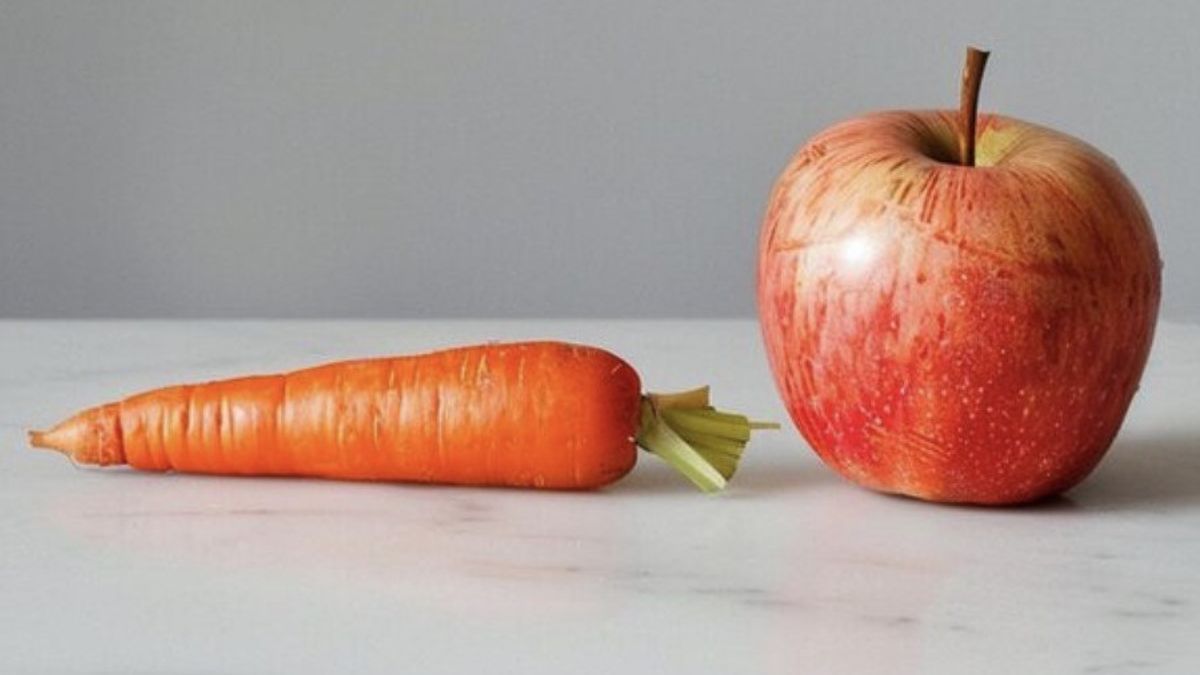
Reported from the Super Age website, apples and carrots appear as the two food ingredients with the highest concentration of microplastics.
In fruit, the median level reached about 223,000 particles per gram, while in vegetables it was about 97,800 particles per gram. Among the fruits studied, apples occupy the highest position.
For the vegetable group, carrots are the most contaminated. If calculated per serving, one apple can contain about 44.6 million microplastic particles, while one carrot weighing 150 grams contains about 14.7 million particles.
What is more worrying, many particles found to be less than 10 micrometers in size. This small size has the potential to penetrate human body tissues after being consumed.
Researchers suspect that microplastics enter plants through contaminated soil and irrigation water. The roots of plants can absorb these very small particles, then distribute them to the stems, leaves, to the fruit or tuber that we eat.
Although it sounds scary, it doesn't mean you have to stop eating fruits and vegetables. Both are still important for long-term health. What you can do is reduce exposure as much as possible.
Choosing fresh products without plastic packaging can help reduce additional contamination from the distribution process. Washing fruits and vegetables thoroughly with running water is also important, although this method does not completely remove particles that are already in the tissue.
For certain types, peeling the skin can slightly reduce exposure. Eating seasonal and varied products is also recommended so that exposure from the same source does not occur continuously in the long term.
Microplastics are already part of the reality of modern environments. We may not be able to avoid them completely, but with more careful choices and better processing methods, daily exposure can still be suppressed. These small steps still mean to maintain body health in the long term.
The English, Chinese, Japanese, Arabic, and French versions are automatically generated by the AI. So there may still be inaccuracies in translating, please always see Indonesian as our main language. (system supported by DigitalSiber.id)
Most Popular Tags
#Prabowo Subianto #donald trump #firearm #8791 #giias 2026Popular


