
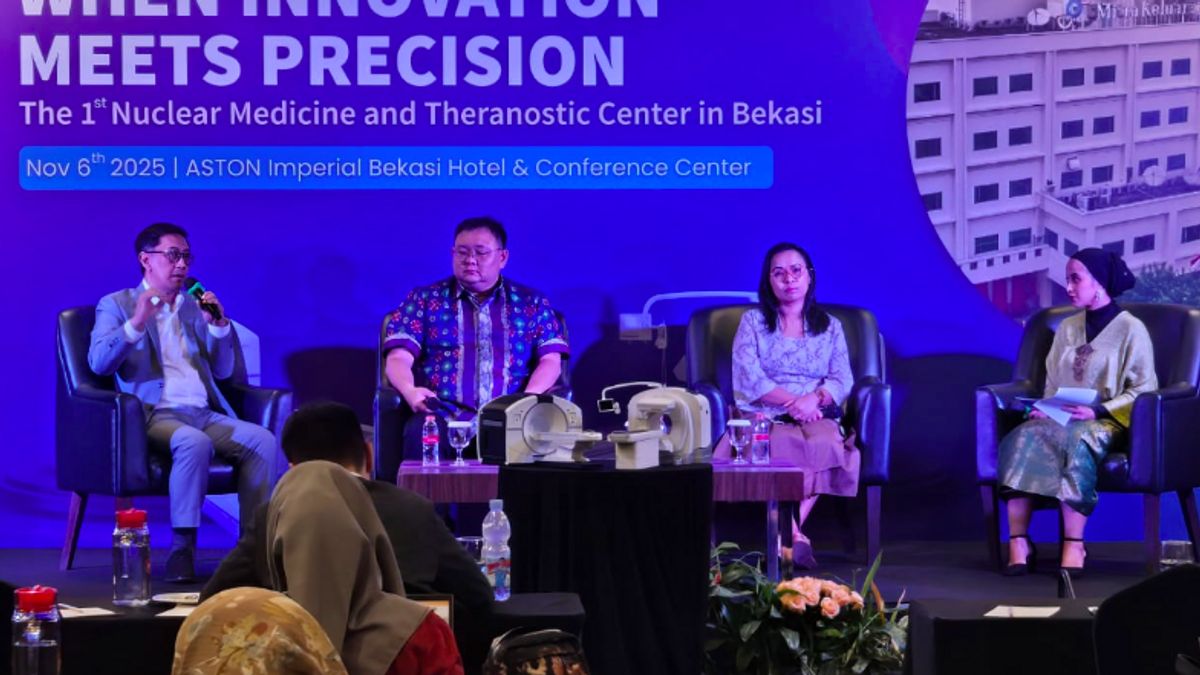


JAKARTA The success of handling cancer is highly dependent on the ability to detect this disease early and accurately. One field that now plays a major role is nuclear medicine, a branch of medical science that uses low-dose radioactive materials to produce internal body images in detail.
This technology allows doctors to see that biological activity in the body's tissue is not just anatomical shape like in CT scans or MRIs, which helps identify cancer cells from the early stages.
Unfortunately, in Indonesia, access to nuclear imaging technology such as PET/CT (Positron Emission Tomography/Computed Tomography) and SPECT/CT (Single Photon Emission Computed Tomography/CT) is still limited, especially outside big cities.
In fact, the accuracy of the diagnosis plays an important role in determining the type of cancer therapy that matches the biological condition of each patient. As we know, cancer is still one of the highest causes of death in Indonesia, and diagnosis delays are one of the main challenges.
Based on data from the Indonesian Ministry of Health, about 50 percent of cancer cases can be prevented or handled better if found in the early stages.
"The increase in cancer cases requires us to continue to innovate. Through faster, more accurate, patient-centered nuclear medicine. This is an important step in accelerating early detection of cancer and supporting more personal and targeted treatment."
Thus said dr. Yudistira Wastu Putra, MARS., MM, Director of Mitra Keluarga Bekasi Timur Hospital in his partnership with GE Healthcare in Bekasi, recently.
SEE ALSO:
-
 | INFO SEHAT
Waspadai Risiko Kanker Payudara pada Pria, Obat Steroid Jadi Salah Satu Pemicu
30 Oktober 2025, 20:45 -
 | INFO SEHAT
SADARI hingga Mammografi, Harapan di Balik Deteksi Dini Kanker Payudara
29 Oktober 2025, 11:25


Kriswanto Trimoeljo, CEO of GE HealthCare Indonesia, stated that innovation in the field of nuclear medicine through tools such as PET/CT and SPECT/CT can be a game-changer in the treatment of cancer in Indonesia.
"This collaboration reflects our commitment to supporting the transformation of the national health system through technological innovations and strategic partnerships with hospitals," he said.
The collaboration not only focuses on providing high-tech medical devices, but also on improving the diagnostic ability of local medical personnel through training and digital system integration.
With this innovation, patients are expected to be able to obtain a faster, more accurate diagnosis, and according to their therapeutic needs.
The English, Chinese, Japanese, Arabic, and French versions are automatically generated by the AI. So there may still be inaccuracies in translating, please always see Indonesian as our main language. (system supported by DigitalSiber.id)
Most Popular Tags
#Prabowo Subianto #donald trump #firearm #8791 #giias 2026Popular


