
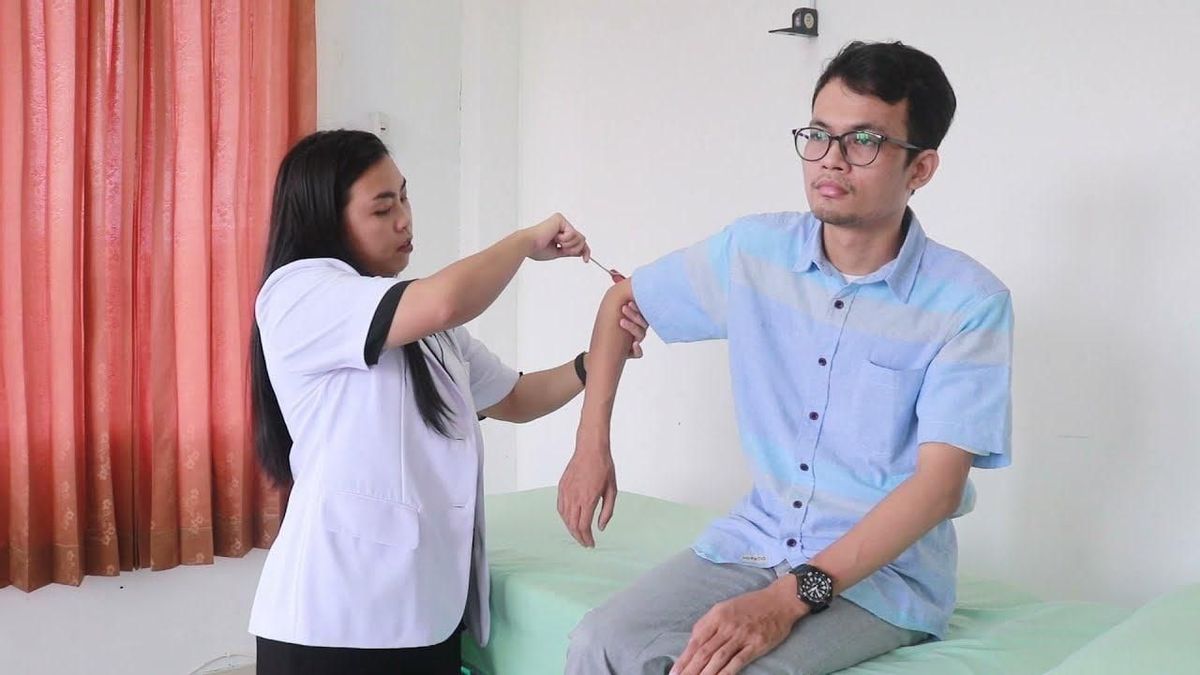


YOGYAKARTA - PhysICAL reflectivity is the body's automatic response to normal stimuli and occurs without awareness, such as the knee movement when tapped. This reflection is part of a healthy body function and can be tested to check the condition of the nervous system.
Physic reflex examinations can detect lesions on the Power Motor Neuron (LMN) and the Upper Motor Neuron (UMN). The results of reflex examination may appear normal, increase (hyperflex), or decrease (hyporeflex). Some cases may also show no reflex at all, depending on the location of the lesion.
In simple terms, physiological reflex works through a path called reflex arcus. Reporting from Healthy, the mechanism is as follows:
The physiological reflex examination has many benefits in the medical world, especially Neurology. The goal is to assess both motor and sensory nervous health, not just looking at movement. Some of the benefits of physiological reflex examination include:
So, physiological reflex examination is not only a simple but very important procedure for evaluation of neurohealth.
The technique of examining physiological reflexs is distinguished into an internal reflex examination and a superficial reflex examination. For the examination of the inner reflex, a reflex hammer is needed to tap on the tendon. Meanwhile, for the examination of the superfitial reflex, stimulation is usually enough to use touch. Touch can come from the tip of the reflex hammer or other objects
Prior to the physiological reflex examination, the examiner needs to carry out an anamnesis that will direct the diagnosis. Furthermore, the examiner conducts a thorough physical examination and conducts a neurology examination if there is a tendency that leads to neurological disorders.
Before starting the examination, the examiner must first ask the patient and the patient's family for information. The examination asks the patient to relax and not strain the muscles because this can affect the results of the examination. The examination also asks the patient to follow the instructions when checking because the examination for certain reflexes requires the position of the body to sit, lie down, or certain joints bend. Make sure the area of the body to be examined is not covered with clothes, so that the examiner can clearly assess the reflex.
To carry out a deep reflex examination, the examiner requires a reflex hammer (reflex hazard) to tap on the tendons. Meanwhile, to carry out a superficial reflex examination, the examiner can use the end of the reflex hammer on a sharp part or use other things that are a bit pointed as loosewood or key. However, specifically to test the chorus reflex, the examiner uses a piece of cotton whose ends are made limp.
The position of the motion members to be examined must be relaxed and must not be tense. The best position for the patient is to lie down or sit on the examination bed. Position both sides of the members of the movement symmetrically so that the examiner can compare the two results of the examination on both sides of the body.
SEE ALSO:
-
 | LIFESTYLE
Budaya Kerja Sehat yang Bikin Karyawan Betah dan Semakin Produktif
28 Agustus 2025, 19:35



The following is a principle for general reflex inspections:
Superficial reflectivity occurs due to skin stimulation or mucosa, which causes muscle contractions below it or around it
Many types of reflex examinations and superficial reflex examinations. Supporting examinations can be carried out according to the findings of reflex examinations and other neurological tests. Supporting examination examples that may be useful are CT Scan, MRI, Electroencephalography (EEG) to assess electrical activity in the brain, Electromyography (EMG) to assess muscle activity, and Electroneurography(EnoG) to assess neural conductivity. Sometimes lumbarl extortion is also needed to sample serebrospinal liquids.
That's a review of physiological reflexs. Hopefully useful. Visit VOI.id to get other interesting information.
The English, Chinese, Japanese, Arabic, and French versions are automatically generated by the AI. So there may still be inaccuracies in translating, please always see Indonesian as our main language. (system supported by DigitalSiber.id)
Most Popular Tags
#Prabowo Subianto #donald trump #Febrie Adriansyah #8791 #giias 2026Popular


