

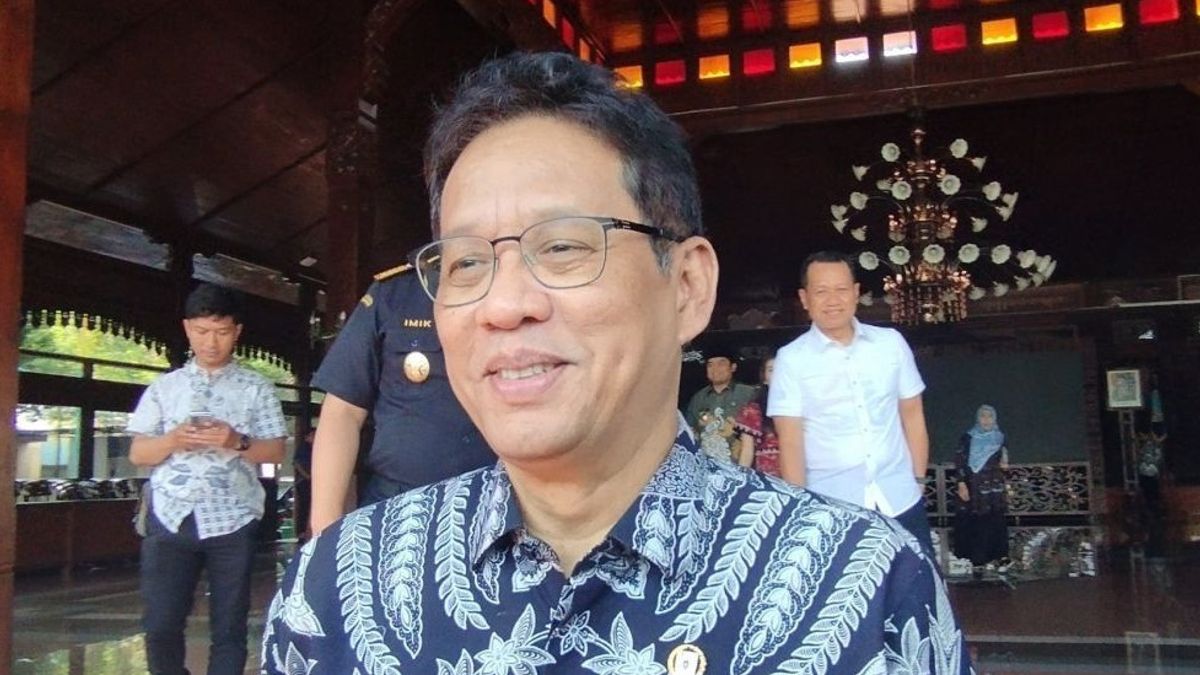


JAKARTA - Finance Minister Purbaya Yudhi Sadewa is optimistic that the implementation of a one-stop system for the export of natural resources (SDA) through PT Danantara Sumberdaya Indonesia (DSI) will increase state revenues by suppressing export smuggling practices that have so far harmed the country.
The government officially started the transition period of a one-stop export policy for strategic commodities such as coal, palm oil, and ferroalloys on Monday, June 1, 2026. The full implementation of the system managed by PT DSI is targeted to take effect no later than January 1, 2027.
According to Purbaya, the existence of PT DSI is expected to be able to improve export governance, especially by eliminating under invoicing practices and various forms of export embezzlement which are suspected to still occur.
"All taxes will apply as usual. I even hope that Mr. Dony will give me a bigger income because the smuggling of exports, under invoicing of all kinds will disappear. So I won't cut taxes, I'll get a bigger income," said Purbaya in a press conference at Wisma Danantara, Jakarta, Sunday, May 31.
He emphasized that there was no change to the current export tax provisions. The government is actually targeting an increase in state revenues from improving the export supervision and transparency system through a one-stop mechanism.
Purbaya even stated that the government would evaluate the performance of PT DSI if the implementation of the policy did not result in an increase in state revenues as expected.
"Later if it doesn't go up, I will check the DSI, what's wrong? It should have gone up from experience or data that we have now," he said.
However, the government is still calculating the potential additional state revenue that can be generated from the new policy. According to Purbaya, the real impact on state revenues can only be measured after the system has been running for some time.
In addition to regulating export governance, the government also requires exporters of strategic natural resources commodities to repatriate all Export Earnings (DHE) to the country with a 100 percent compliance rate. This provision is regulated in Government Regulation Number 21 of 2026 which came into force simultaneously with the one-door export policy.
"Starting tomorrow, June 1. In PP 21/2026, the government has set several new provisions regarding the placement of DHE SDA. Among them, the exporter of SDA is obliged to repatriate DHE to the country with a 100 percent compliance rate," said Purbaya.
The government also requires the placement of DHE SDA in the Indonesian Financial System (SKI). For non-oil and gas exporters, all DHEs must be placed in a special account in the country for a minimum of 12 months. Meanwhile, oil and gas exporters are required to place at least 30 percent of DHE for a minimum of three months.
According to Purbaya, the placement of funds must be carried out through banks that are members of the State-Owned Bank Association (Himbara) in order to strengthen domestic liquidity and increase the benefits of export foreign exchange for the national economy.
On the other hand, the government has tightened the management of foreign exchange by limiting the conversion of DHE SDA into foreign currencies or rupiah. If previously the conversion could be carried out up to 100 percent, now the maximum limit is set at 50 percent.
Even though the rules have been tightened, the government still provides a number of relaxations for exporters who have trade relations based on bilateral agreements or international cooperation. In this scheme, exporters are allowed to place a portion of the DHE at banks outside Himbara with a maximum portion of 30 percent and a maximum period of three months.
To encourage compliance by business actors, the government has also prepared various fiscal incentives. One of them is in the form of a lower income tax (PPh) rate compared to investment instruments in general.
Purbaya explained that the tax rate on income from DHE SDA placement instruments can even reach 0 percent, depending on the period of placement of funds.
"Usually, if it is a bond, the yield is taxed at 20 percent. If the source of funds is DHE SDA, then the tax on the instrument is 0 percent," he said.
The government hopes that the combination of a one-stop export system, foreign exchange repatriation obligations, and fiscal incentives can increase state revenues while strengthening national economic resilience through the optimization of natural resource management.
The English, Chinese, Japanese, Arabic, and French versions are automatically generated by the AI. So there may still be inaccuracies in translating, please always see Indonesian as our main language. (system supported by DigitalSiber.id)
Most Popular Tags
#Prabowo Subianto #donald trump #firearm #8791 #giias 2026Popular


