

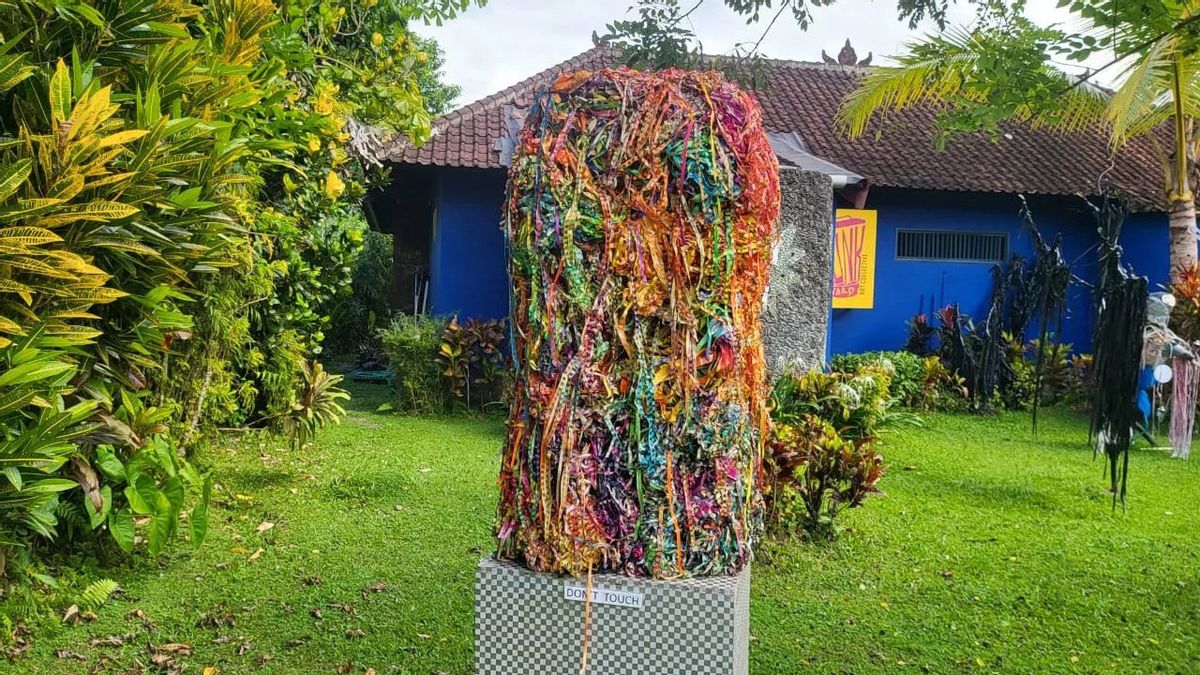


JAKARTA - In a small alley on Jalan Raya Sanggingan, Ubud, there is an art space that does not charge a penny. There is no counter. There is no price. There is no pretense.
All there is is plastic. And a warning.
Eight artists, a combination of Bali and abroad, named themselves Junkyard Collective Bali. They turn plastic waste into works of art. Not for sale. But to raise awareness.
"We don't think about money," said Dr. I Made Jodog, an academic and artist who is one of the driving forces behind this collective. "We think about awareness."
Jodog is not a new name. He is the Vice Rector of the Indonesian Institute of Arts (ISI) Bali. But in a small room in Ubud, he is just a restless artist.
His anxiety began in the late 1990s, when he was leading a youth organization in his village. The river below his house was filled with garbage. He cleaned it up. He woke up the residents. But the plastic never really went away.
Then he realized: cleaning is not enough. People need to understand why this garbage is dangerous, not only for the environment, but for their own bodies.
"After becoming microplastics, it is absorbed by plants, enters the rice seeds, and eventually becomes our own food," explained Jodog.
This is not a theory. This is the food chain. Plastic that flows into the river eventually enters the rice fields. In the rice fields, it breaks down into microplastics. Microplastics are absorbed by the rice plants. And enter the rice we eat every day.
"This is not just about pollution. It's about health. It's about survival. It's about the food that goes into our mouths," said Jodog.
Every artist in the Junkyard Collective has a different way of communicating. Some make paintings from layered ironed plastic. Some create a statue of a woman with garbage rooted in her body. Some plant real vegetables on top of the artwork as a reminder that our food grows in the waste we throw away.
And there are giant jellyfish from plastic bags, floating blown by the fan.
"When the jellyfish stings, you wake up," said Jodog. "This jellyfish is designed to sting your consciousness."
In the midst of the garbage emergency that is still plaguing the Island of the Gods, Jodog conveyed his hopes to the local government.
"We hope the government sees that art can be a bridge to grow public awareness," said Jodog. "We don't protest in a harsh way. We express our anxiety through works. But we hope there is attention, there is facilitation, and there is support for movements like this."
He added that the problem of plastic waste in Bali is at an alarming point. The government, according to him, cannot work alone. Collaboration is needed with communities, artists, academics, and the private sector.
Junkyard Collective does not sell their works. The gallery in Gang Bintang is open for free to anyone. Tourists. Expats. School children. Neighbors. There is no commercial target. Only idealism.
Jodog hopes this movement will grow. He is very open to artists from other countries who want to join.
"We hope that one day it will be big, even global," he said.
But for now, he is content if one person stops in front of their work. See. Ask. And go home with a slightly higher awareness than before.
The English, Chinese, Japanese, Arabic, and French versions are automatically generated by the AI. So there may still be inaccuracies in translating, please always see Indonesian as our main language. (system supported by DigitalSiber.id)
Most Popular Tags
#Prabowo Subianto #donald trump #firearm #8791 #giias 2026Popular


