

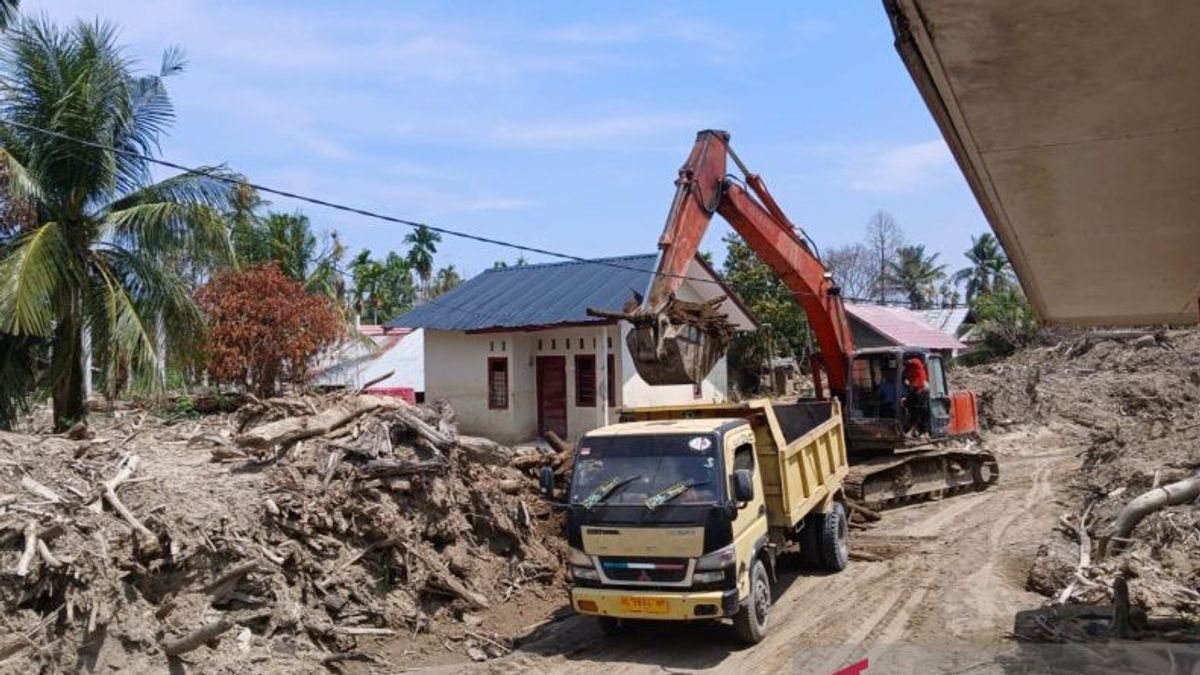


JAKARTA - Minister of Public Works (PU) Dody Hanggodo admitted that the post-disaster recovery process in Aceh is still lagging behind other regions.
Dody assessed that the geographical conditions and massive damage were the main causes of the slow handling, especially for bridge and irrigation infrastructure.
According to him, in general, the progress of disaster recovery in the last six months has been good. However, Aceh is the most challenging area because the damage to rivers and upstream areas is very severe.
"The one that is a little behind, according to me personally, is Aceh. Because Aceh (the damage) is very big and massive," said Dody.
He explained, many rivers in Aceh have widened up to five to ten times due to disasters.
This condition makes the design of the bridge must be completely changed before permanent construction is carried out.
"The maximum that has not been handled is the bridge because the average river is widening and sinking," he said.
According to Dody, wood and stone materials from the upstream area are also still a threat when it rains.
Therefore, the PU Ministry decided to build a dam (dam) even though it was still in the emergency response period to prevent greater damage in the downstream area.
Apart from bridges, said Dody, the restoration of the irrigation sector is the most delayed work.
The government still has to ensure the condition of the affected rice fields, including checking whether the land can still be used or must be moved due to being buried in mud.
"If the rice fields have to be moved, yes, we are forced to make a new irrigation area," he said.
Meanwhile, the government is currently focusing on accelerating the recovery of rice fields and irrigation in Aceh in order to support the 2026 food self-sufficiency target which is the direction of President Prabowo Subianto.
The PU Ministry is also working with the Ministry of Agriculture (Kementan) to ensure that the recovery of agricultural infrastructure runs optimally.
In addition, the government has also started to reactivate the labor-intensive program to clean up mud in the disaster-affected residential areas.
Through this program, residents will be directly involved in cleaning their homes and receive wages according to the provisions set together with the Financial and Development Supervisory Agency (BPKP).
The English, Chinese, Japanese, Arabic, and French versions are automatically generated by the AI. So there may still be inaccuracies in translating, please always see Indonesian as our main language. (system supported by DigitalSiber.id)


