

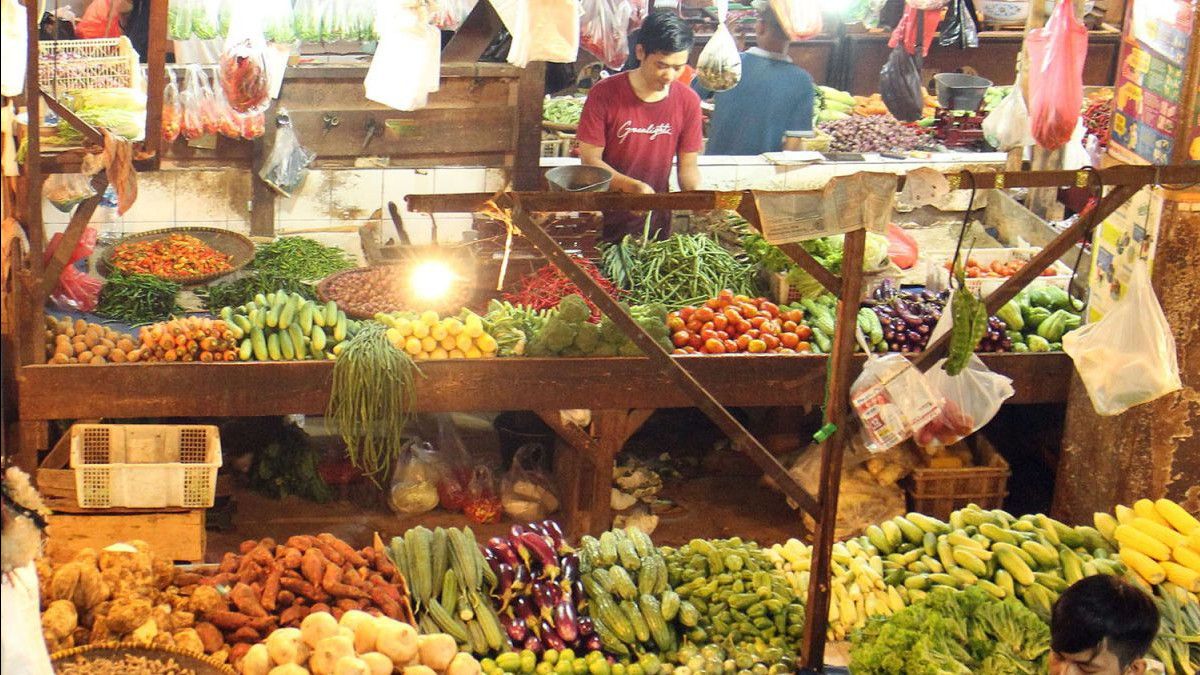


JAKARTA - The National Food Agency (Bapanas) claims that the prices of domestic chicken meat and domestic chicken eggs nationwide show a trend that is increasingly under control ahead of Eid al-Fitr or Lebaran 2026.
Bapanas also continues to strengthen stabilization measures to ensure that price improvements are even in various regions, as demand increases ahead of Eid al-Fitr.
Based on the Bapanas Food Price Panel as of March 9, the average live broiler price at the producer level was recorded as falling to Rp24,508 per kilogram or down 0.13 percent compared to the previous day.
Meanwhile, the highest price was recorded in North Sumatra at Rp27,781 per kilogram, while the lowest price was in Banten at Rp22,500 per kilogram. The average price is below the Manufacturer's Purchase Reference Price (HAP) which was set at Rp25,000 per kilogram.
Meanwhile, the average price of broiler meat at the consumer level nationwide is IDR 40,657 per kilogram. The highest price was recorded in Central Papua at IDR 64,412 per kilogram and the lowest price was in South Sulawesi at IDR 32,196 per kilogram.
The same trend is also seen in the price of broiler eggs. At the producer level, the price of eggs was recorded to have fallen by 0.75 percent compared to the previous day with an average of Rp26,874 per kilogram. The highest price is in North Sulawesi at Rp32,000 per kilogram and the lowest price in Jambi at Rp24,667 per kilogram.
Although it is still slightly above the HAP of the manufacturer which is set at Rp26,500 per kilogram, the movement of the price is considered to show a positive direction. Meanwhile, the price of broiler eggs at the consumer level nationwide is in the range of Rp31,674 per kilogram, with the highest price in South Papua reaching Rp51,000 per kilogram and the lowest in Aceh at Rp27,867 per kilogram.
Director of Food Supply and Price Stabilization at Bapanas Maino Dwi Hartono said that price monitoring continues to be carried out in various regions. According to him, there are still a number of regions that record prices above the government reference price so that they require more attention.
"And in our monitoring, there are indeed some that have been recorded to be priced higher than the government reference, especially for Indonesia-East Indonesia or 3TP. But of course it is our concern how to minimize the price increase, especially ahead of Lebaran which may be less than two weeks left," said Maino in an official statement, Wednesday, March 11.
Based on data from the Central Statistics Agency (BPS), as of the first week of March 2026, there were 176 regencies/cities that experienced an increase in the Price Development Index (IPH) for pure chicken meat commodities. A total of 111 regencies/cities or about 66 percent are still below the HAP, while 59 regencies/cities or about 33 percent are recorded to exceed the HAP.
Meanwhile, for the commodity of pure chicken eggs, there are 207 regencies/cities that have experienced an increase in IPH. Of these, as many as 108 regencies/cities or about 52 percent are still below the HAP, while 99 regencies/cities or about 47 percent are recorded above the HAP.
Maino explained that the current condition of national poultry production is still in a sufficient state so that supplies are maintained. Based on field monitoring, the availability of producers is still able to meet market needs.
"Well, this is certainly the situation, maybe later before Lebaran, usually the psychological market, the increase in community needs, prices adjust. But from the production side, from our monitoring in the market, the supply of eggs from producers is normal, enough, chicken meat is also like that, which means that maybe from the production side, there is no problem," he explained.
Previously, the Head of Bapanas who is also the Minister of Agriculture Andi Amran Sulaiman emphasized that the production and national food stock conditions are sufficient.
Amran also reminded all business actors not to play with prices, especially ahead of the momentum of major religious holidays which are usually followed by an increase in demand.
"Our production is high, our stock is a lot. Our food self-sufficiency is already nine, there are three. Well, these three are not self-sufficient, there are a lot of stocks. So there should be no fooling around," said Amran.
The government assesses that the dynamics of prices in a number of regions are more influenced by distribution factors and increased demand during Ramadan to Eid al-Fitr. Therefore, coordination with poultry business actors continues to be strengthened so that the distribution of commodities from the production center area to the consumer area runs smoothly at the established price.
Meanwhile, Director General of Livestock and Animal Health of the Ministry of Agriculture, Agung Suganda, emphasized that the government continues to encourage that the price of chicken meat and eggs at the consumer level remains within the government's reference price range.
"We are all asked, from Bapanas, from us at the Ministry of Agriculture, to continue to encourage the price of eggs and broiler meat at the consumer level to be within the government's reference price range that has been set. And of course we must be able to achieve this with our cooperation," said Agung.
From the business actors, the Chairman of the Sejahtera Poultry Farmers Cooperative, Suwardi, conveyed the readiness of farmers in Central Java to also maintain the stability of egg prices ahead of Eid al-Fitr. He said farmers were ready to support the government's stabilization program, including the Cheap Food Movement (GPM).
"So in the Central Java region, if there is, please ask the GPM to call me where, then we will immediately launch it. Because I am the GPM in Kendal, the price is Rp. 25,000. I subsidize from farmers. Selling eggs is also brave to subsidize for the region," said Suwardi.
According to him, the involvement of farmers in the GPM activity is a form of commitment to help the community obtain eggs at a more affordable price, especially ahead of the increasing demand during the Lebaran period.
"In principle, ahead of Eid al-Fitr, the Central Java region's eggs are quite safe and under control. We are ready to control prices in accordance with existing rules," he said.
The English, Chinese, Japanese, Arabic, and French versions are automatically generated by the AI. So there may still be inaccuracies in translating, please always see Indonesian as our main language. (system supported by DigitalSiber.id)


