

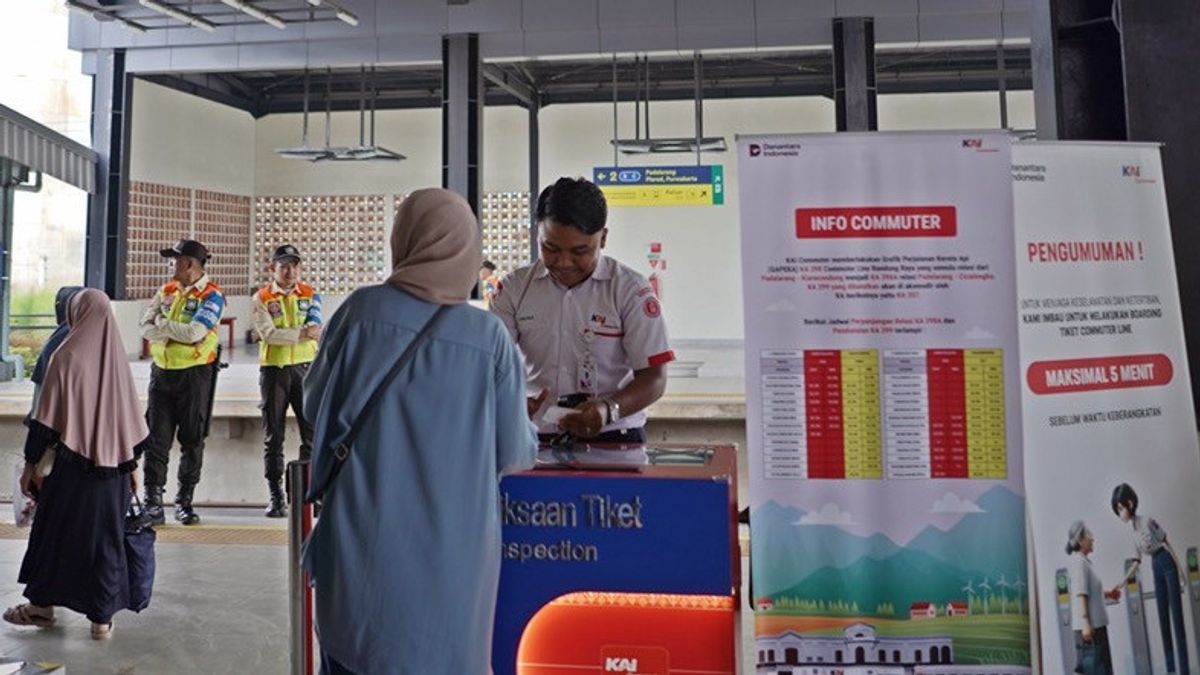


JAKARTA - The mobility of West Bandung residents continues to increase along with the strengthening of Commuter Line services.
This is reflected in the surge in passenger numbers at Gadobangkong Station, which has increased by 19 percent since the operation of the new building in early February 2026.
KAI Commuter Area 2 Bandung together with the Directorate General of Railways (DJKA) of the Ministry of Transportation through BTP Bandung continues to improve services at Gadobangkong Station as a transportation node of the Commuter Line in the Greater Bandung area.
The new station building, which has been operational since February 1, 2026, is presented to accommodate the growth of daily mobility of the community, as economic activity and movement towards activity centers in Bandung City and its surroundings increase.
Gadobangkong Station, which is located in Ngamprah District, West Bandung Regency, has a strategic position because it is located in the area of the central government, administration, and regional economy. Its presence is one of the main access to public transportation based on rail that is used by the community in daily activities.
VP Corporate Secretary of KAI Commuter, Karina Amanda said the increase in services in the West Bandung area was a response to the growing needs of the community.
"We have mapped the input of the community in the western region thoroughly. KAI Commuter responds to it by increasing services which are carried out gradually, in line with the strengthening of infrastructure so that operations run orderly, safely, and sustainably," said Karina in an official statement, Tuesday, February 10.
Based on operational data, from 1 to 8 February 2026, the number of users who went up from Gadobangkong Station was recorded at 7,016 people. This figure increased by about 19 percent compared to the same period in 2025, reflecting the high demand of the community for access to rail transportation in West Bandung Regency.
This increase is also in line with the characteristics of the region as a center of government activities. Data from the Central Statistics Agency (BPS) 2025 recorded more than 5,300 State Civil Apparatus (ASN) working in West Bandung Regency, which also contributed to the high mobility of labor towards public service centers.
More broadly, the trend of increased mobility is also reflected in the performance of the Bandung Raya Commuter Line. Throughout January 2026, the volume of users of this service reached 999,725 people, or increased by around 11 percent compared to the same period last year.
To support the effectiveness of the service, KAI Commuter made adjustments to the travel schedule starting February 1, 2026.
One of them is through the extension of the KA 398 Commuter Line Bandung Raya relationship to KA 398A.
The train, which originally served the Padalarang-Kiaracondong route, has now been extended to Cicalengka, with departure schedule from Padalarang Station at 21.46 WIB.
"The extension of the relationship has a positive impact. Before the adjustment, the average user of KA 398 was only about 34 people. After becoming KA 398A, the number of users increased significantly to 138 people at the beginning of the operational period," said Karina.
According to Karina, the enthusiasm of the community shows that the adjustment of the services carried out has been in accordance with the needs of users.
"This enthusiasm proves that the schedule adjustment is in accordance with the needs of the community, along with the growing significant public confidence," he said.
All service development and infrastructure strengthening at Gadobangkong Station are carried out through coordination with the Ministry of Transportation's DJKA, from the planning stage, technical testing, to operations, to ensure that services run according to national railway standards.
In the future, KAI Commuter together with DJKA will continue to operate other new station buildings gradually to strengthen integrated urban rail services in the Greater Bandung area.
"This step is expected to maintain a balance between the high mobility needs of the community and the comfort of Commuter Line users in the Bandung area and its surroundings," concluded Karina.
The English, Chinese, Japanese, Arabic, and French versions are automatically generated by the AI. So there may still be inaccuracies in translating, please always see Indonesian as our main language. (system supported by DigitalSiber.id)


