

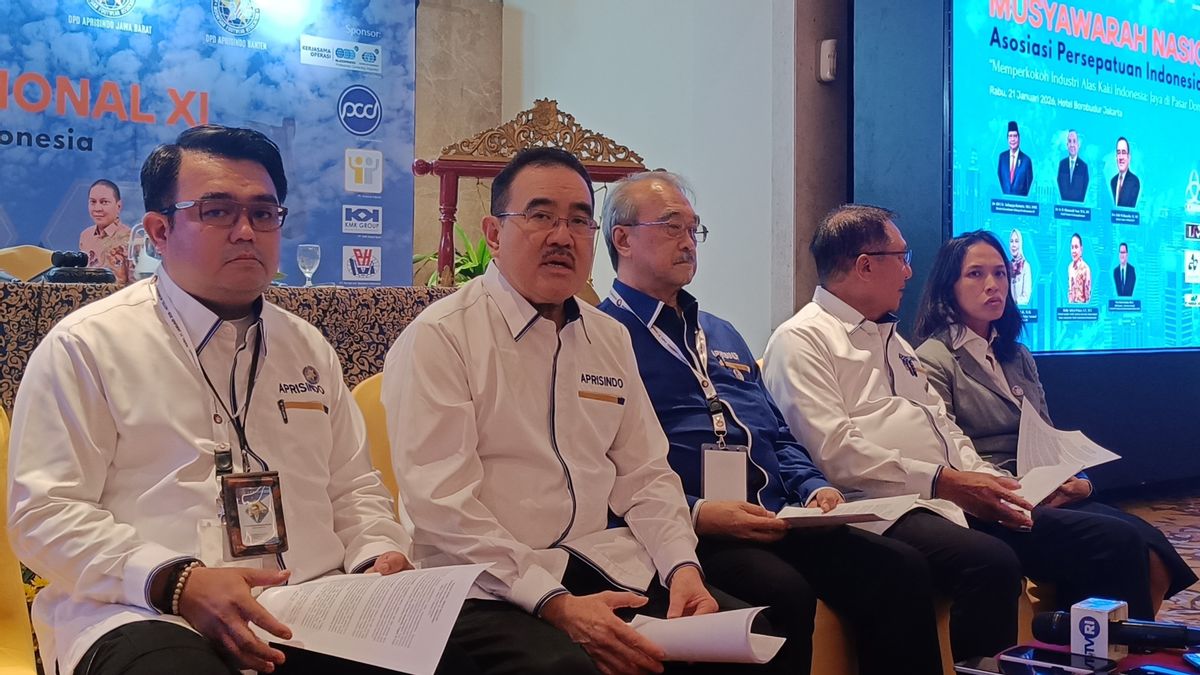


JAKARTA - The Indonesian Association of Cooperatives (Aprisindo) targets that the value of footwear exports will reach 10 billion US dollars or Rp169 trillion (assuming a rate of Rp16,900 per US dollar) in the next 3 years.
Meanwhile, footwear exports in 2025 reached 7.8 billion US dollars.
Aprisindo Board of Trustees Chairman Eddy Widjanarko said that optimism was driven by the expansion of export markets to the European Union with the Indonesia-European Union Comprehensive Economic Partnership Agreement (IEU-CEPA).
"If the economic conditions are good, then IEU-CEPA can also be decided or approved later this year and will be implemented next year, we have an ambition and believe it will be successful in 2028 or maximum 2029, we will reach (footwear exports) at least 10 billion US dollars," said Eddy at the XI Aprisindo Congress in Jakarta, quoted Thursday, January 22.
In addition, the implementation of the United States (US) reciprocal tariff of 19 percent is indeed considered to trigger stagnation in performance. Even so, entrepreneurs' optimism for exports to the US is still strong.
The dynamics of the US main market remain the main partner with a contribution of 30 percent, even though it faces a 19 percent reciprocal tariff challenge by August 2025, exports to Uncle Sam still rose 7.73 percent to US$2.54 billion.
On the same occasion, the newly elected Chairman of Aprisindo, Anton J Supit, said that the growth of the footwear industry as a labor-intensive sector must continue to be maintained to maintain people's purchasing power.
"In terms of economic contribution, the footwear industry is also considered to have a significant impact on workers' income," he said.
In terms of labor quality, said Anton, about 60 percent of the workforce has a maximum SMP education level.
This condition makes labor-intensive industries, including the shoe industry, still relevant and have long-term prospects.
However, the main challenge of the labor-intensive industry in the future is still related to employment issues and the need for a common perception with the government.
Primarily, regarding remuneration based on the new regulation in PP 49/2025 which is considered far from the expectations and capabilities of the labor-intensive footwear industry from sectoral wages and high alpha figures.
Apart from the labor issue, another challenge faced by the labor-intensive industry is logistics efficiency and just-in-time production systems. Distribution delays have the potential to increase overtime costs to the use of expensive air transport.
"If it is late in production, we are overtime. If overtime is very progressive. The general consequence is that if it is late, the consequence of air freight," he said.
Therefore, industry players hope that the government can provide real support by reducing various obstacles, including in the licensing process.
"So, the government should formulate how (the right policy). If this is still considered important, please do things that hinder such as the amdal process, we are always confused with complaints like that. It's not that we don't obey, but don't tie our own feet and can't run," he added.
The English, Chinese, Japanese, Arabic, and French versions are automatically generated by the AI. So there may still be inaccuracies in translating, please always see Indonesian as our main language. (system supported by DigitalSiber.id)


