



JAKARTA - As a country with a population of around 285 million, Indonesia places the food sector as a strategic issue that has a close relationship with national resilience.
Food supply stability is a key requirement for the continuation of social and economic activities, so that the management of the food sector needs to be planned, integrated, and sustainable so that the availability, affordability, and food security for all people are still guaranteed.
In line with this, President Prabowo Subianto emphasized the importance of national independence as a foundation for development, with food self-sufficiency as one of the main pillars.
Prabowo also set the agriculture and food sector as a national priority to strengthen food security, improve the welfare of farmers, and ensure the sustainability of long-term economic development.
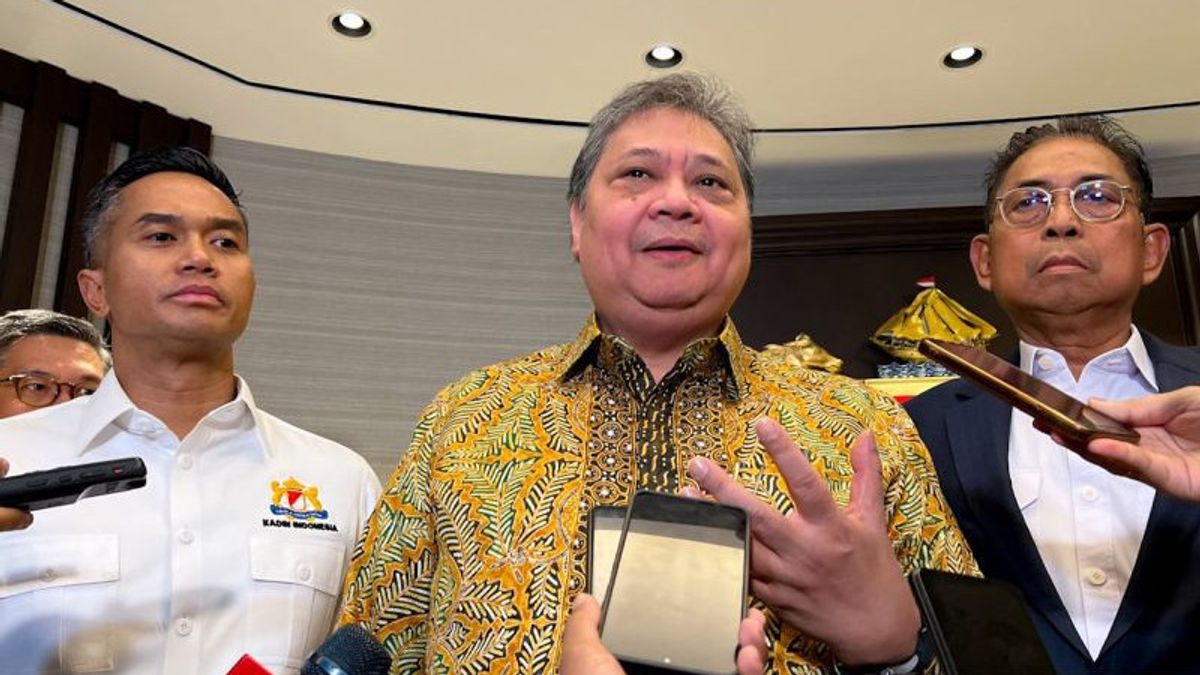
Therefore, Coordinating Minister for Economic Affairs Airlangga Hartarto explained that Indonesia's rice production in 2025 is estimated to reach 34.71 million tons, one of the highest in history and producing a rice surplus of 3.52 million tons.
"And also what we have to take care of is related to inflation. However, we must also be grateful that with the increase in prices and relatively good prices, the exchange rate for farmers is also the highest in recent years," he said in his statement, Tuesday, January 13.
Strengthening food security is also the foundation of the government's strategic programs, such as the Free Nutritious Meal (MBG) Program which is supported by the state budget allocation of up to Rp. 335 trillion.
According to him, the payment scheme at the beginning of this program maintains the sustainability of production, encourages business participation, and at the same time channels economic stimulus to the grassroots level.
This has an impact on the creation of employment and acceleration of national economic growth in accordance with government targets.
In addition to MBG, Airlangga said the government also strengthened food security through budget support in 2026 amounting to Rp. 164.4 trillion for increasing agricultural production and food stock stability.
In addition, he said that the empowerment of rural MSMEs was allocated Rp. 181.8 trillion, including strengthening logistics and the Red and White Market Operation, to maintain the smooth distribution, price stability, and inflation control in the community.
Airlangga added that the government also noted a number of strategic challenges, including the impact of climate change such as the El Niño and La Niña phenomena that occurred simultaneously in 2024 which had put pressure on national rice production.
He explained that given that the agricultural sector has a vital contribution to the economy of around 14.35 percent of GDP and absorbs almost 29 percent of the workforce or around 40.7 million people, attention to this issue is very important.
According to Airlangga, to face these challenges, the government encourages the strengthening of the agricultural sector through various strategic programs, including the development of food estates.
He added that the implementation of modern farming with advanced technology, increased efficiency, and climate risk management was also carried out so that agricultural productivity would continue to increase even in the face of climate change and global dynamics.
"Then the government continues to encourage Mandatory Biodiesel B40, this saves emissions of close to 42 million tons of CO2 in 2025 and also saves US $8 billion in solar import foreign exchange in 2024. This is what we call energy sovereignty based on agricultural power," explained Airlangga.
In the future, he said, the government pays attention to logistics issues and Food Loss as a challenge in strengthening food security.
According to the 2021 Bappenas Study, Food Waste and Loss in Indonesia reaches around 23-48 million tons per year, so more integrated management is needed, ranging from improving the logistics system to utilizing it with added value.
Airlangga explained that controlling Food Waste and Loss not only strengthens food security, but also opens up opportunities for cross-sector collaboration, including the role of the business world through corporate social responsibility (CSR) programs, as a form of cooperation to realize an efficient and sustainable food system.
The English, Chinese, Japanese, Arabic, and French versions are automatically generated by the AI. So there may still be inaccuracies in translating, please always see Indonesian as our main language. (system supported by DigitalSiber.id)
Most Popular Tags
#Prabowo Subianto #donald trump #firearm #8791 #giias 2026Popular


