

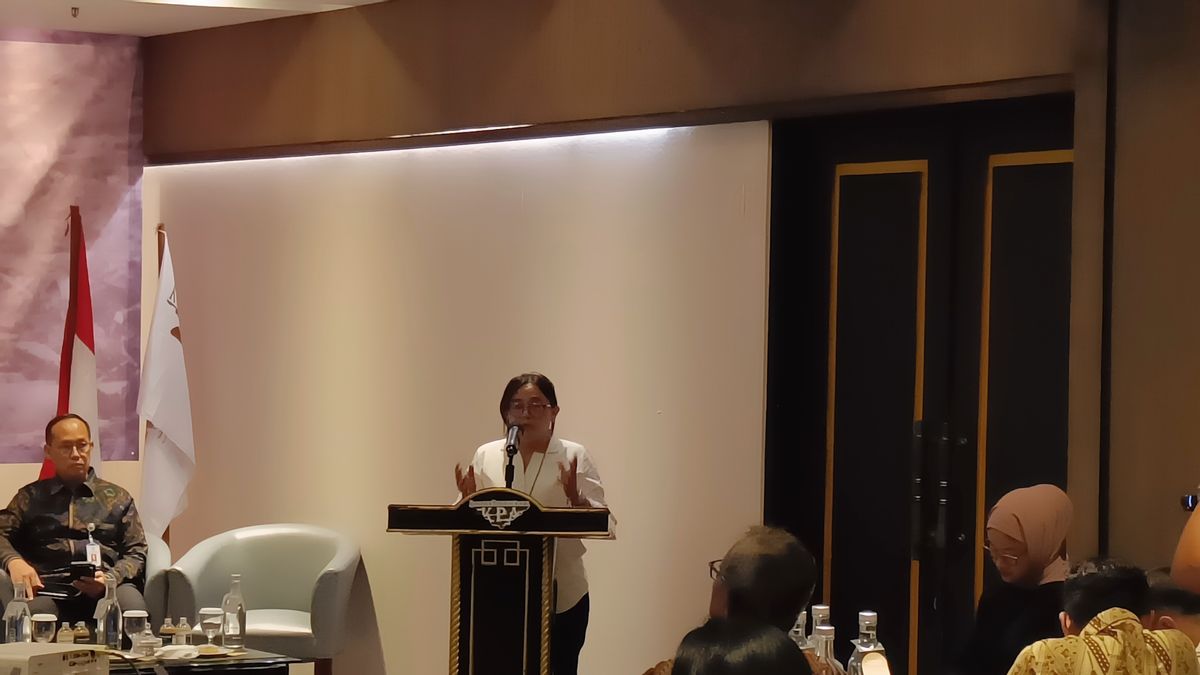


JAKARTA - The Agrarian Reform Consortium (KPA) has spoken out about President Prabowo Subianto's plan to plant oil palm in Papua Province. The Head of State's discourse to plant oil palm in the province was carried out to reduce the import of fuel oil (BBM).
"However, many pros and cons arise today. The reason is that the expansion of oil palm plantations is believed to cause land function shifts that ultimately cause flash floods, such as in Sumatra.
"The Secretary General of the KPA, Dewi Kartika, assessed that the President's discourse was a paradox and the government was considered not serious about agrarian reform.
"In the midst of a disaster, it should be part of the self-criticism of our political economic system related to agriculture and forestry and the spirit of the agrarian reform principle should be strengthened, not paradoxically," Dewi said in a National Workshop and Consolidation of Agrarian Reform and Forestry in Jakarta, Friday, December 19.
"In Sumatra, okay, we apologize, for example, we are careful, we can't deforest anymore and so on. But then there is another command to open oil palm in Papua," he continued.
"Moreover, the floods that recently hit three provinces in Sumatra have claimed more than 1,000 lives. Not to mention other material and non-material losses experienced by the affected communities.
Meanwhile, the green light for the cultivation of palm oil in Papua is believed to add to the potential for other natural disasters that occur in Indonesia.
"Don't worry, it won't just be in Sumatra. If it's mismanaged again, it could be in various regions, including Papua. And now there have been many landslides, floods, land degradation, and so on," he said.
"Dewi also criticized oil palm plantations, which are considered the same as forests. In fact, oil palm is very destructive because it produces large carbon gas emissions. It is also inversely proportional to Indonesia's spirit to mitigate climate change.
"Instead of expanding the oil palm plantation even more, it should start to dampen, reorganize, discipline illegal concessions, restore the rights of the people who were seized by oil palm plantations and stop expansion," he said.
Previously, President Prabowo Subianto emphasized that the government was committed to realizing national energy self-sufficiency to reduce dependence on imported fuel and potentially saving hundreds of trillion rupiah each year from the subsidy budget.
In his instructions to the heads of regions throughout Papua and the Papua Special Autonomy Development Acceleration Executive Committee at the State Palace, Jakarta, Tuesday, December 16, he said, Indonesia's fuel imports currently reach Rp520 trillion per year. If the dependence on imports can be reduced by half, the country has the potential to save Rp250 trillion.
"Every year we spend hundreds of trillions on imported fuel. If we can plant oil palm, cassava, sugar cane, use solar energy and hydropower, imagine how many trillions we can save every year," he said.
"The former Minister of Defense stated that the government was starting to take concrete steps by targeting no longer importing solar in 2026.
Furthermore, the government also targets Indonesia to no longer import gasoline. According to the President, this is very capable of being realized given that Indonesia has the potential for renewable new energy sources (EBT) in various regions, including Papua.
According to him, the government has prepared a policy so that energy-producing areas can enjoy the benefits of energy produced in their own region.
The English, Chinese, Japanese, Arabic, and French versions are automatically generated by the AI. So there may still be inaccuracies in translating, please always see Indonesian as our main language. (system supported by DigitalSiber.id)


