


JAKARTA - The Jakarta-Bandung High-speed Rail Project, known as Godas, has been operating for about two years. However, the project is still the financial burden of BUMN-BUMN which is the shareholder.
PT Kereta Cepat Indonesia China (KCIC) as an operator company, has recorded trillions of rupiah losses since operating. Last year, KCIC losses were recorded at IDR 2.69 trillion.
BUMN observer and Director of the Next Indonesia Center, Herry Gunawan, assessed that the financial condition of PT Kereta Cepat Indonesia-China (KCIC) is indeed complicated. In addition to operating in deficit conditions, the project also bears the burden of jumbo debt.
"The train quickly has financial problems, not only debt but also operating with a deficit. This shows that the prospects for the future are not good," he told VOI, written Thursday, October 16.
According to Herry, the status of KCIC is not as a BUMN, so the government cannot interfere directly with the project.
For your information, KCIC is a joint venture between a consortium of Indonesian SOEs and a company from China. The Indonesian consortium, which is part of PT Pilar Sinergi BUMN Indonesia (PSBI), owns 60 percent of the shares, while China through China Railway International Co. Ltd. (CRI) holds 40 percent of the shares.
PSBI's shareholder composition consists of PTPT Kereta Api Indonesia (Persero) 58.53 percent, PT Wijaya Karya (Persero) Tbk 33.36 percent, PT Perkebunan Nusantara I 1.03 percent, and PT Jasa Marga (Persero) Tbk 7.08 percent.
"So KCIC is not a state-owned company. With such conditions, the state budget cannot be used directly to KCIC for intervention," he explained.
Transportation Rescue Options Without State Budget
Without the support of the state budget, Herry said there are several realistic options to save this project. First, extend the route to expand operational capacity.
"Expanding production capabilities, this can only be done by extending the route. However, apart from being very expensive, the time is also very long. So it's too difficult to do," he said.
The second option, continued Herry, is operational consolidation as a realistic step. He said, KCIC can collaborate or a strategic alliance with companies that are still related to SOEs, such as PT KAI, which has a network and a larger economic scale.
"Just for example, consolidated operationally with the LRT under PT KAI or others so that it can operate according to the economic scale, so that the problem can be localized," he said.
Not only that, Herry also encouraged KCIC to continue to make efficiency in the controllable cost sector.
In addition to cost efficiency, KCIC is also advised to look for new business opportunities that are still relevant, for example in the field of transportation information technology or logistics services.
"Of course they know their strength," he said.
However, Herry stressed that whatever options the government has chosen to save the project, debt restructuring must still be carried out.
"The debt still has to be renegotiated in order to match the ability to pay. Otherwise, it will be subject to new burdens such as fines," he said.
For your information, warehish cost a jumbo investment of up to USD 7.2 billion. The investment value experienced a cost overrun of USD 1.2 billion from the initial project cost target of USD 6 billion.
Of the 1.2 billion US dollars, 60 percent is charged to the Indonesian consortium or around 720 million US dollars. Meanwhile, the remaining 480 million US dollars will be charged to the Chinese consortium.
The financing structure consists of 25 percent through KAI's State Capital Participation (PMN) worth IDR 3.2 trillion. Meanwhile, the remaining 75 percent were sourced from loans to China Development Bank (CDB) amounting to USD 542.7 million.
Government Will Not Be Debt Responsibility
Previously, Minister of Finance Purbaya Yudhi Sadive said the government would not bear part of the debt from the Jakarta-Bandung high-speed rail project run by PT Kereta Cepat Indonesia-China (KCIC).
According to Purbaya, the responsibility for repaying debt should be under the Anagata Nusantara Resources Investment Management Agency (BPI Danantara), which oversees a number of SOEs, including PT Kereta Api Indonesia (Persero) as KCIC's shareholder.
SEE ALSO:
-
 | EKONOMI
Posisi Keuangan Kereta Cepat Sulit, Selain Operasional Defisit juga Punya Utang
16 Oktober 2025, 12:36 -
 | EKONOMI
Purbaya Ungkap Pembayaran Utang KCIC jadi Tanggung Jawab Danantara, Bukan APBN
15 Oktober 2025, 20:47
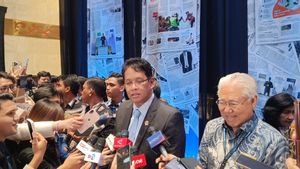
"What is clear is that I have not been contacted regarding this issue. But KCIC is now under the Danantara, right? If it is under Danantara, they should already have their own management, their own dividends," he said in the Media Gathering of the 2026 State Budget, Friday, October 10.
He explained, Danantara currently manages dividends of around Rp. 80 trillion per year. With such a large fund, according to him, the resources of the Sovereign Wealth Fund (SWF) Indonesia should be sufficient to solve the debt financing problem for the high-speed rail project, without having to use funds from the state budget.
"If they are under Danantara, they already have their own management, already have their own dividends, which on average a year can reach Rp80 trillion or more. They should be able to manage the debt of the Jakarta Fast Train Project "Bandung from there," he said.
The English, Chinese, Japanese, Arabic, and French versions are automatically generated by the AI. So there may still be inaccuracies in translating, please always see Indonesian as our main language. (system supported by DigitalSiber.id)
Most Popular Tags
#Prabowo Subianto #donald trump #2026 World Cup #Febrie Adriansyah #8791Popular


