


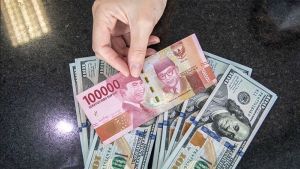
JAKARTA - Banks that are members of the Association of State-Owned Banks (Himbara) simultaneously raise the deposit interest rate in US Dollars (USD) to 4 percent. This figure far exceeds the average deposit interest rate in rupiah which as of August 2025 was recorded at 3.07 percent.
For the record, Himbara, which consists of Bank Mandiri, BRI, BNI, and BTN, simultaneously determined the increase in the USD foreign exchange deposit interest rate on Wednesday, September 24.
Head of Bank Permata economist Josua Pardede said that the policy of increasing the interest rate of foreign exchange deposits could not be separated from a number of risks that needed to be observed.
He conveyed that first, the difference in interest, which now benefits more deposits in US dollars, has the potential to encourage some customers to divert funds from rupiah to dollars.
According to him, this transfer can withstand the downward trend in the cost of funds in the rupiah that has occurred in recent months, as a result, the transmission of the relaxation of monetary policy to the reduction in rupiah loan interest rates can slow down.
He conveyed that the second risk is that the increase in foreign exchange deposit interest will increase the cost of funds for banks in the midst of a profit margin that has tended to be tight this year due to operational costs and efforts to improve profits amid a decrease in securities results can further suppress margins.
"The increase in dollar funds is at risk of suppressing margins further if the foreign exchange lending rate cannot be adjusted as quickly as deposit interest increases, especially for corporate debtors who are sensitive to funding costs," he told VOI, Thursday, September 25.
Josua said that in terms of market perception, this step can be read as a signal that the pressure on the rupiah exchange rate is quite significant, because currently the rupiah has weakened to around Rp. 16,676 per US dollar, the lowest level in recent months.
According to him, although the USD high deposit rate interest policy aims to maintain stability, the market can interpret it as a form of caution that increases the midst of uncertainty.
"The supporting effect on the rupiah is still possible, but not immediately if the transfer of deposits from rupiah to dollars occurs in large quantities," he explained.
He conveyed the fourth factor, namely, financing costs in dollars for business actors are feared to increase, or at least drop as quickly as expected.
SEE ALSO:
-
 | EKONOMI
Suku Bunga Deposito Valas Jadi 4 Persen jadi Strategi Jangka Pendek Jaga Stabilitas
25 September 2025, 13:14 -
 | EKONOMI
Perkuat Daya Saing di ASEAN, BTN Tetapkan Bunga Deposito USD 4 Persen
25 September 2025, 09:45 -
 | EKONOMI
Perkuat Likuiditas Valas, BRI Naikkan Suku Bunga Deposito Valas Jadi 4 Persen
25 September 2025, 09:30
According to him, banking data shows that lending is still not optimal, with a credit ratio to third party funds (DPK) that is still loose and the portion of credit facilities that have not been withdrawn is relatively high.
He said that if the high cost of dollars was forwarded to foreign lending rates, this could reduce investment interest, especially in sectors that depend on imports of raw materials and capital goods.
Josua said there are several ways to mitigate risks, including by limiting the validity period of high-interest promotions, prioritizing deposits that have natural cash flow such as exporters, requiring plans to use clear funds.
He added another way is to strengthen communication that this policy is temporary and is part of the macro policy mix that remains focused on stability and support for real sector financing through macroprudential liquidity incentives.
Josua views this policy as a short-term step to contain the flow of dollars in the country and ensure the availability of financing for strategic sectors.
However, he stressed that its implementation needs to be carried out in a measured manner so as not to interfere with the effectiveness of the transmission of the relaxation of monetary policy in the rupiah.
The English, Chinese, Japanese, Arabic, and French versions are automatically generated by the AI. So there may still be inaccuracies in translating, please always see Indonesian as our main language. (system supported by DigitalSiber.id)
Most Popular Tags
#Prabowo Subianto #donald trump #Febrie Adriansyah #8791 #giias 2026Popular


