

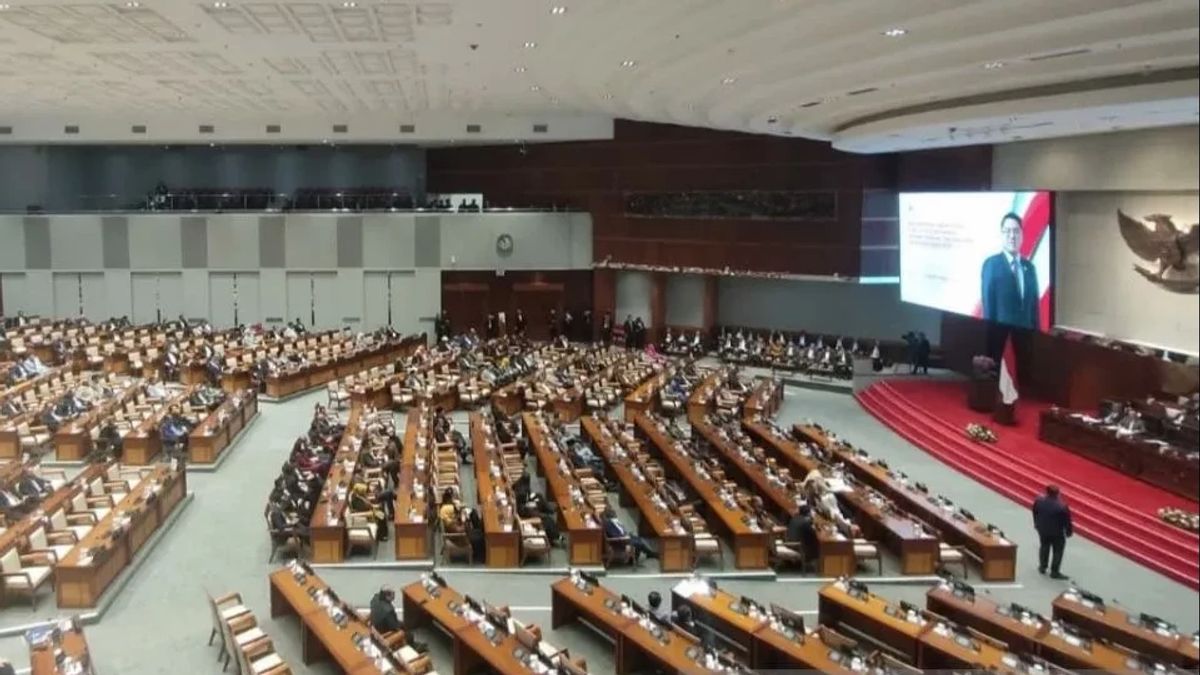


JAKARTA - The People's Representative Council of the Republic of Indonesia (DPR RI) officially started the discussion of the 2026 State Revenue and Expenditure Budget Draft (RAPBN).
The process began after President Prabowo Subianto delivered a Financial Note on August 15, 2025 and each faction gave a general view of the draft initial budget which was fully designed by the Prabowo-Gibran administration.
The majority of factions agreed that the 2026 State Budget should be an effective tool in improving people's welfare, maintaining national economic stability, and responding to increasingly complex global challenges.
Member of the PDIP faction Rio AJ Dondokambey emphasized that the state budget is a constitutional mandate for the welfare of the people and the implementation of the state budget must have a real impact on people's lives, including the fulfillment of basic needs such as food, education, health, and housing.
In addition, the PDIP faction also encourages a more detailed explanation from the government regarding economic transformation strategies and sources of added value growth.
Then also highlighted the growth target of 5.4 percent and 2.5 percent inflation, and asked that the target be truly able to strengthen people's purchasing power.
Golkar faction member Hamka B.Kady views the 2026 RAPBN as an important foundation towards the vision of Indonesia Gold 2045 and also highlights domestic challenges, such as shrinking the middle class, high stunting rates, and decreasing the contribution of the manufacturing sector.
In addition, the Golkar faction assessed that the 2026 State Budget should be a key instrument to answer these challenges and encourage economic growth of up to 8 percent in 2029
Gerindra faction member Danang WS expressed support for the 2026 RAPBN which emphasized sovereignty in the fields of food, energy and economy.
In addition, the Gerindra faction also considers the growth target of 5.4 percent as a form of realistic optimism and also emphasizes the importance of fiscal policies that maintain people's purchasing power, strengthen social protection, and support household consumption.
Nasdem faction member Ratih Megasari Singkarru called the 2026 RAPBN a reflection of the initial direction of national development under Prabowo-Gibran's leadership, as well as supporting priority programs in the food, energy, and free nutritious eating programs.
Then, the NasDem Faction also highlighted state spending of IDR 3,786.5 trillion, with details of central government spending of IDR 3,136.5 trillion and transfers to the regions of IDR 649.9 trillion, and requested that the reduction of regional transfers be accompanied by the effectiveness of the ministry program so that the benefits are directly felt by the community.
In addition, the central government's allocation of spending is also expected to accelerate priority programs such as food security, energy, free nutritious eating programs, improving access and quality of education, expanding health services, village development, cooperatives, MSMEs, and strengthening defense.
PKB faction member Ratna Juwita Sari assessed that the growth target of 5.4 percent was quite moderate, but emphasized that this could only be achieved if the government consistently carried out industrialization and downstreaming. As well as highlighting the oil and gas lifting target which is considered not in line with the vision of energy independence.
In addition, the PKB faction also encourages the government to set an unemployment target that is more optimistic, utilizing demographic bonuses through creating formal jobs.
Member of the PKS Amin faction expressed support for the 5.4 percent economic growth target, as long as it is inclusive and sustainable.
In addition, the PKS faction also supports free nutritious eating programs and assesses that this program is important for nutritional fulfillment, improving the quality of human resources, and forming superior generations in the future.
PAN faction member Ahmad Rizki Sadig stated that the 2.5 percent inflation target was considered realistic, but reminded the importance of close coordination between the government and Bank Indonesia in maintaining food price stability.
SEE ALSO:
-
 | EKONOMI
BPS Catat Sektor Konstruksi Serap 8,7 Juta Pekerja hingga Februari 2025
19 Agustus 2025, 15:25

Selain itu, Fraksi PAN juga menekankan perlunya penguatan penerimaan pajak tanpa membebani masyarakat kecil dan pelaku UMKM. Serta mendorong perluasan basis pajak yang adil, modernisasi sistem perpajakan, serta peningkatan kepatuhan.
Anggota Fraksi Demokrat Andi Muzakkir Aqil menekankan agar delapan agenda prioritas dalam RAPBN 2026 benar-benar menyasar kebutuhan rakyat, mulai dari sektor pendidikan, kesehatan, hingga ketahanan energi dan pangan.
Selain itu, Fraksi Demokrat juga menyoroti pentingnya transparansi, termasuk dalam pelaksanaan program sertifikasi halal, peningkatan gaji ASN, serta pemberian subsidi yang tepat sasaran.
SEE ALSO:
-
| EKONOMI
BPS Catat Sektor Konstruksi Serap 8,7 Juta Pekerja hingga Februari 2025
19 Agustus 2025, 15:25
In addition, the PAN faction also emphasized the need to strengthen tax revenues without burdening the small community and MSME actors. As well as encouraging the expansion of a fair tax base, modernizing the tax system, and increasing compliance.
Member of the Democratic Faction Andi Muzakkir Aqil emphasized that eight priority agendas in the 2026 RAPBN really target people's needs, ranging from the education, health sector, to energy and food security sectors.
In addition, the Democratic Faction also highlighted the importance of transparency, including in the implementation of halal certification programs, increasing ASN salaries, and providing targeted subsidies.
The English, Chinese, Japanese, Arabic, and French versions are automatically generated by the AI. So there may still be inaccuracies in translating, please always see Indonesian as our main language. (system supported by DigitalSiber.id)
Most Popular Tags
#Prabowo Subianto #donald trump #2026 World Cup #Febrie Adriansyah #8791Popular


