
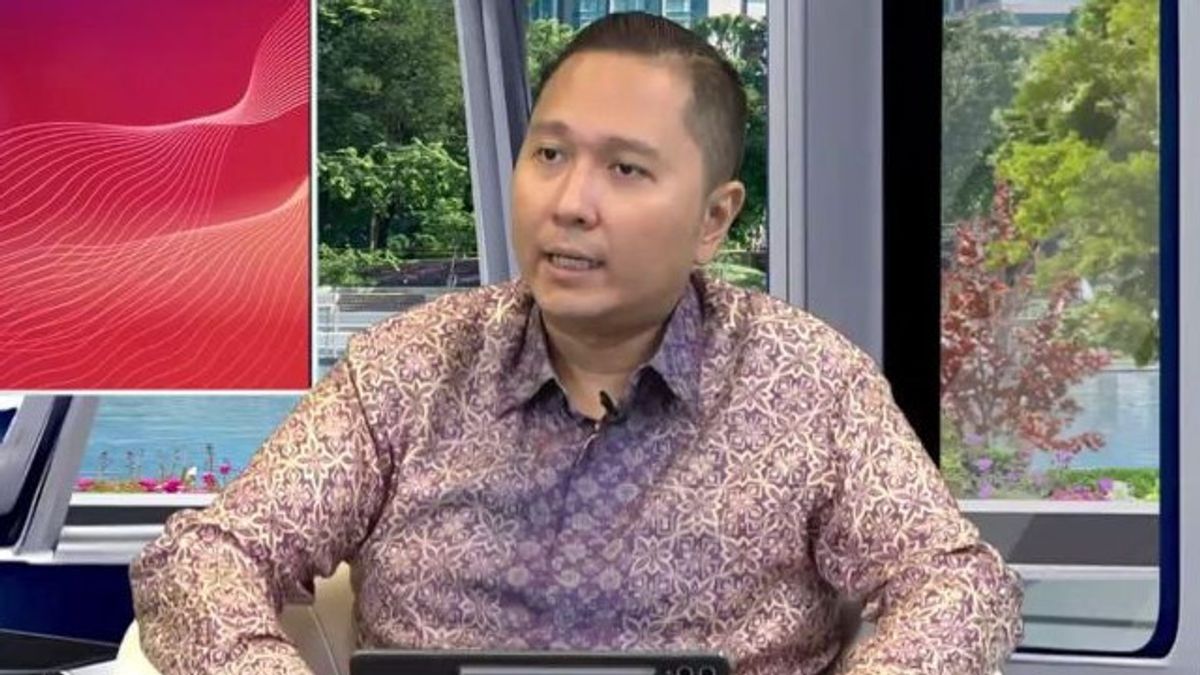


JAKARTA - Bank Josua Pardede's Chief Economist reminded that Indonesia needs to consider and anticipate the risk of weakening China's economy as an indirect impact of the tariff war launched by the United States (US).
The International Monetary Fund (IMF) has even reduced China's economic growth projections this year and next year to 4 percent. This could be one of the risks for Indonesia's economic growth considering that Indonesia's export destination to China has a share of around 20-25 percent of total exports in Indonesia.
"So, of course, the slowdown in China's economy will also affect Indonesia's economic performance later and will also have implications for performance in terms of the financial sector in Indonesia," said Josua in the OJK Institute webinar in Jakarta, quoted by Antara, Thursday, May 15.
Josua explained that the simulation conducted by Permata Bank shows that any slowdown of 1 point percent of China's economy will have a negative impact on Indonesia's economic slowdown of around 0.1 point percent. Meanwhile, the US economic slowdown will have an impact of around 0.07 percent point percent on the Indonesian economy.
Meanwhile, the prices of Indonesia's main export commodities, such as CPO and coal, are also expected to decline due to the US tariff war. Based on the simulation, Josua noted that every 10 percent decrease in CPO and coal prices will have implications for the slowdown in Indonesia's GDP of around 0.09 points per percent and 0.08 points per percent, respectively.
If the impact of the tariff war is seen sectorally, Josua said that Indonesia's export structure to the US is dominated by manufacturing products with several sub-sectors showing a fairly high dependence.
In 2024, manufacturing exports to the US reached 25.1 billion US dollars which included 12.9 percent of Indonesia's total manufacturing exports. There are 14 industries that have significant exposures that make it very vulnerable to changes in tariffs from the US.
Furthermore, added Josua, the impact of US tariffs will vary between sectors. Highly export-oriented and market-dependent industries such as textiles, footwear, electronics, furniture, and rubber products, are expected to face the greatest risks.
On the other hand, the mining and agriculture sectors show limited direct dependence on the US, although they remain vulnerable to indirect impacts through a decline in global commodity prices amid rising trade tensions.
Josua added that the commodity market had responded to US President Donald Trump's policy where oil, copper, nickel and agricultural products prices declined quite sharply after the escalation of the trade war.
"If this trade escalation continues, then global economic growth can also weaken further so that this will reduce external demand, including Indonesian exports," he said.
Josua views that the direct impact of the tariff war on the Indonesian economy is actually relatively marginal or insignificant. This considers that the Indonesian economy is still dominated by household consumption, so that its impact on the slowdown in the domestic economy can be relatively mitigated by strengthening the domestic economy.
SEE ALSO:

"Therefore, structural reforms must still be carried out and accelerated in order to strengthen our domestic economy in the future," he said.
Since Trump took office, the second volume of the trade war began with the most significant escalation between the US and China, which applied retaliatory rates. The latest developments, the US and China finally tried to negotiate to reduce tensions. Although there is hope for a positive signal, Josua warned of a risk that will still take place.
"If we look at the future, of course the risk or probability whether this trade war ceasefire will continue or not, of course this probability will also be influenced again by how the dynamics in trade negotiations between the two parties in the future," said Josua.
The English, Chinese, Japanese, Arabic, and French versions are automatically generated by the AI. So there may still be inaccuracies in translating, please always see Indonesian as our main language. (system supported by DigitalSiber.id)


