

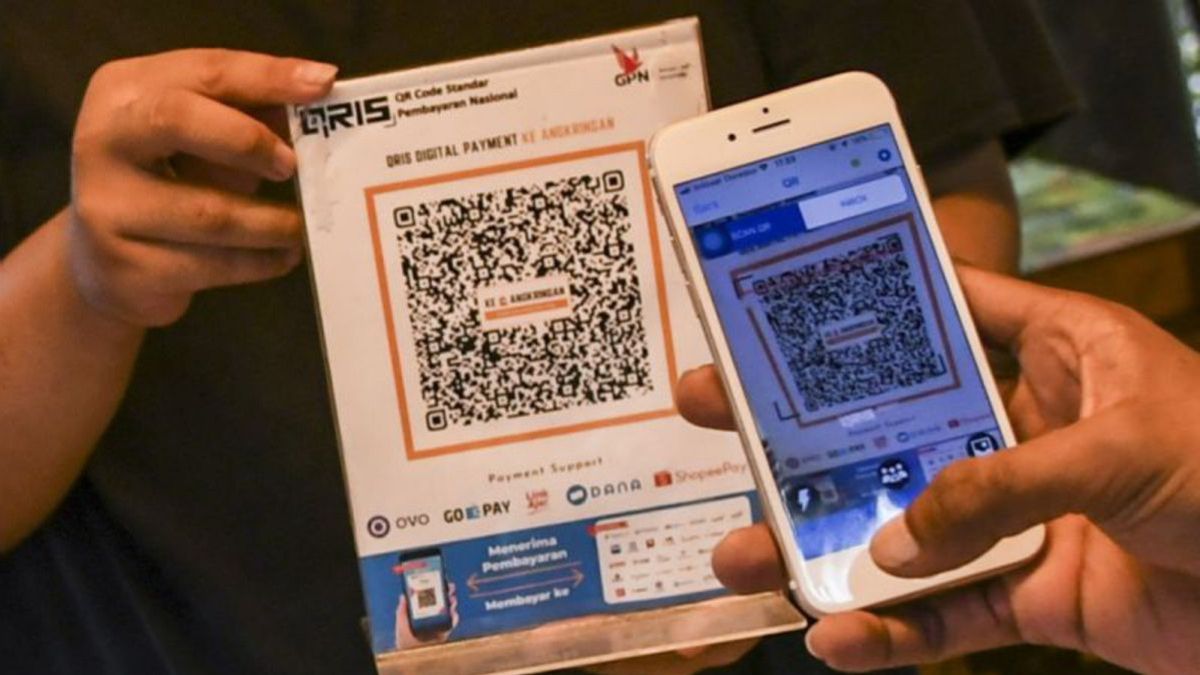


JAKARTA - Jakarta Veterans UPN Public Policy Economist Achmad Nur Hidayat conveyed criticism from the United States (US) of Indonesia's digital payment system policy, especially QRIS (Quick Response Code Indonesian Standard) and GPN (National Payment Gateway) reflecting the eternal tension between globalization and economic nationalism.
Achmad explained that the policy for the US as the home for fintech giants such as PayPal, Stripe, and Visa Indonesian policy is considered to hamper its business expansion.
However, Achmad said Indonesia must prioritize the interests of its 277 million citizens, because liberalization of the payment sector without filters can kill local fintech startups that are not ready to compete with multinational companies.
"For example, in Africa, the dominance of M-Pesa (despite its success in increasing financial inclusion) has narrowed the space for local developers to create more contextual solutions. In addition, US demands for BI to be more transparent in policy preparation need to be criticized," he explained in his statement, Tuesday, April 22.
According to him, every sovereign country has the right to formulate regulations according to its national needs without foreign intervention where US protests are similar to their reactions to local data localization policies in the European Union through the GDPR.
"If Indonesia gives up on this pressure, it could be a bad precedent where public policy is determined by corporate lobbying, not the interests of the people," he said.
Achmad said that economic sovereignty is the absolute right of Indonesia, constructive dialogue with global players is still needed and accusations that Indonesia's policies are actually a form of projection from global corporate concerns about the potential loss of market share.
However, he conveyed that protection in the sense of protecting the sovereignty of the national financial system is a natural thing, and even must be done by any country that is serious about building its economic independence.
"Indonesia remains open to investment and international cooperation. However, this openness must be placed in a framework that does not sacrifice the long-term national interests," he explained.
Achmad said that when BI stipulates that GPN switching institutions must be domestically based and have a local license, it is a form of state responsibility to ensure control and transparency in the management of domestic payment systems. this must be maintained because it is related to national interests.
He added that foreign companies can still participate, but must go through strategic partnerships with local entities and support technology transfer. This is a fair and oriented mechanism for strengthening domestic capacity, not merely exclusivity.
For this reason, Achmad conveyed that the first thing BI can do is open a limited consultation room with foreign companies without sacrificing policy principles.
"For example, allowing foreign participation in the development of QRIS technology on condition of transfer of knowledge and use of local servers," he explained.
Achmad conveyed the second thing, the government needs to strengthen economic diplomacy to explain that QRIS is not an obstacle, but a collaboration opportunity.
"The QRIS standard can be promoted as a model for other developing countries, so US companies that want expansion into Southeast Asia must adapt to it," he said.
SEE ALSO:
-
 | EKONOMI
BI Buka Suara Soal QRIS dan GPN, Tegaskan Tidak Ada Diskriminasi Negara
21 April 2025, 12:40 -
 | EKONOMI
AS Soroti QRIS, GPN, dan TKDN dalam Negosiasi Tarif Impor dengan Indonesia
20 April 2025, 07:15

Achmad conveyed the third thing, Indonesia can adopt a gradual interoperability approach such as ensuring QRIS is compatible with regional payment systems such as SGQR (Singapore) or PromptPay (Thailand) first, before stepping into global integration.
"This step will reduce US concerns as well as strengthen Indonesia's bargaining position in the international arena," he said.
Achmad conveyed that QRIS and GPN are representatives of Indonesia's enthusiasm to build an inclusive, efficient, and sovereign payment system.
"Criticism from the US is a natural thing in the dynamics of global trade, but it cannot be used as an excuse to withdraw from the national agenda," he said.
According to him, this initiative must be strengthened so that Indonesia not only becomes a market, but also a major player in the global digital economy.
"Submitting QRIS control to foreign parties is a form of neglect of economic sovereignty and the security of people's data. So, this is where we must stand upright: maintaining independence while maintaining fair and balanced cooperation," he concluded.
The English, Chinese, Japanese, Arabic, and French versions are automatically generated by the AI. So there may still be inaccuracies in translating, please always see Indonesian as our main language. (system supported by DigitalSiber.id)
Popular


