

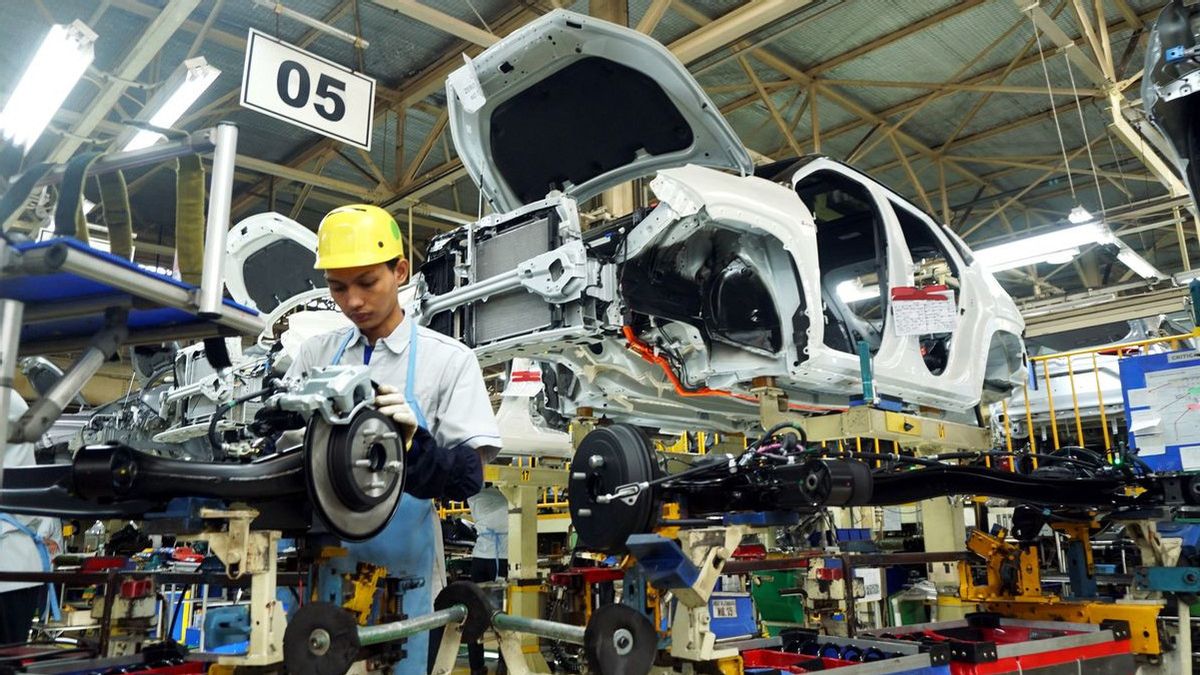


JAKARTA - The Indonesian Manufacturing Purchasing Managers' Index (PMI) in March 2025 was still at the level of 52.4 or expansive. However, this figure fell compared to PMI in the previous month, which was at the level of 53.6.
The Ministry of Industry (Kemenperin) said that the momentum of religious celebrations, especially Eid and holidays after that, had become a barrier to the decline rate of PMI even deeper.
The momentum of religious celebrations such as Ramadan and Eid every year has always been a point of increasing demand for manufacturing products and followed by an increase in PMI.
But this time, the spike did not occur. The momentum of religious celebrations this time was only able to support PMI so as not to go deeper.
Based on an industry company report to the Ministry of Industry, manufacturing product sales, especially for food, beverage and textile and textile products (TPT) products, experienced a decline in sales ahead of Eid.
The decline in sales was partly due to the weakening of people's purchasing power.
"This slowdown can also be seen from the report of the March 2025 Industrial Trust Index (IKI) which is at 52.98 or a narrow decline of 0.17 points compared to February 2025. However, industry players still express high optimism in running their business in Indonesia," said Ministry of Industry spokesman Febri Hendri Antoni Arief in his official statement, Wednesday, April 2.
Based on data released by S&P Global, Indonesia's manufacturing PMI in March 2025 was able to surpass RRT (51.2), Vietnam (50.5), Thailand (49.9), Taiwan (49.8) United States (49.8) Myanmar (49.8), Netherlands (49.6), South Korea (49.1), France (48.9), Germany (48.3), Japan (48.3) and the UK (44.6).
Almost all countries in Southeast Asia (ASEAN) experienced a decline in PMI this March. In fact, some PMI countries are still contracting. Some of these countries do not have religious holidays this month to be the driver of the surge or contain the decline in PMI.
Febri assessed that if there were no celebrations of religious holidays and holidays this March, it was feared that Indonesian PMI could go deeper.
"Indonesian PMI jumped higher than last month's PMI of 53.6 if it was able to optimize the demand for religious celebrations and also optimize the control of cheap imported products in the domestic market," he said.
SEE ALSO:
-
 | EKONOMI
Kemnaker Terima 2.343 Aduan Perusahaan Belum Bayarkan THR hingga 1 April 2025
02 April 2025, 11:40 -
 | EKONOMI
Donald Trump Umumkan Tarif Impor Baru, 15 Negara Berisiko Terkena Dampak
02 April 2025, 09:00

He added that Indonesian manufacturing remains a magnet for investors to invest. In fact, a number of industries that invest will soon absorb 24,568 workers.
"This is based on a report from SIINAs, that during January-February 2025, there were around 198 industrial companies that reported them being built and they were in the process of building production facilities with more than 24,000 employment," he said.
Although there is a factory closure and termination of employment (PHK), Febri assesses that the number of factories opened is much more.
His party also empathizes with industrial companies that are closed and workers are laid off.
"However, the new industry is building production facilities and absorbing new workers, the number is still much larger than the closed industry and also absorbs workers much greater than the number of workers affected by layoffs," said Febri.
Furthermore, said Febri, Indonesia's manufacturing industry is still a mainstay sector to spur national economic growth as well as a major contributor to job creation.
"Until now, the manufacturing industry has absorbed more than 19 million workers. However, with the swift flow of imported goods, cheaply entering the domestic market, it certainly threatens the sustainability of the domestic industry," he explained.
This means that the performance of the manufacturing industry still relies heavily on the potential domestic market. Nearly 80 percent of manufactured products are sold in the domestic market to meet the needs of the government, private and household.
"Therefore, if manufacturing has good performance, the income from 19 million Indonesians working in the manufacturing sector will also increase. On the other hand, when the domestic market is flooded with imported goods, it will result in heavy pressure on domestic demand, and even threaten household income for the 19 million workers," he said.
The English, Chinese, Japanese, Arabic, and French versions are automatically generated by the AI. So there may still be inaccuracies in translating, please always see Indonesian as our main language. (system supported by DigitalSiber.id)


