

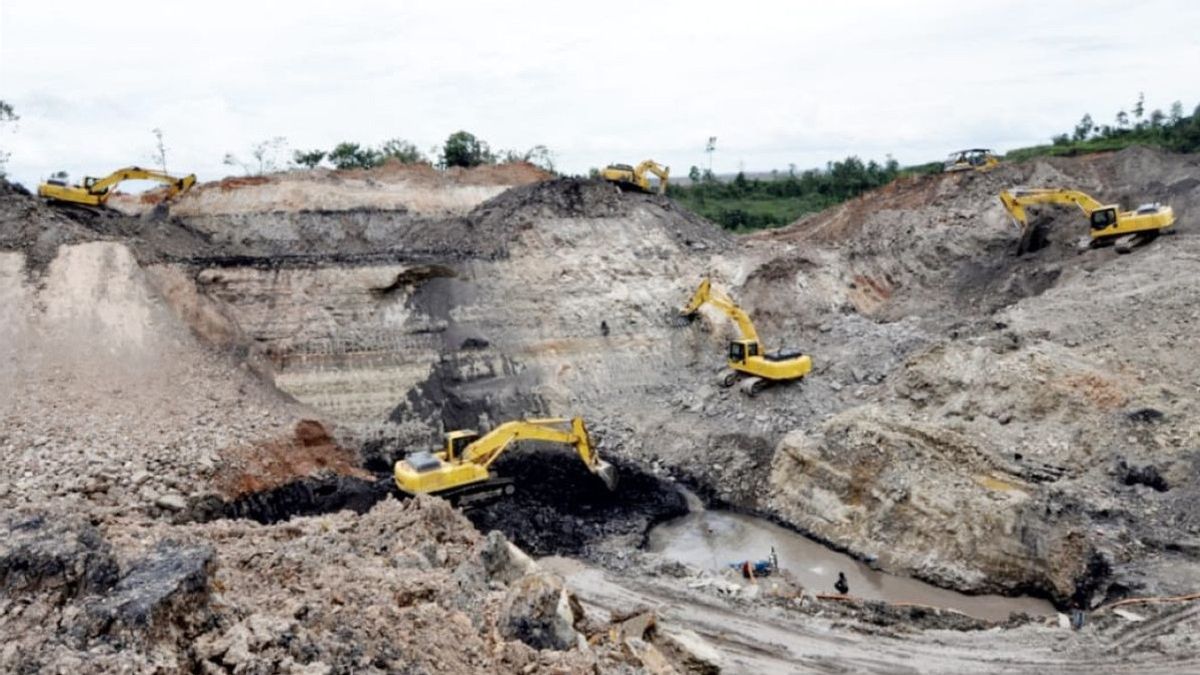


JAKARTA - The Muhammadiyah Central Board (PP) has initiated several articles in the Revision of the Mineral and Coal Law (Minerba) which is currently being discussed by the DPR.
Representative of PP Muhammadiyah, Syahrial Suwandi said, Muhammadiyah was actually trying to respond positively to what had been prepared by the government, namely providing a mining concession to mass organizations.
However, he admitted, there were many articles that Muhammadiyah questioned.
First, related to Article 17A paragraph 2, which states that the Central and Regional Government guarantees that there will be no changes in the use of space and areas as long as it does not conflict with statutory provisions.
As one of the mining business actors, Syahrial admitted that this was not in accordance with the reality in the field.
"We see this, conflicts between laws and regulations often occur, especially mines with forestry, with the environment, agriculture, spatial planning. I see that there needs to be synchronization between this mining-related law," he said at a Plenary Meeting with the Legislation Body of the DPR, Wednesday, January 22.
He continued, business entities belonging to mass organizations also need to be given a clear understanding regarding the meaning of people's mines.
Syahrial admitted that findings in the field often made mistakes between people's mines and mines on behalf of the people
"It is difficult for us to distinguish people's mines from mines on behalf of the people who are actually illegal," he continued.
Furthermore, Syahrial also criticized Article 51A paragraph 2 point B of the draft Minerba Bill which provides mining concessions to universities with a minimum accreditation B.
He assessed that not all universities have a mining and Geological Study Program.
"Even if you have a mining and geological study program, not all of them have the best accreditation," continued Syahrial.
Then Article 51B of the draft Minerba Bill which is considered to provide a Special Mining Business Permit Area (WIUPK) priority to private business entities in Indonesia.
According to him, the WIUPK should be handed over to state-owned companies.
"Why is that? It is handed over to the private sector, especially since PMA also owes debt to the bank later. I think this is our thought," he said.
He continued, the next article is Article 169A paragraph 5 of the draft Minerba Bill regarding IUP holders as a continuation of contract operations or agreements for coal mining commodities that have carried out mining obligations given an extension for 10 years every extension.
"In our opinion, we need to try to see if the length of the mine has expired or the age of the contract or agreement given by the government. Because if we look here there is no limit on when he will be, the important thing is that he proposes an extension to how far the evaluation is, we both understand. So if we think there needs to be restrictions there," said Syahrial.
SEE ALSO:
-
 | EKONOMI
Temui Baleg, PBNU Kembali Tegaskan Tidak Pernah Minta Konsesi Tambang ke Pemerintah
22 Januari 2025, 15:05 -
 | EKONOMI
Bukan DME, PTBA Fokus Kembangkan Hilirisasi Batu Bara jadi Bahan Baku Baterai
22 Januari 2025, 13:31

Finally, he also asked for further studies related to Article 133D of the draft Minerba Bill regarding the overlap of previously applicable laws on Mining Business Permits (IUP) which were revoked and returned to the state.
"Because this overlap problem has become a problem that has been a long time until now there has been no best solution," said Syahrial.
The English, Chinese, Japanese, Arabic, and French versions are automatically generated by the AI. So there may still be inaccuracies in translating, please always see Indonesian as our main language. (system supported by DigitalSiber.id)
Most Popular Tags
#Prabowo Subianto #donald trump #firearm #8791 #giias 2026Popular


