
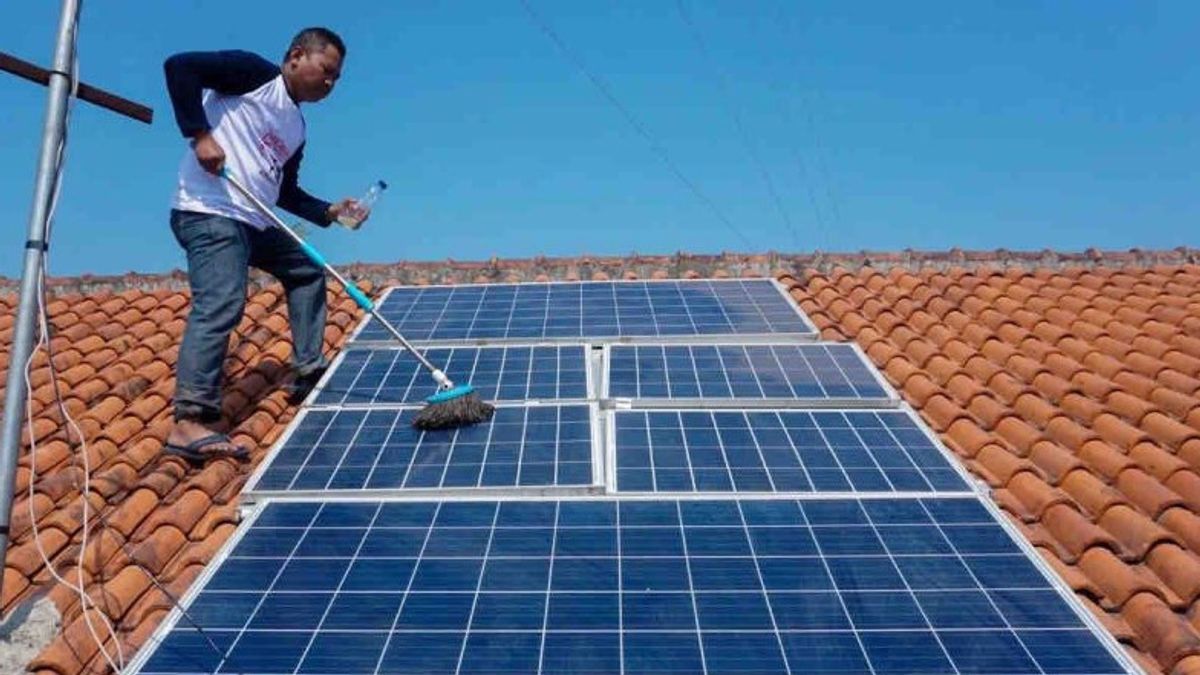


JAKARTA - The Indonesian Chamber of Commerce and Industry (Kadin) encourages MSMEs to make a transition to clean energy, which is environmentally friendly, considering that these business sector activities contributed to greenhouse emissions of up to 216 million tons of CO2 during 2023.
Chairman of the Energy Transition Working Group as well as Chairman of the Indonesian Chamber of Commerce and Industry's Energy, Renewable, and Energy Conservation Committee Anthony Utomo said that Indonesia had only used about 14 percent of the potential for renewable energy.
Currently, there is still a lot of potential for new and renewable energy (EBT), especially power plants that have not been utilized. Of the 3,686 gigawatts of Indonesia's renewable energy resources, its utilization has only reached 13.7 gigawatts.
Among the sectors that will be the motor for the future energy transition is MSMEs. Currently, there are around 65 million MSMEs in Indonesia that contribute up to IDR 9,580 trillion or the equivalent of 91 percent of gross domestic product (GDP) and absorb 97 percent of the total workforce.
"MSMEs have an important role in accelerating the energy transition because they not only support the development of clean energy, but also contribute to economic growth and job creation," said Anthony, quoted from Antara, Friday, December 13.
However, there is still a gap in the transition process to clean energy among MSMEs. So far, many small businesses do not understand business practices based on sustainability principles.
Data from Indonesia Energy Transition Outlook 2024 noted that greenhouse gas emissions produced from MSME activities in 2023 reached 216 million tons of CO2. Limited access to funding and education is one of the main challenges that hinder MSMEs in transition to the use of clean energy.
"Kadin will continue to encourage MSMEs to carry out a clean energy transformation through energy efficiency campaigns, appropriate application of technology, policy support and regulation as well as education and training," said Anthony.
Meanwhile, Deputy Chairperson of the Indonesian Chamber of Commerce and Industry's ESDM, Aryo PS Djojohadikusumo, emphasized that Kadin's long-term vision for the ESDM sector is to create sustainable and inclusive national energy resilience, including its use in the MSME sector.
"The sector is one of the important motorbikes in the national economy," said Aryo.
Therefore, it is necessary to process the transformation of bureaucracy and regulations to support the investment climate and the development of clean energy, especially clean energy-based power plants.
"The more supply and certainty of critical renewable energy plants to encourage the achievement of the 8 percent economic growth target," said Aryo.
Especially for MSMEs, fiscal policy support and incentives for those who use clean energy are also very important as a stimulus for accelerating the transition process.
According to Aryo, MSMEs together with the industrial sector that use clean energy will be an important pillar for the development of a low-carbon green economy in Indonesia.
In line with, the Chairman of the Standing Committee for Strategic Plans and Institutions for ESDM Kadin M Maulana added that innovation and policy support from the government are the keys to ensuring that the use of clean energy meets the economic scale needed by the MSME sector.
SEE ALSO:

"MSMEs are one of the sectors that are sensitive to prices so that the existence of affordable clean energy will be very important," he said.
Therefore, it is very important to build sustainable cooperation between the government and the private sector to explore the potential for clean energy that can be developed. Innovative technology must be combined with investment, bureaucratic and regulatory transformation and incentive support both fiscal and non-fiscal.
"Incentives should be given to those who develop and users. That way, there will be acceleration of the use of clean energy from upstream to downstream, from producers to consumers," said Maulana.
The English, Chinese, Japanese, Arabic, and French versions are automatically generated by the AI. So there may still be inaccuracies in translating, please always see Indonesian as our main language. (system supported by DigitalSiber.id)
Most Popular Tags
#Prabowo Subianto #donald trump #Febrie Adriansyah #8791 #giias 2026Popular


