

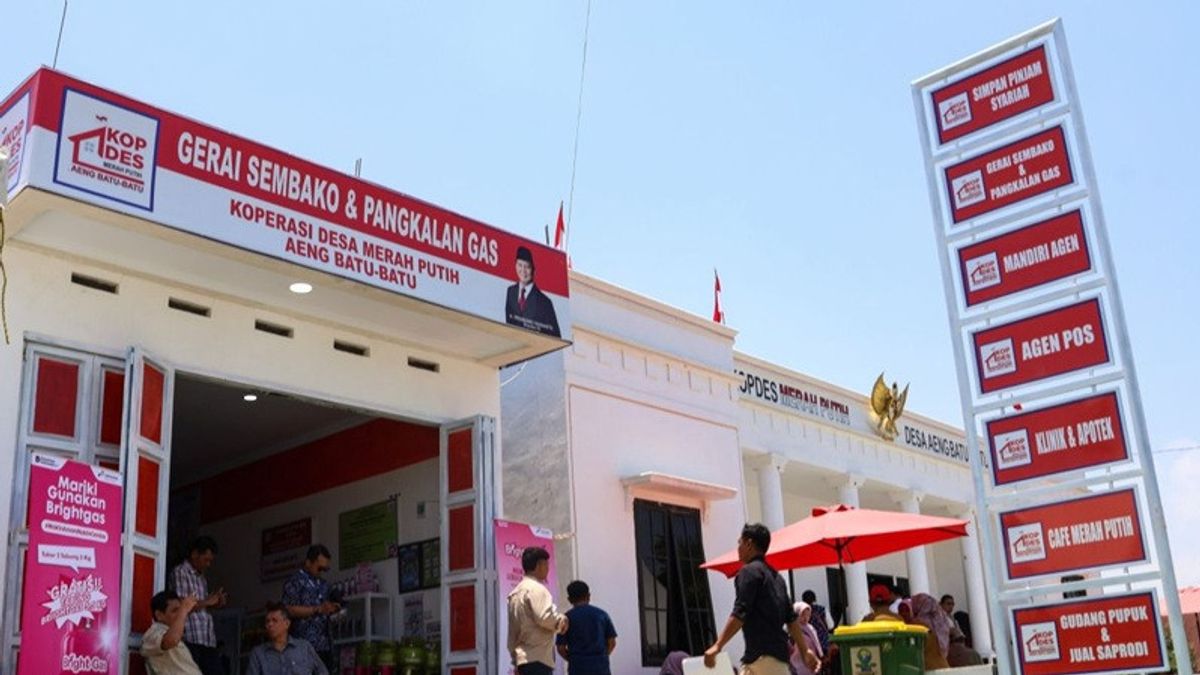


JAKARTA - The Chairman of the Strategic Socio-Economic Kader Association (AKSES), Suroto, assessed that the issue involving the closure of a number of Alfamart and Indomaret outlets with the existence of the Red and White Village / Village Cooperative (KDKMP) was not appropriate. According to him, the issue is more related to violations of zoning rules, spatial planning, to alleged monopoly practices.
Suroto said that modern retail networks such as Alfamart and Indomaret have grown so massively that they have reached alleys and rural areas. The number of outlets for the two companies is said to have exceeded 40 thousand outlets in various areas.
In fact, he said, the Regulation of the Minister of Trade Number 18 of 2022 regulates the ownership of outlets by one company a maximum of 150 outlets. In addition, the existence of modern retail outlets must also comply with the zoning and spatial regulations set by the local government.
"Spatial arrangement and monopoly prohibitions are legal mandates to protect the public and create economic justice," Suroto said in a statement, Thursday, May 28.
He explained that the zoning rules were created to provide living space for traditional shops and non-network retail businesses so that they can continue to develop in the midst of the expansion of the modern market. According to him, a similar policy is also strictly implemented in a number of developed countries in Europe and the United States.
In addition, Suroto alluded to Law Number 5 of 1999 concerning Prohibition of Monopoly Practices and Unhealthy Business Competition. The regulation, he continued, aims to prevent the dominance of large capital business actors that have the potential to harm the community.
"If left unchecked, large business actors can determine prices, direct patterns of public consumption, and even shut down small businesses. Even at a certain level, it is able to influence and buy the rules of the market itself," he said.
In his statement, Suroto also explained that the KDKMP was formed as a distribution channel for people's basic needs that are directly connected to manufacturers or product principals. The cooperative is also directed to become a distribution channel for various government subsidized goods, such as melon gas, SPHP rice, Minyakita, fertilizer, seeds, medicines, and other needs so that they are targeted, priced correctly, and of the right quality.
According to him, the existence of KDKMP aims to create market balance as well as a tool for correcting monopolistic practices and the dominance of large businesses.
He added that all businesses run by KDKMP, including minimarket outlets, are owned by the local village or neighborhood community. Thus, the community is considered to be able to directly control the course of the business and enjoy the economic benefits.
Suroto gave an example of the NTUC FairPrice cooperative in Singapore which managed to become the dominant chain of minimarkets and had a large market share compared to many private retailers. The cooperative, which initially only operated in the minimarket sector, has now expanded into various other sectors, such as finance, construction, and transportation services.
They are growing rapidly because people realize that joint ownership of economic enterprises is the most effective way to correct the market while protecting people's lives from the dominance of mafia cartels that are only oriented towards profit and the accumulation of wealth for a few people.
Therefore, Suroto emphasized that the KDKMP is actually an instrument of public control over the market, which has been dominated by large conglomerates. When this program began to be built, Suroto assessed that the presence of the program had the potential for many parties to feel disturbed, including some bureaucrats who are accustomed to providing various special facilities to certain large business groups.
The English, Chinese, Japanese, Arabic, and French versions are automatically generated by the AI. So there may still be inaccuracies in translating, please always see Indonesian as our main language. (system supported by DigitalSiber.id)
Most Popular Tags
#Prabowo Subianto #donald trump #2026 World Cup #Febrie Adriansyah #8791Popular


