

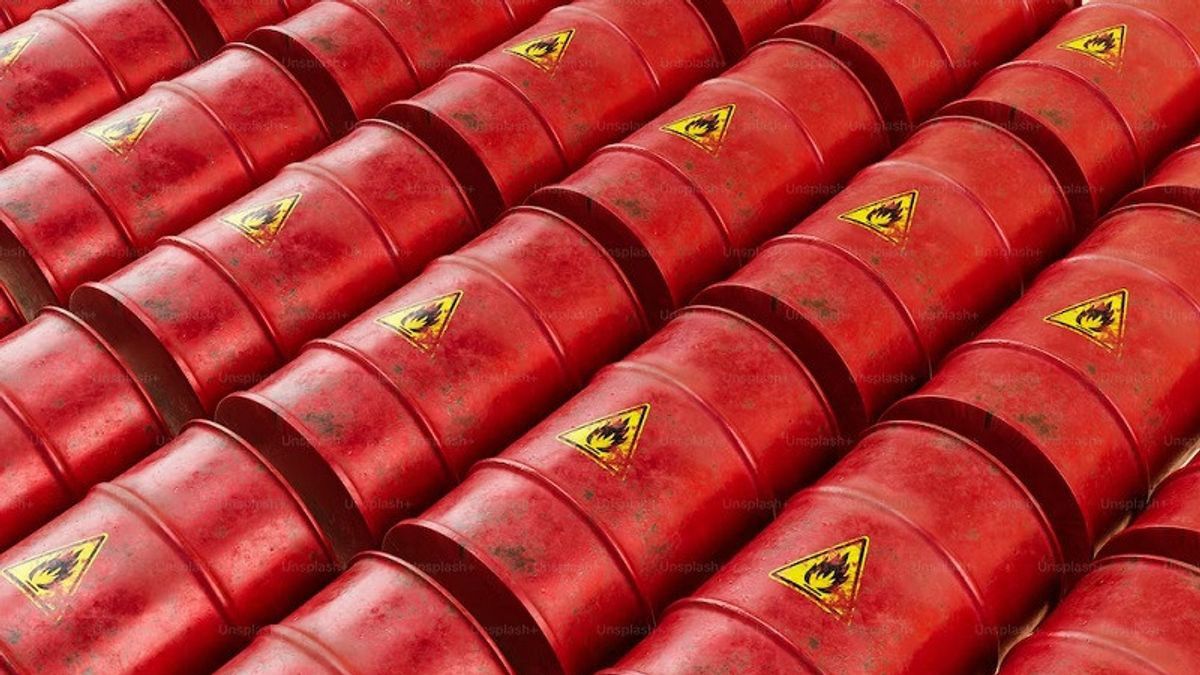


JAKARTA - Oil prices fell and world stock markets strengthened amid hopes for a de-escalation of the conflict in the Middle East. The Guardian, quoted Thursday, March 26, reported that market sentiment was driven by news that the United States sent a 15-point peace framework to Iran.
Market strengthening was also triggered by Iran's statement allowing "non-hostile" ships to pass through the Strait of Hormuz. This narrow strip is vital because it is used by about 20 percent of the world's energy supply. Therefore, any signal of easing is immediately read by the market as an opportunity to ease supply pressure.
On Wednesday, March 25 in the early hours, the price of Brent crude fell 4 percent to below US$100 per barrel. However, prices then rose slightly and remained in the US$100 range throughout the day. Markets move quickly, but political certainty is not really there.
Tehran denies having held talks with Washington since the war broke out. That's why market strengthening is more based on hopes for peace, not on the results of negotiations that are certain.
Even so, the global market remains bright. The Japanese Nikkei closed up 2.9 percent and the Hong Kong Hang Seng added a little over 1 percent. In Europe, the FTSE 100 in London rose 1.4 percent, the German DAX rose 1.3 percent, and the French CAC 40 added about 1.3 percent. In the United States, the Nasdaq rose 0.7 percent, while the S&P 500 and Dow Jones each gained about 0.6 percent.
The disruption in Hormuz itself has not subsided. The International Energy Agency called Iran's de facto closure the largest oil supply disruption ever. Data from S&P Global, quoted by The Guardian, showed that only four ships were recorded crossing on Tuesday, March 24, far below the daily average of 138 ships before the war.
The impact also spread to food. One-third of the world's fertilizer supply passes through the Strait of Hormuz. The WTO warns that disruptions in fertilizer supplies could put pressure on global food production, cut harvests, and push prices up.
Market turmoil has also pressured gold, which has been considered a safe asset. Reported by The Guardian, after surviving the early days of the war, gold prices fell about 13 percent to US$4,550 per ounce, after previously breaking through US$5,000 per ounce in January. At the same time, BlackRock CEO Larry Fink warned that a prolonged conflict could push oil prices to US$150 per barrel and trigger a global recession.
The English, Chinese, Japanese, Arabic, and French versions are automatically generated by the AI. So there may still be inaccuracies in translating, please always see Indonesian as our main language. (system supported by DigitalSiber.id)


