


JAKARTA - The Deposit Insurance Corporation (LPS) has begun separating the recording and financial reporting between the conventional and sharia systems. This step is taken to strengthen transparency and provide certainty for sharia banking customers regarding the management of guarantee funds.
Director of the LPS Group Relations. Nur Budiantoro said that the separation includes premium sources, fund management, to the use of funds for claims payment. With this scheme, funds originating from sharia banks will be managed and used in accordance with sharia principles.
"This year LPS separates our financial statements, our accounting has been separated between conventional and sharia. This is an effort from LPS to give confidence to customers, especially in the experience of sharia banking," said Nur Budiantoro in a Financial Literacy and Breaking Fast Workshop with the Jakarta Economic Journalist Club at the Arcici Hotel, Cempaka Putih, Jakarta, Saturday, March 14.
Nur Budiantoro explained that LPS has guaranteed customer deposits in all banks in Indonesia, both conventional banks and sharia banks. When a bank fails, LPS will pay the deposit guarantee claim to customers who meet the requirements.
"If we pay the guarantee claim for a sharia bank or BPRS, it is natural for the customer to demand the money received is also purely sharia and not mixed. That's why LPS has started this year to separate the accounting between conventional and sharia," said Budiantoro.
He added that the insurance premium paid by the bank was also recorded separately. Premiums from conventional banks will be included in the conventional portfolio, while premiums from Islamic banks are managed in a sharia scheme and placed in instruments that comply with sharia principles.
With this scheme, the payment of guarantee claims for sharia bank customers will also use funds sourced from sharia premiums. According to Nur, this step provides certainty that the funds received by sharia bank customers remain in accordance with sharia principles.
In addition to guaranteeing deposits, LPS also has a verification mechanism before paying the guarantee claim. Nur explained, there are three main requirements known as 3T, namely deposits recorded in the bank's books, interest rates do not exceed the LPS guarantee interest rate, and are not indicated to commit criminal acts that are detrimental to the bank.
"For Islamic banks, the interest rate provision does not apply because in the Sharia system there is no concept of interest. The principle is profit sharing and fairness in transactions," said Nur.
For information, LPS guarantees deposits of up to IDR 2 billion per customer per bank. Guaranteed deposits include current accounts, savings, and deposits, both in conventional banks and sharia banks with wadiah and mudharabah contracts.
Currently, all banks in Indonesia are required to become participants in LPS guarantees. LPS data shows that the number of participants in the guarantee reaches 1,605 banks in 2025, consisting of 105 commercial banks as well as around 1,500 BPR and BPRS.
On this occasion, Nur Budiantoro also highlighted the rapid development of Islamic economics in Indonesia. According to him, Islamic economics is basically an economic practice that is not contrary to the principles of sharia, such as justice, transparency, and the prohibition of riba and speculation practices.
He explained that the adoption of the Sharia economy generally develops through three stages, namely for religious reasons, then becomes a lifestyle, until finally it is chosen because it is considered to provide economic benefits for business actors and the community.
The development of the Islamic finance industry is also supported by the consolidation of the banking sector. The merger of a number of sharia banks has significantly increased the industry's assets.
In addition, the Islamic capital market also showed positive performance. The price of shares included in the Indonesian Sharia Stock Index (ISSI) was recorded to have grown by 43.11 percent in 2025, higher than the increase in the Composite Stock Price Index (JCI) which reached 22.13 percent.
The Chairman of the Jakarta Economic Journalists Club (KJEJ) Windarto said that this financial literacy workshop activity was an important discussion space for economic journalists to understand Sharia financial issues more comprehensively.
According to Windarto, this increase in literacy is important so that news about Islamic economics can be conveyed more accurately to the public.
"The issue of Islamic economics continues to grow and requires a strong understanding from economic journalists. Activities like this help journalists understand the deposit guarantee system and the development of the Islamic financial industry more fully," said Windarto.
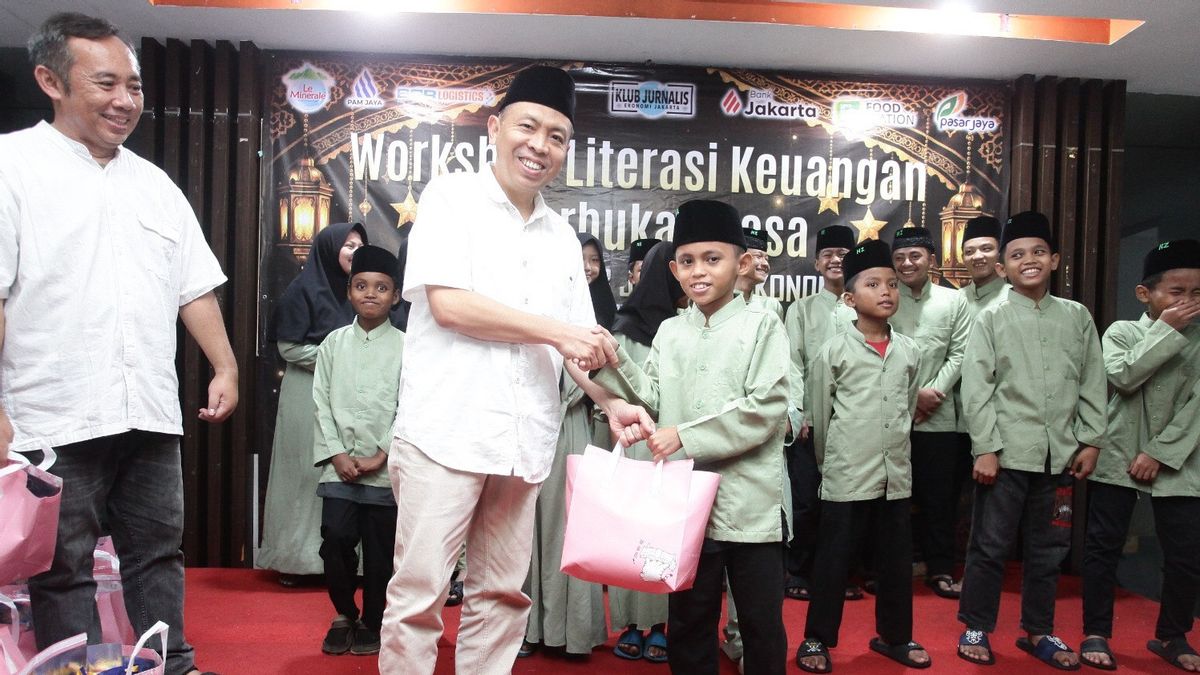
The Financial Literacy and Breaking the Fast Workshop with the Jakarta Economic Journalist Club was also filled with the provision of assistance to orphans. This event is part of efforts to strengthen financial literacy as well as sharing in the month of Ramadan.
This activity is supported by Le Minerale, PAM Jaya, BGR Logistics, LPS, Bank Jakarta, Food Station, and Pasar Jaya.***
The English, Chinese, Japanese, Arabic, and French versions are automatically generated by the AI. So there may still be inaccuracies in translating, please always see Indonesian as our main language. (system supported by DigitalSiber.id)
Popular


