

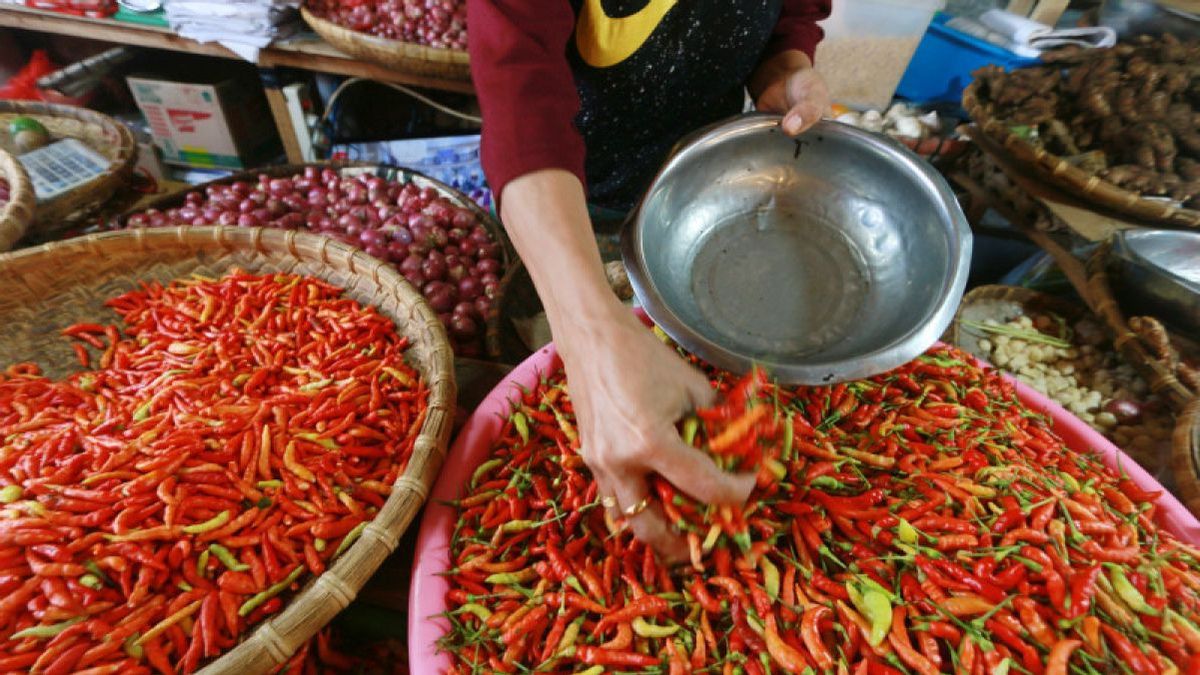


JAKARTA - The price of chili at Jatinegara Market, East Jakarta, ahead of the holy month of Ramadan has started to rise, especially for the type of cayenne pepper.
"Ahead of Ramadan, the price of red chilies has started to rise, up to Rp. 70 thousand per kilogram (kg)," said one of the traders of chili and onions named Endah (65) at Jatinegara Market, East Jakarta, quoted by Antara.
He said that the increase in the price of sweet peas had occurred in recent times. At the end of 2025, the price of sweet peas is still around Rp. 35-40 thousand per kg.
"Yes, it's usually like that. If it's Ramadan, many people will go up, it could be doubled or go up by a certain percentage. The increase can also go up immediately, or go up slowly," said Endah.
According to him, the increase in the price of sweet peas was allegedly influenced by the supply which began to decrease from the producing area.
Weather conditions and distribution are also said to be one of the factors that affect the availability of commodity stocks in the market.
In addition, Endah said that this condition is different from other types of chili which actually experienced a decrease.
The price of curly chili and large red chili is observed to be relatively lower. Currently, both types of chili are sold at a price of IDR 35 thousand per kg.
This price is down compared to last year which was in the range of Rp50-60 thousand per kg.
"Curly chilies have even gone down, now Rp. 35 thousand. Big red chilies are also Rp. 35 thousand. Whereas before it was Rp. 50 thousand and above," said Endah.
Apart from chili, one of the onion traders at Jatinegara Market, namely Rohmiati (50), said that the price of onions was still stable ahead of Ramadan.
Garlic is sold at Rp40 thousand per kg, while onions are at Rp50 thousand per kg.
"The price of onions is still normal, there has been no increase so far," said Rohmiati.
Although the price of rawit chili has started to rise, people's shopping activities ahead of Ramadan have not experienced a significant increase.
Traders admit that until now, buyers are still relatively quiet compared to previous years.
"Usually, if you want Ramadan, it has started to be crowded, now it is still quiet," said Rohmiati.
Traders also hope that the increase in chili prices will not continue until entering the fasting month.
They also hope that the government can maintain the smooth distribution and supply of food so that prices remain stable and affordable for the public.
Monitoring at Jatinegara Market this morning showed that most of the stalls were still operating normally.
However, the fluctuation in chili prices is a major concern, considering that the commodity is one of the main ingredients that are most widely used by the community in daily needs.
Previously, the Governor of DKI Jakarta Pramono Anung Wibowo ensured that food stocks in Jakarta were safe ahead of the Chinese New Year and Ramadan until Eid al-Fitr 1447 Hijriah.
He admitted that he continued to communicate with the heads of food producing regions in a number of regions that have been supplying food to the capital.
"I always communicate with heads of food producing regions throughout Indonesia who supply them to Jakarta for food matters. Hopefully, welcoming Chinese New Year, fasting, and Eid, the food problem in Jakarta will not be a problem, including meat," said Pramono, Tuesday (3/2).
He revealed that currently, the DKI Jakarta Provincial Government has prepared food stocks for the Imlek religious holiday to the upcoming Eid al-Fitr.
The English, Chinese, Japanese, Arabic, and French versions are automatically generated by the AI. So there may still be inaccuracies in translating, please always see Indonesian as our main language. (system supported by DigitalSiber.id)


