



JAKARTA - The Indonesian Ceramic Industry Association (Asaki) complained about disruptions in the supply of raw materials in the form of clay and feldspar. The majority of raw materials for national ceramic production come from West Java Province (Jabar).
Asaki Chairman Edy Suyanto revealed that West Java-Banten is a region rich in clay and feldspar, so that about 60 percent of the ceramic industry is produced in West Java.
However, since the fourth quarter of 2025, there has been a supply disruption, because there is a suspension and moratorium on mining permits by the West Java Regional Government (Pemda).
Not only for the ceramics industry, Edy emphasized, clay will be very needed by the tile industry to support the gentrification project that has been announced by President Prabowo Subianto.
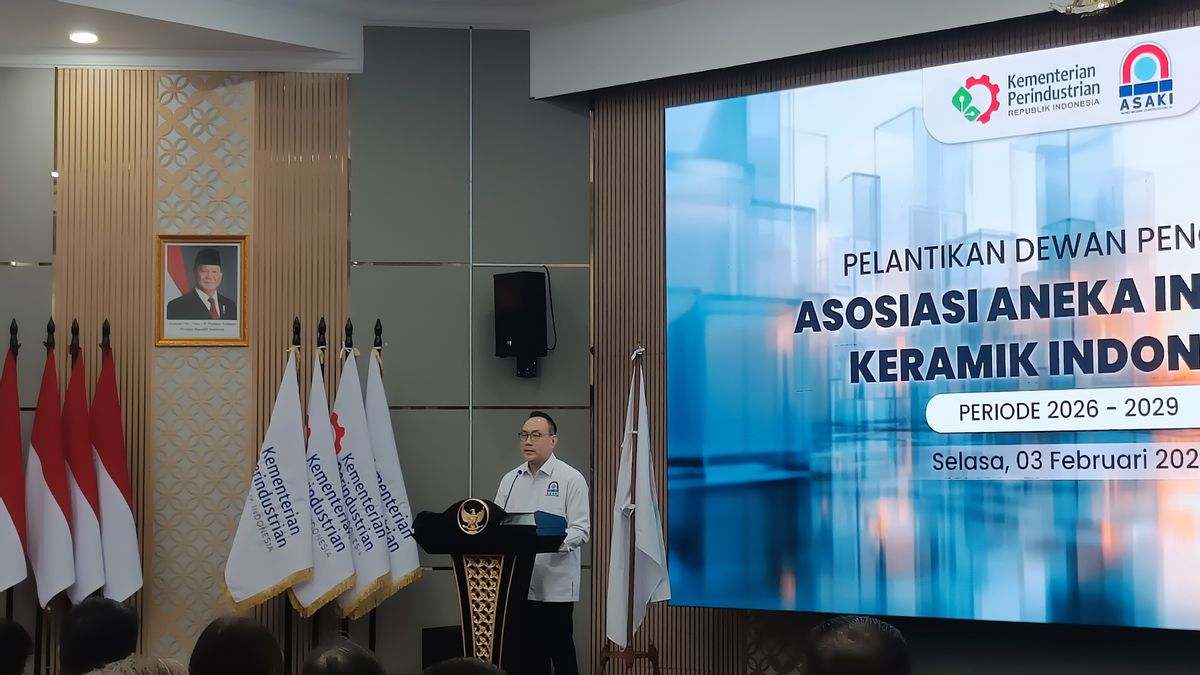
"Because here (West Java-Banten) the raw materials are available, we certainly hope that there will be an immediate solution from the West Java Government, so that this production process is not hampered," said Edy when met by reporters after the inauguration of the Board of Directors of the Indonesian Ceramic Industry Association (Asaki) Period 2026-2029 at the Ministry of Industry office, Jakarta, Monday, February 3.
To note, West Java supplies about 60 percent of the raw materials for the ceramics industry. With the disruption of supplies in West Java, Edy said, a number of Asaki member companies are looking for sources of raw materials in other regions. Sumatra is the destination, especially in Bangka and Belitung.
"Of course this adds costs, because the distance is very far. We also heard that there are not many deposits there. What we care about is that the market is there, the material is there, but one day we have to import raw materials, especially from neighboring countries, Malaysia," he said.
Responding to this, on the same occasion, the Minister of Industry (Menperin) Agus Gumiwang Kartasasmita admitted that he had contacted the Governor of West Java who was familiarly called Kang Dedi Mulyadi (KDM).
Agus also asked the ceramic industry mentor, namely the Directorate General of Chemical, Pharmaceutical and Textile Industries (IKFT) of the Ministry of Industry to immediately communicate to find a solution with the West Java Provincial Government.
"I tried to call KDM, but he was not picked up, I have WA (WhatsApp). I gave instructions to IKFT to immediately approach the West Java Provincial Government. Find out what the problem is, they must have a reason, but there must also be a way out so that the ceramic industry does not have difficulty in obtaining raw materials," he said.
In addition to the disruption of raw materials in the form of clay and feldspar, Asaki also highlighted the challenges from the side of industrial gas supply. Edy said, the trend in industrial gas prices in Indonesia continues to increase. He also highlighted the decrease in the Allocation of Certain Industrial Gas (AGIT) in the Certain Natural Gas Price (HGBT) policy.
Edy revealed that the allocation of HGBT industrial gas supply in West Java decreased from around 75 percent in 2024 to 60-65 percent in 2025. Meanwhile, the allocation in East Java is only around 50-55 percent. "Of course this is very disturbing for the competitiveness of the ceramic industry," he said.
With AGIT 60-65 percent, Edy described the average gas cost in West Java at around 9.5 US dollars per million British thermal units (MMBTU). Meanwhile, the average price in East Java is around 9.5-10 US dollars per MMBTU.
According to Edy, the average cost is actually still balanced with neighboring countries such as Malaysia at around 9.6 US dollars per MMBTU and Thailand at 9.9 US dollars per MMBTU. Only, he saw the opposite trend. In Indonesia, the trend of gas prices is getting more expensive, while in other countries it is getting cheaper.
"However, we see a trend. The trend in gas prices in Malaysia every year has decreased. They were above 10 US dollars, this is decreasing. Likewise in Thailand. On the other hand, with us as a gas producing country, but the gas price every year has increased. This is our hope, the government should make the availability of gas for domestic industries a top priority," he explained.
Furthermore, Edy also highlighted the disruption of industrial gas supply in East Java at the beginning of this year. According to him, the gas supply disruption has occurred since January 17, 2026. From information conveyed by the State Gas Company (PGN) to the industry, Edy said, the new supply disruption will be completed on February 5, 2026.
The disruption in supply has caused a number of ceramic manufacturers to temporarily stop production. Even so, Edy ensured that this disruption in the supply of industrial gas did not lead to housing or layoffs in the ceramic industry.
"We are also sorry, don't let us do employee housing when we want to celebrate Eid (Idulfitri), so we are maintaining even though the factory stops production. However, there is no housing until today. However, we certainly ask that this does not drag on," he concluded.
The English, Chinese, Japanese, Arabic, and French versions are automatically generated by the AI. So there may still be inaccuracies in translating, please always see Indonesian as our main language. (system supported by DigitalSiber.id)
Popular


