

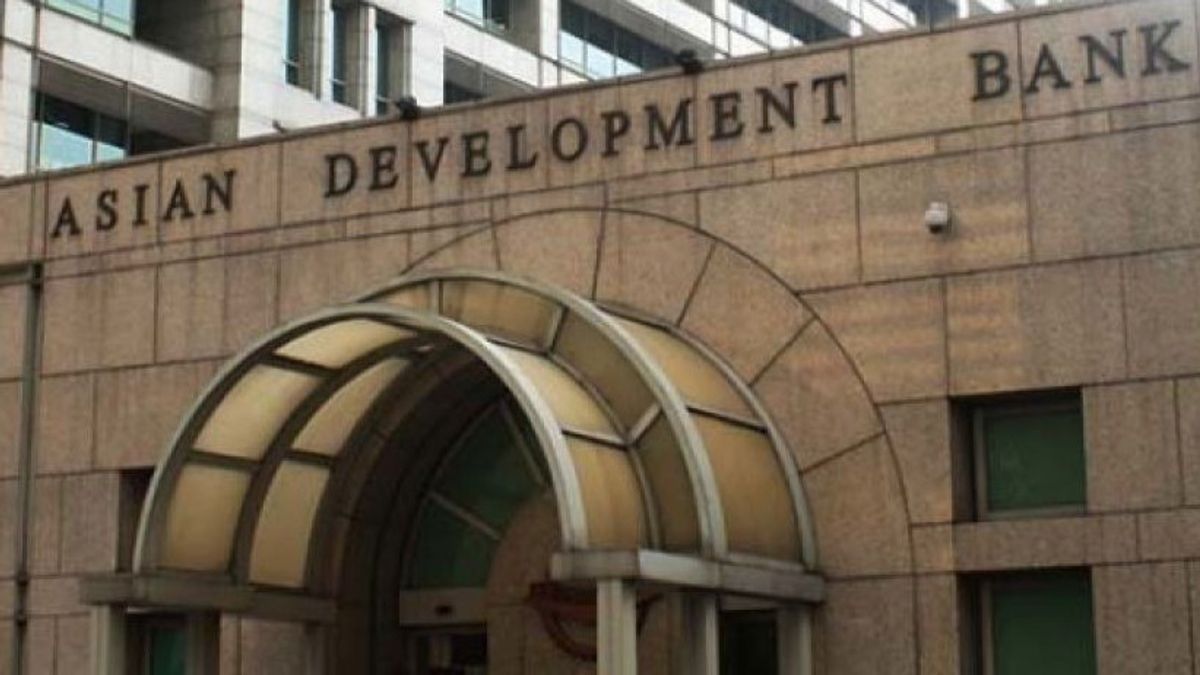


JAKARTA - The Asian Development Bank (ADB) is increasing its projected economic growth for developing Asian countries and the Pacific region this year and next year.
The revision was triggered by export performance that was stronger than expected and easing trade uncertainty after several trade deals were reached with the United States.
ADB chief economist Albert Park conveyed that solid export performance, especially in the semiconductor sector and technology products coupled with declining inflation and stable financial conditions, are the main factors for strengthening the growth projection.
In addition, he added that driven by India's growth which far exceeds expectations, the regional economy is now predicted to grow 5.1 percent this year, up from its previous projection of 4.8 percent in the September report.
For next year, ADB will also increase its projection by 0.1 percentage points to 4.6 percent, as stated in the December 2025 edition of the Asian Development Outlook (ADO).
The solid Fundamental economy of Asia and the Pacific supports strong export performance and steady growth, although the global trade environment has been less supportive of the tremendous uncertainty this year," he said in a statement, Thursday, December 11.
He said trade agreements could indeed reduce some of these uncertainties, but external risks remain.
"The government in this area must continue to support open trade and investment in order to maintain resilience and growth," he said.
ADB said a number of risks could suppress regional economic prospects, including increased trade tensions, financial market volatility, geopolitical pressure, and weakening property markets in the People's Republic of China (RRT) which are potentially more severe than expected.
For the RRT, this year's projected economic growth was increased to 4.8 percent from the previous 4.7 percent, driven by strong exports and implementation of fiscal stimulus.
Meanwhile, the projection for 2026 remains at the level of 4.3 percent.
India's growth projection in 2025 was also revised to 7.2 percent, or 0.7 percentage points higher than previously estimated, this increase reflects the strong growth in the third quarter which was helped by tax cuts that boost consumption, while forecasts for 2026 remain at 6.5 percent.
For the Kaukasus and Central Asia regions, ADB increased its projection this year to 5.8 percent from 5.5 percent, thanks to the government's strong investment, increased remittance, and solid domestic demand.
Southeast Asia's growth this year was also revised to increase by 0.2 percentage points to 4.5 percent, reflecting the strong performance of the third quarter in Indonesia, Malaysia, Singapore and Vietnam.
SEE ALSO:
-
 | EKONOMI
Tindak Tegas! Bea Cukai Amankan Kontainer Berisi Bermuatan Garmen Ilegal
11 Desember 2025, 09:19 -
 | EKONOMI
Rupiah Diprediksi Menguat di Tengah Pelemahan Dolar AS dan Dinamika Kebijakan The Fed
11 Desember 2025, 08:40 -
 | EKONOMI
IHSG Kamis Berpeluang Bergerak di Kisaran 8.625–8.750, Simak Rekomendasi Sahamnya
11 Desember 2025, 07:07
Sementara itu, proyeksi kawasan Pasifik tetap tidak berubah untuk tahun ini dan tahun depan, masing-masing pada 4,1 persen dan 3,4 persen.
Adapun inflasi di kawasan Asia berkembang dan Pasifik diperkirakan turun ke 1,6 persen pada tahun ini, sedikit lebih rendah dari estimasi sebelumnya 1,7 persen, terutama karena inflasi pangan di India lebih rendah dari perkiraan, serta untuk tahun depan, ADB mempertahankan proyeksi inflasi di 2,1 persen.
SEE ALSO:
-
| EKONOMI
Tindak Tegas! Bea Cukai Amankan Kontainer Berisi Bermuatan Garmen Ilegal
11 Desember 2025, 09:19 -
| EKONOMI
Rupiah Diprediksi Menguat di Tengah Pelemahan Dolar AS dan Dinamika Kebijakan The Fed
11 Desember 2025, 08:40 -
| EKONOMI
IHSG Kamis Berpeluang Bergerak di Kisaran 8.625–8.750, Simak Rekomendasi Sahamnya
11 Desember 2025, 07:07
Meanwhile, Pacific projections remain unchanged for this year and next year, at 4.1 percent and 3.4 percent, respectively.
Meanwhile, inflation in the Asian region is developing and the Pacific is expected to fall to 1.6 percent this year, slightly lower than the previous estimate of 1.7 percent, mainly as food inflation in India is lower than expected, and for next year, ADB retains inflation projections at 2.1 percent.
The English, Chinese, Japanese, Arabic, and French versions are automatically generated by the AI. So there may still be inaccuracies in translating, please always see Indonesian as our main language. (system supported by DigitalSiber.id)


