

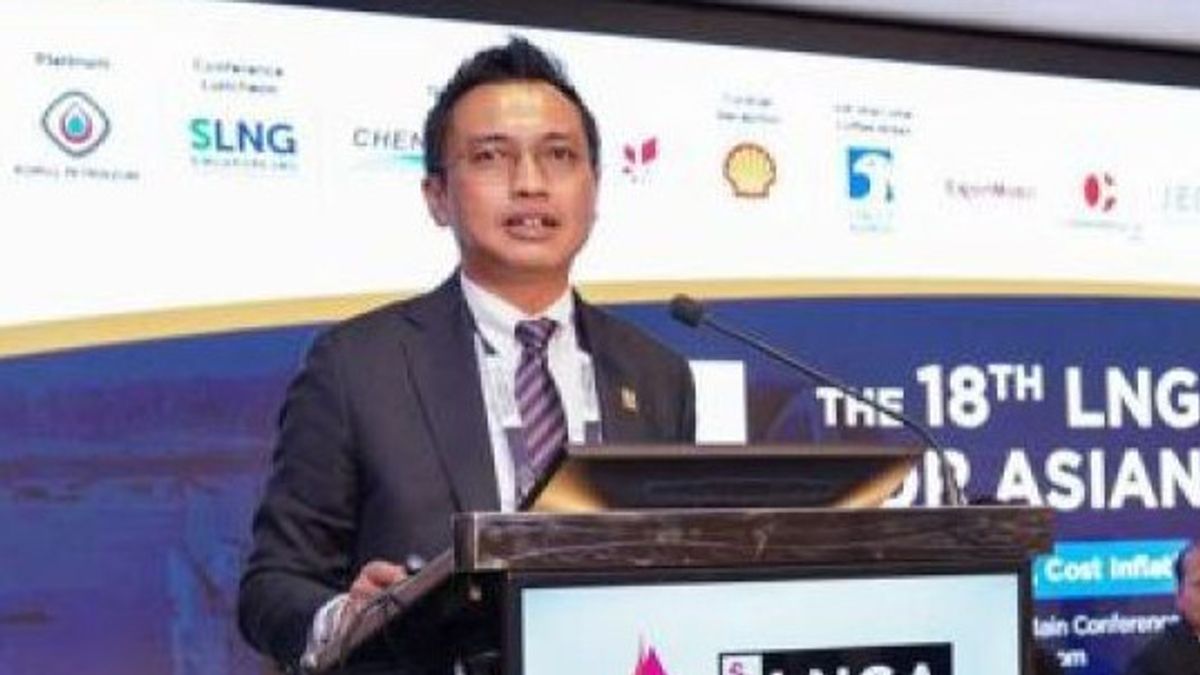


JAKARTA - PT PLN Energi Primary Indonesia (PLN EPI) opens opportunities for collaboration with business people in blaspheming together with LNG, CNG, Bioenergy facilities, and fuel storage facilities.
"Coal coal will develop from 74 million tons in 2023 to nearly 100 million tons this year. For gas, we manage about 1.2 billion standard cubic feet per day in 2023 and next year it has the potential to reach 1.4 billion cubic feet standards per day including 104 LNG cargoes," said PLN President Director EPI Rakhmad Dewanto, Tuesday, December 2.
"It's okay"
In addition to coal and gas, PLN EPI is also developing clean energy.
According to Rakhmad, the new product that grows fast is bioenergy.
"This year our supply reaches almost 2.6 million tons of bioenergy, and next year we hope to approach 3.7 million tons," said Rakhmad.
Judging from the demand, the national energy demand is estimated to grow by around 2 percent per year until 2035.
The electricity sector is the biggest driver with an average growth projection of 5.3 percent per year, driven by electrification and soaring electricity needs from data centers, industrial estates, to electric vehicles.
Although new renewable energy will increase dramatically, gas and coal will continue to play a dominant role in the generating energy mix for the next decade.
"Gas will grow an average of 4'6 percent per year and bioenergy will grow an average of 15'17 percent per year. All primary energy in the industry increases except for oil," continued Rakhmad.
"It's okay"
In line with this projection, PLN EPI opens business opportunities for investors and industrial partners. In the fuel sector, PLN Group's tank capacity reaches 800 thousand kiloliters throughout Indonesia but only around 45 percent is utilized and is expected to continue to decline with de-dieselized and gasification programs.
"We offer a cooperation scheme for the utilization of idle tank capacity, both for industrial needs and trading," he said.
The next opportunity is joint use of gas infrastructure. PLN EPI is currently building a midstream LNG network in the Nias cluster, Sulawesi Maluku, Nusa Tenggara, to North Papua.
This infrastructure is designed to lower midstream costs, create virtual pipeline gases, and open markets for industries and commercials outside Java.
"We are open if there are other users who will jointly take advantage of the facilities so that cheap midstream costs can be enjoyed together while creating a new gas market to support national energy security," he explained.
In addition to LNG, PLN Group's CNG plant capacity in Tambak Lorok, Gresik, Grati, and Muara Tawar has the potential for utilization of more than 60 BBTUD but has not been optimally utilized.
"With the flexibility of gas allocation from the government, this idle capacity can be opened for the industrial and commercial sectors so that upstream oil and gas producers can increase their production and users can get more efficient gas," said Rakhmad.
In the bioenergy sector, PLN EPI noted that the national bioenergy potential reaches 83 million tons per year with actual utilization of around 20 million tons. For this reason, PLN EPI is developing a biomass ecosystem with partners which includes production and transportation facilities to aggregate supply for both PLN's cofiring needs as well as opening non-PLN markets including exports.
"The need for PLN is only 10 million tons. This means that the business opportunity for bioenergy outside PLN is still very large," he said.
SEE ALSO:

Di sisi pendanaan, PLN EPI memperkirakan kebutuhan pendanaan sebesar Rp 16–18 triliun pada periode 2025–2030 yang mencakup modal kerja dan belanja investasi yang bisa berbentuk berbagai skema pendanaan seperti project financing, structured leasing, supplier financing, atau trade financing.
“Kami siap berdiskusi dengan mitra bisnis potensial termasuk institusi keuangan agar pasokan energi primer berjalan tidak hanya andal, tetapi juga kompetitif dan berkelanjutan,” tutup Rakhmad.
SEE ALSO:
On the funding side, PLN EPI estimates funding needs of IDR 16'18 trillion in the 2025'30 period which includes working capital and investment expenditures that can be in the form of various funding schemes such as project financing, structured leasing, supplier financing, or trade financing.
"We are ready to discuss with potential business partners including financial institutions so that the primary energy supply runs not only reliablely, but also competitively and sustainably," concluded Rakhmad.
The English, Chinese, Japanese, Arabic, and French versions are automatically generated by the AI. So there may still be inaccuracies in translating, please always see Indonesian as our main language. (system supported by DigitalSiber.id)
Most Popular Tags
#Prabowo Subianto #donald trump #2026 World Cup #Febrie Adriansyah #8791Popular


