



JAKARTA - Indonesia's commitment to a green economy is getting stronger on the international stage.
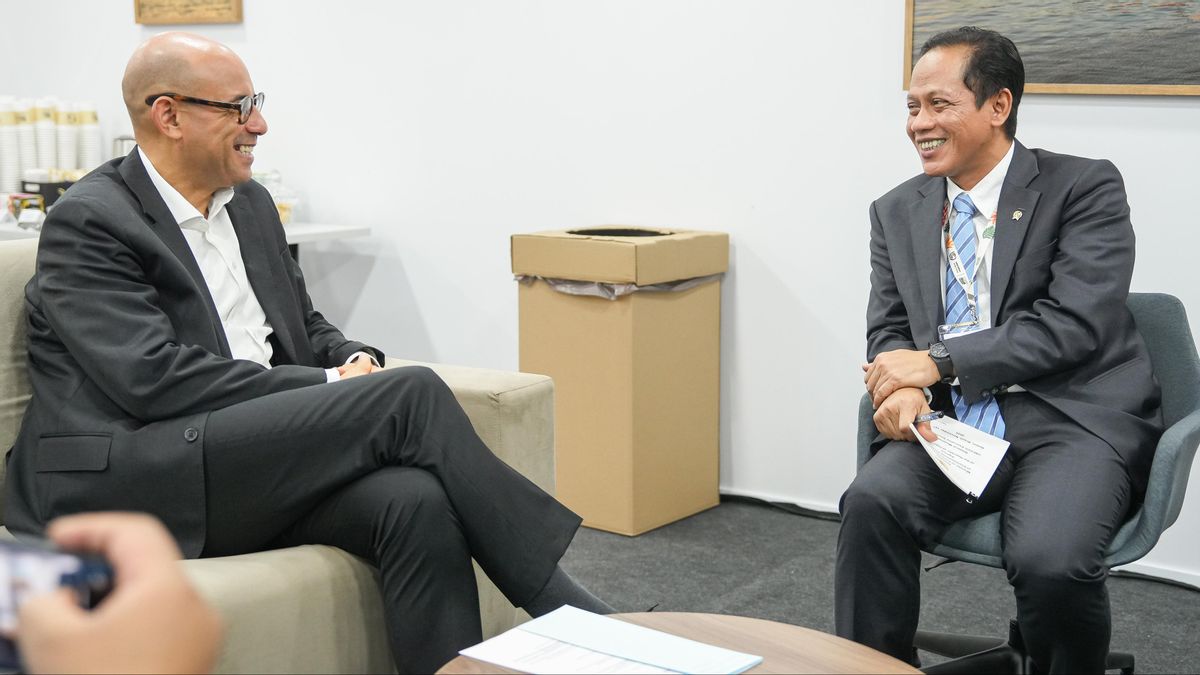
At the COP30 World Climate Change Conference in Brazil, the Minister of Environment/Head of BPLH Hanif Faisol Nurofiq officially submitted two strategic documents, namely the National Adaptation Plan (NAP) and Second Nationally Determined Contribution (SNDC) to the United Nations.
Both are the foundation of the economy and policies that regulate the direction of low-carbon development and national climate resilience.
The NAP contains a long-term strategy for adapting climate change in vital sectors: clean water, food, health, and infrastructure. This document is important from an economic perspective because it maps the risk of loss due to climate disasters and provides its mitigation scheme.
The government emphasizes that strengthening adaptation will reduce future economic costs, ranging from potential crop failure, supply chain disruption, to infrastructure damage.
The preparation of the NAP is carried out inclusively, including involving vulnerable groups, to ensure more effective implementation.
Meanwhile, SNDC is an update on Indonesia's target for reducing greenhouse gas emissions.
In this document, the government stated a commitment to reduce emissions by 12 percent below the 2019 level in 2035, as well as to emphasize the direction of the energy transition.
For business actors and investors, SNDC serves as a roadmap for regulatory certainty, particularly related to the development of renewable energy, investment in the clean technology sector, shifting from fossil energy, and opportunities for domestic and international carbon markets.
This commitment is in line with Indonesia's efforts to take advantage of the global financing mechanism, including the energy transition and adaptation funding.
The UN Secretariat for Climate Change represented by Simon E. Stiell welcomed Indonesia's move.
He called the two documents a real example of developing countries that did not just give promises, but showed plans for implementation that could be executed despite being in a transitional period of government.
SEE ALSO:
-
 | EKONOMI
Kementerian PU Rampungkan Kampus Khonghucu Negeri Pertama di Indonesia Senilai Rp46 Miliar
15 November 2025, 22:00 -
 | EKONOMI
Kemenperin Pamer Produk Farmasi dan Kosmetik RI Tembus Pasar Amerika hingga Eropa
15 November 2025, 22:30 -
 | EKONOMI
Ma'ruf Amin Beberkan Alasan Wakaf Belum Tergarap Maksimal di Indonesia
15 November 2025, 14:25
SEE ALSO:
-
| EKONOMI
Kementerian PU Rampungkan Kampus Khonghucu Negeri Pertama di Indonesia Senilai Rp46 Miliar
15 November 2025, 22:00 -
| EKONOMI
Kemenperin Pamer Produk Farmasi dan Kosmetik RI Tembus Pasar Amerika hingga Eropa
15 November 2025, 22:30 -
| EKONOMI
Ma'ruf Amin Beberkan Alasan Wakaf Belum Tergarap Maksimal di Indonesia
15 November 2025, 14:25
The handover of the NAP and SNDC is believed to open up greater opportunities for Indonesia to access international climate funding.
This provides space for financing green infrastructure projects, food security, water conservation, and renewable energy expansion.
This step also strengthens Indonesia's position as one of the important players in the global green economy.
The English, Chinese, Japanese, Arabic, and French versions are automatically generated by the AI. So there may still be inaccuracies in translating, please always see Indonesian as our main language. (system supported by DigitalSiber.id)


