

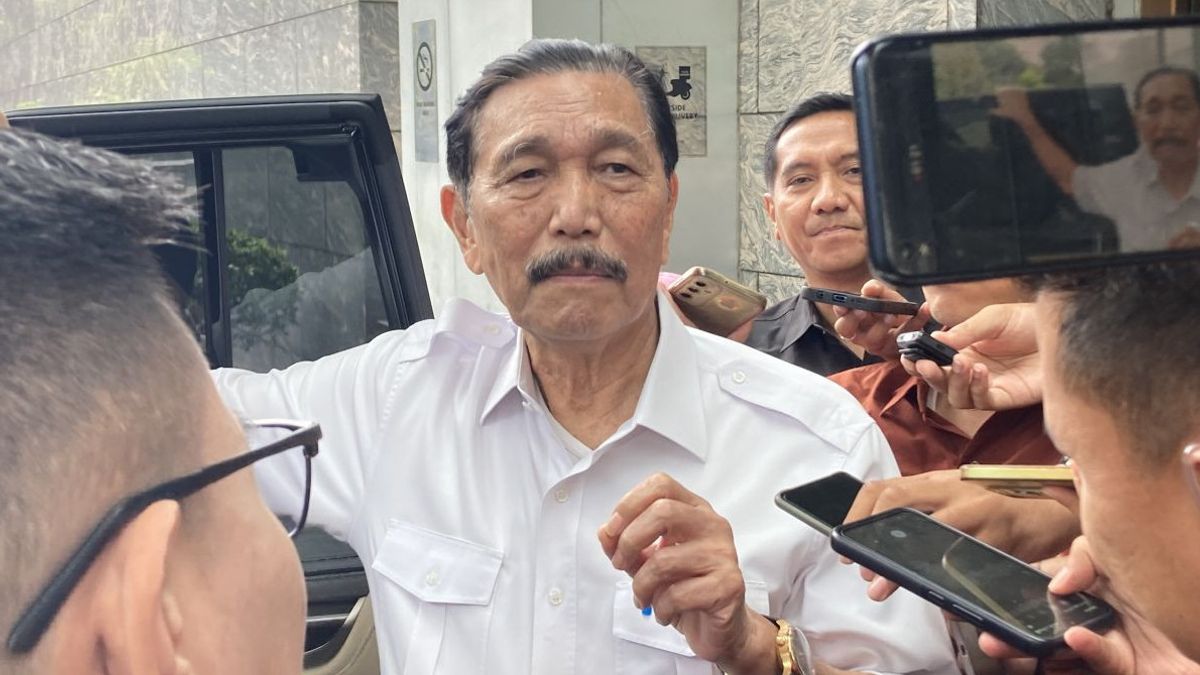


JAKARTA - Chairman of the National Economic Council (DEN) Luhut Binsar Pandjaitan recounted the beginning of the journey of the Jakarta-Bandung high-speed rail project or known as ramaish.
He said when the project was handed over to him it was in a 'rotting' condition, aka problematic.
According to Luhut, after receiving the project, improvements were made. He also collaborated with the Financial and Development Supervisory Agency (BPKP) to conduct an audit.
"I was the one who worked on it from the start, because I accepted that it was rotten. Then we tried to fix it, we audited it, BPKP," said Luhut on the agenda of 1 Year of the Prabowo-Gibran Government in Jakarta, written Friday, October 17.
Even so, Luhut said the high-speed rail project would not stop on the Jakarta-Bandung route. He said the government plans to continue the project until Surabaya.
In fact, Luhut revealed that an initial study (preliminary study) to extend the route had been prepared. Later, he said, Java Island will develop into an interconnected area, so a fast transportation system is needed that reaches all regions.
Karena study juga, saya selalu basisnya study. Jawa ini akan menjadi kota pulau. Jadi transport itu harus dibutuhkan sampai ke Surabaya, ujarnya.
The former Coordinating Minister for Maritime Affairs and Investment revealed that the Surabaya high-speed train route had also been prepared. He said the route was designed to cross a number of areas.
Luhut said the route started from Bandung, then connected to Kertajati, Purwokerto, continued to Cilacap, Solo, to the last stop station, namely Surabaya.
"We have made a study at that time, from Bandung to Kertajati, Kertajati to Purwokerto, then Cilacap, Cilacap and then Solo, Solo continued to Surabaya," he explained.
In the construction of the Surabaya high-speed rail project, Luhut emphasized that the experience of building the Jakarta-Bandung high-speed rail line is an important lesson.
SEE ALSO:
-
 | EKONOMI
Purbaya Minta Menteri UMKM Laporkan Dugaan Oknum Bea Cukai Langsung, Bukan ke Media
17 Oktober 2025, 10:31 -
 | EKONOMI
Menkeu Purbaya Bakal Temui OJK Bahas Penghapusan Kredit Macet di Bawah Rp1 Juta
17 Oktober 2025, 09:24
Kata dia, pemerintah berencana untuk meminimalkan pembangunan terowongan karena biayanya tinggi dan mengurangi pembebasan lahan yang luas. Tetapi, jalur baru akan dirancang sejajar dengan rel kereta atau jalan raya yang sudah ada agar proses konstruksi lebih efisien.
“Dan kita sudah tahu juga, mengalami pelajaran daripada Jakarta-Bandung, kita jangan bikin banyak tunnel, karena tunnel yang mahal. Kita juga jangan banyak pembebasan tanah,” ucapnya.
SEE ALSO:
-
| EKONOMI
Purbaya Minta Menteri UMKM Laporkan Dugaan Oknum Bea Cukai Langsung, Bukan ke Media
17 Oktober 2025, 10:31 -
| EKONOMI
Menkeu Purbaya Bakal Temui OJK Bahas Penghapusan Kredit Macet di Bawah Rp1 Juta
17 Oktober 2025, 09:24
He said the government plans to minimize the construction of tunnels because the costs are high and reduce land acquisition. However, the new line will be designed parallel to existing railroads or highways so that the construction process is more efficient.
"And we already know, experiencing lessons from Jakarta-Bandung, we don't make a lot of tunnels, because the tunnel is expensive. We also don't carry out a lot of land acquisition," he said.
The English, Chinese, Japanese, Arabic, and French versions are automatically generated by the AI. So there may still be inaccuracies in translating, please always see Indonesian as our main language. (system supported by DigitalSiber.id)


