

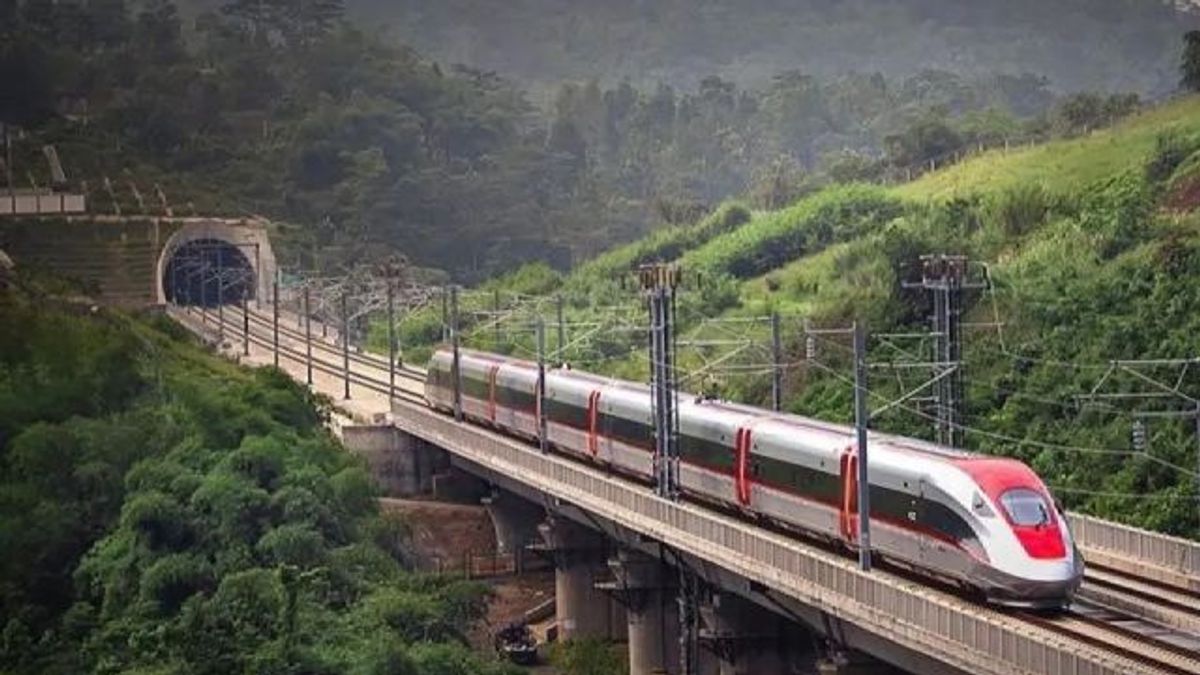


JAKARTA - The fate of the Jakarta Fast Train (KCJB) project is still facing a steep road.
In addition to operating in deficit conditions, the project, which is being worked on by PT Kereta Cepat Indonesia China (KCIC), also bears a large debt burden.
BUMN observer Herry Gunawan assessed that KCIC was indeed in a difficult position due to a number of fundamental factors.
One of them is the status of KCIC which does not include BUMN.
"The position of the Jakarta-Bandung high-speed train is very difficult, due to several things. Among them is KCIC as a cultivator, not a BUMN," he told VOI, written Thursday, October 16.
For your information, KCIC is a joint venture between a consortium of Indonesian SOEs and a company from China.
The Indonesian consortium, which is part of PT Pilar Sinergi BUMN Indonesia (PSBI), owns 60 percent of the shares, while China through China Railway International Co. Ltd. (CRI) holds 40 percent of the shares.
PSBI's shareholder composition consists of PTPT Kereta Api Indonesia (Persero) 58.53 percent, PT Wijaya Karya (Persero) Tbk 33.36 percent, PT Perkebunan Nusantara I 1.03 percent, and PT Jasa Marga (Persero) Tbk 7.08 percent.
With this composition, continued Herry, KCIC is not included in the BUMN category because the Indonesian government does not have direct shares or special shares, dwiwarna in it, but through indirect ownership through the BUMN consortium.
"KCIC is not a state-owned company, because the criteria for SOEs are if there is direct government share ownership or there is a special government stake, namely dwiwarna shares," said Herry.
Currently, continued Herry, there is already a special institution called Danantara Indonesia that the government has appointed to manage SOEs centrally. That way, the position of KCIC outside the BUMN structure makes state interventions, including through the State Budget, limited.
However, continued Herry, the current problem is related to KCIC's worrying financial condition.
"The train quickly has financial problems, not only debt but also operating with a deficit. This shows that the prospects for the future are not good," he said.
To note, the Jakarta-Bandung high-speed rail project, known as MAYh, cost up to USD 7.2 billion in jumbo investments.
The investment value experienced a cost overrun of USD 1.2 billion from the initial project cost target of USD 6 billion.
Of the 1.2 billion US dollars, 60 percent was charged to the Indonesian consortium or around USD 720 million.
While the rest, USD 480 million will be charged to the Chinese consortium.
The financing structure consists of 25 percent through KAI's State Capital Participation (PMN) worth IDR 3.2 trillion.
SEE ALSO:
-
 | EKONOMI
Purbaya Ungkap Pembayaran Utang KCIC jadi Tanggung Jawab Danantara, Bukan APBN
15 Oktober 2025, 20:47 -
 | EKONOMI
Purbaya Ogah Tanggung Utang Kereta Cepat Whoosh, Bos Danantara: Kita Lagi Evaluasi
14 Oktober 2025, 16:55 -
 | BERITA
Utang Kereta Cepat Capai Rp112,7 Triliun, Menkeu Purbaya Pasrahkan ke Danantara
14 Oktober 2025, 06:25
Sedangkan 75 persen sisanya bersumber dari pinjaman ke China Development Bank (CDB) sebesar 542,7 juta dolar AS atau Rp8,4 triliun.
Herry menekankan, apa pun opsi yang dipilih pemerintah untuk menyelamatkan proyek tersebut, restrukturisasi utang tetap harus dilakukan.
“Utangnya tetap harus dinegosiasikan ulang agar sesuai dengan kemampuan bayar. Kalau tidak, nanti kena beban baru seperti denda,” tuturnya.
SEE ALSO:
-
| EKONOMI
Purbaya Ungkap Pembayaran Utang KCIC jadi Tanggung Jawab Danantara, Bukan APBN
15 Oktober 2025, 20:47 -
| EKONOMI
Purbaya Ogah Tanggung Utang Kereta Cepat Whoosh, Bos Danantara: Kita Lagi Evaluasi
14 Oktober 2025, 16:55 -
| BERITA
Utang Kereta Cepat Capai Rp112,7 Triliun, Menkeu Purbaya Pasrahkan ke Danantara
14 Oktober 2025, 06:25
While the remaining 75 percent came from loans to the China Development Bank (CDB) amounting to USD 542.7 million or IDR 8.4 trillion.
Herry stressed that whatever options the government has chosen to save the project, debt restructuring must still be carried out.
"The debt still has to be renegotiated in order to match the ability to pay. Otherwise, it will be subject to new burdens such as fines," he said.
The English, Chinese, Japanese, Arabic, and French versions are automatically generated by the AI. So there may still be inaccuracies in translating, please always see Indonesian as our main language. (system supported by DigitalSiber.id)
Most Popular Tags
#Prabowo Subianto #donald trump #Febrie Adriansyah #8791 #giias 2026Popular


