

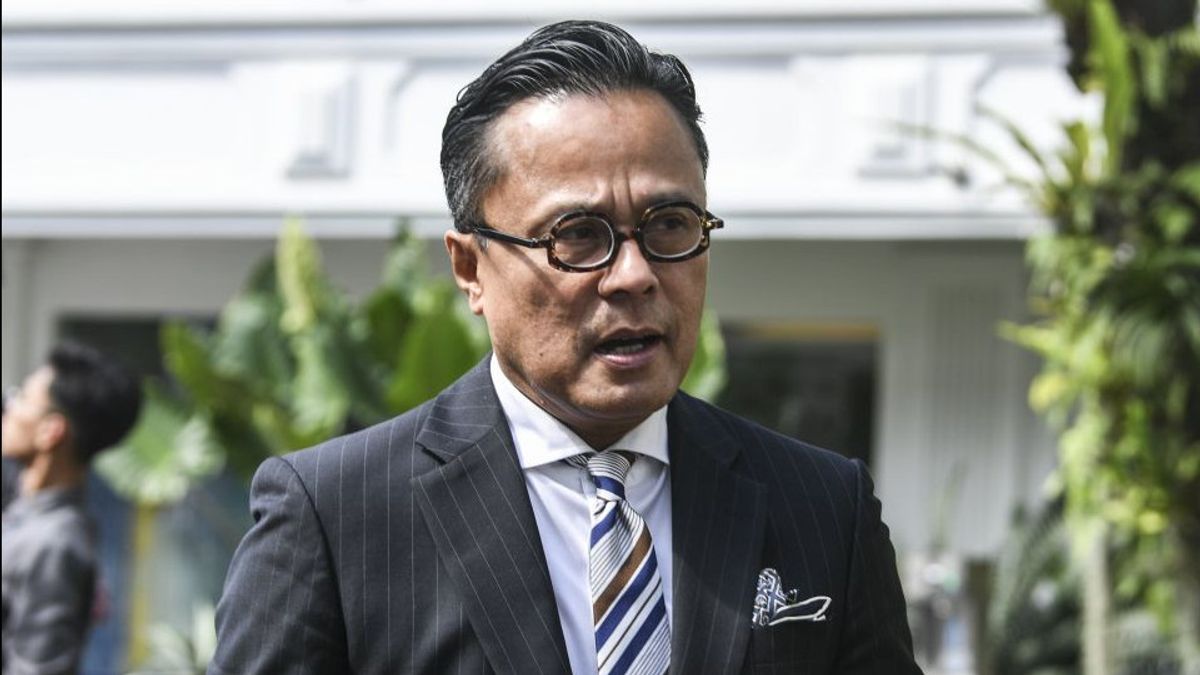


JAKARTA - Danantara's Chief Operating Officer (COO) Dony Oskaria explained that the problem of debt for the Jakarta-Bandung high-speed rail project or nicesh must be resolved comprehensively.
The reason is, it has something to do with the finances of PT Kereta Api Indonesia (Persero) as the parent company.
"So it's not a restructuring, but it must be a comprehensive solution. Because it's related to KAI too, right," said Dony when met at Graha Mandiri Jakarta, Monday, September 29.
Danantara, continued Dony, is still looking for the most appropriate mechanism in solving the debt problem for the high-speed rail project.
"So we're looking for the best mechanism regarding the settlement ofINAsh," he said.
Dony also highlighted the benefits of Thanks to the national economy. He said the presence of this project also provided economic benefits, therefore restructuring steps were needed.
"So that this trashsh will provide a lot of benefits for the economy, for the community as well, but financially it's quite problematic, this must be learned now," said Dony.
KAI Burden Reduction Scheme On Fast Train Project
Minister of State-Owned Enterprises (BUMN) Erick Thohir revealed that the government is reviewing a scheme to cut the burden on PT Kereta Api Indonesia (Persero) or KAI in the Jakarta-Bandung High Speed Rail (KCJB) project or known today as
Later, said Erick, KAI will only bear the obligation of railway facilities. Meanwhile, the construction of infrastructure, such as rails and stations, will be borne by the government.
"In accordance with the previous agreement, that the plan of supporting facilities is proposed to belong to the government. But the trains are all operational at KAI," said Erick at the DPR RI Building, Jakarta, Monday, September 15.
Regarding the scheme for distributing railway facilities and infrastructure, continued Erick, it will be renegotiated with the Chinese consortium.
"But we need an agreement with the Chinese side. Because it is the cooperation between Indonesia and China," said Erick.
Erick also said that renegotiation with the Chinese consortium would not be commanded by the Ministry of SOEs.
"There will be renegotiations later. Not us of course, the main task is from other ministries," said Erick.
For information, the operator of the HIGH Speed Train is PT Kereta Cepat Indonesia China (KCIC). Meanwhile, KCIC is a joint venture between the Indonesian consortium and the Indonesian consortium.
The Indonesian consortium is PT Pilar Sinergi BUMN Indonesia (PSBI). In this project, the share ownership of the Indonesian consortium is 60 percent. Meanwhile, the Chinese consortium, Beijing Yawan HSR Co. Ltd, pocketed 40 percent of KCIC shares.
PSBI consists of four SOEs, namely PT Kereta Api Indonesia (Persero) or KAI, PT Wijaya Karya (Persero) tbk or WIKA, PT Jasa Marga (Persero) Tbk, and PT Perkebunan Nusantara VIII (Persero) or PTPN VIII. Where, KAI became the majority shareholder, namely 51.37 percent.
KCIC itself recorded a loss of up to IDR 1.6 trillion in the first semester of 2025. KAI also felt the loss as the majority shareholder of PSBI, the total absorption of KAI losses in the first semester of 2025 was IDR 1.42 trillion.
The Debt Of Thection Project Becomes A Time Bomb
Previously, the President Director of PT Kereta Api Indonesia (Persero) or KAI, Bobby Rasyidin admitted that the debt burden for the Jakarta-Bandung high-speed rail project would be a time bomb for his company.
The statement answered questions from several members of Commission VI of the DPR who highlighted the mounting debt of the high-speed rail project.
"The KCIC problem, which was conveyed earlier, is indeed a time bomb made (KAI)," he said in a meeting with Commission VI of the DPR, at the DPR Building, Parliament Complex, Jakarta, Wednesday, August 20.
SEE ALSO:
-
 | EKONOMI
Utang LRT Jabodebek ke Adhi Karya Mau Diambil Alih KAI, Danantara Cek Skemanya
29 September 2025, 17:06 -
 | EKONOMI
Erick Thohir Bongkar Skema Pengurangan Beban KAI di Proyek Kereta Cepat Whoosh
15 September 2025, 19:01
Bobby also asked the House of Representatives Commission VI for time to explore the problems that occurred within KAI, including problems sourced from the high-speed rail project.
Considering that Bobby himself was only appointed as Director of KAI a few days ago.
"We ask that one more time, maybe in the form of an FGD to understand more deeply and we are sure that in the next week we can understand all the obstacles. The problems that exist in KAI," he said.
The English, Chinese, Japanese, Arabic, and French versions are automatically generated by the AI. So there may still be inaccuracies in translating, please always see Indonesian as our main language. (system supported by DigitalSiber.id)


