



JAKARTA - Indonesia's gross domestic product (GDP) growth target of 5.4 percent as stated in the 2026 Revenue and Expenditure Budget Draft (RAPBN) is projected to be very difficult for the Government to achieve. This was conveyed by the Center for Strategic and International Studies (CSIS).
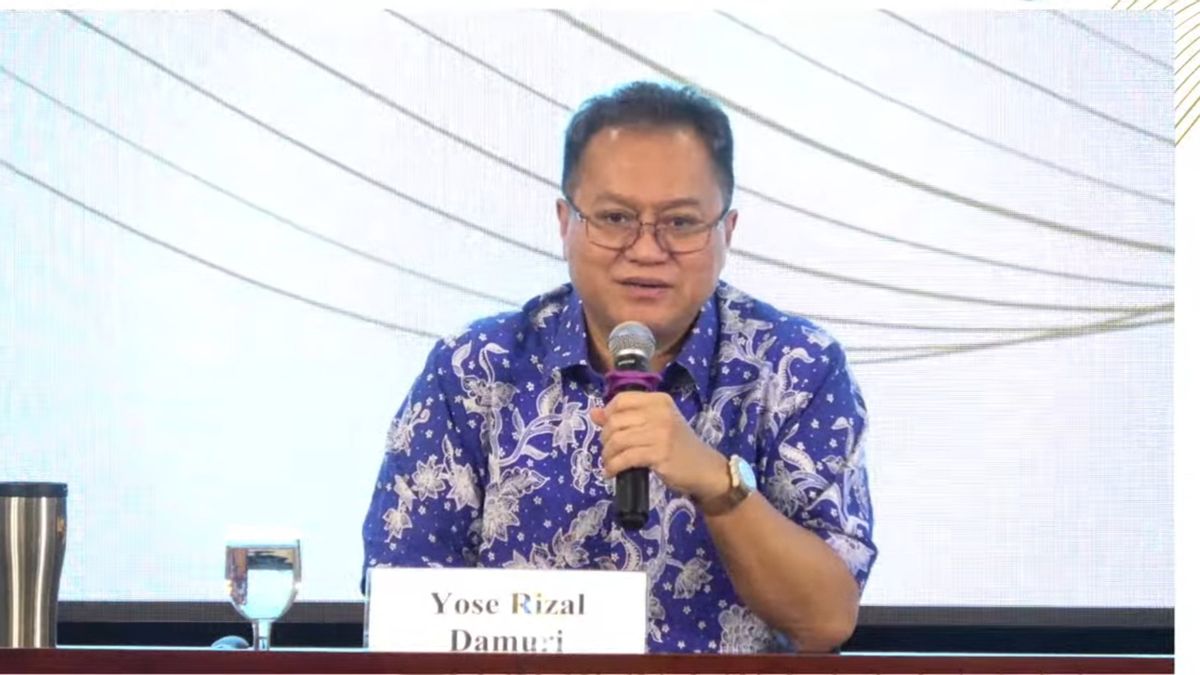
The Executive Director of CSIS, Yose Rizal Damuri, explained that this was due to the global economy, which is still overshadowed by uncertainty, including the trend of weakening domestic flagship export commodity prices.
"If we look at it from the global side, of course 2026, the possibility is that it will still experience high uncertainty."
"Uncertainty comes from either its policies at the global level or from the economic conditions of the world, which has been inherently running for the past five years."
"One thing I also want to highlight is the decline in Indonesia's export commodity prices and demand."
SEE ALSO:
-
 | OLAHRAGA
Arsenal Menang di Old Trafford, Manchester United Tumbang di Laga Perdana
18 Agustus 2025, 00:41 -
 | OLAHRAGA
Bayern Munchen Rebut Piala Super Jerman, Harry Kane Raih Trofi Lagi
17 Agustus 2025, 12:54

"So, again it will be very difficult to achieve the target of 5.4 percent or the assumption of 5.4 percent mentioned in the RAPBN," said Yose in a media briefing entitled RAPBN 2026: Considering Political Promises in the Middle of Fiscal Constraints, monitored online, Monday, August 18, 2025.
Yose said a number of Indonesia's mainstay export commodities, such as crude palm oil (CPO) along with its derivative products, coal, nickel, and gas are currently experiencing a weakening price.
The four commodities, said Yose, accounted for at least 40 percent of total domestic exports, which contributed significantly to state revenues.
"Four of them have weakened prices quite deeply compared to two or three years ago. This weakening will continue."
"If commodity prices decrease, the possibility of economic growth will also decrease. In addition, this also affects state revenues, where government revenues during 2022-2024 are greatly helped by revenues from export taxes. This is very high in contribution to Government revenues," he said.
According to Yose, the target set by the Government is far more optimistic than the projection of a number of global economic institutions, such as the International Monetary Fund (IMF), which projects that Indonesia's economic growth will only reach 4.8 percent.
Globally, he continued, the IMF is also projecting world economic growth to be only 3.1 percent in the latest reports, more pessimistic than previous projections which still reached 3.3 percent.
"One of the assumptions in the RAPBN is that the achievement of economic growth is 5.4 percent, of course it is a bit far from the projections conveyed by various world agencies. Including, the IMF, World Bank and others," said Yose.
Previously, President Prabowo Subianto set Indonesia's economic growth target in 2026 at 5.4 percent or more, with inflation remaining under control at the level of 2.5 percent.
The target was conveyed in the President's speech when delivering the 2026 State Budget Bill (RUU) and Financial Notes at the House of Representatives Building, Senayan, Jakarta, Friday, August 15, 2025.
In addition to inflation, Prabowo also revealed that the 10-year State Securities (SBN) interest rate is estimated to be in the range of 6.9 percent.
"We hope that the discussion of the 2026 RAPBN can be carried out constructively in the spirit of mutual cooperation in order to achieve the ideals of an independent, sovereign, just and prosperous Indonesia," he said.
The English, Chinese, Japanese, Arabic, and French versions are automatically generated by the AI. So there may still be inaccuracies in translating, please always see Indonesian as our main language. (system supported by DigitalSiber.id)
Most Popular Tags
#Prabowo Subianto #donald trump #Febrie Adriansyah #8791 #giias 2026Popular


