

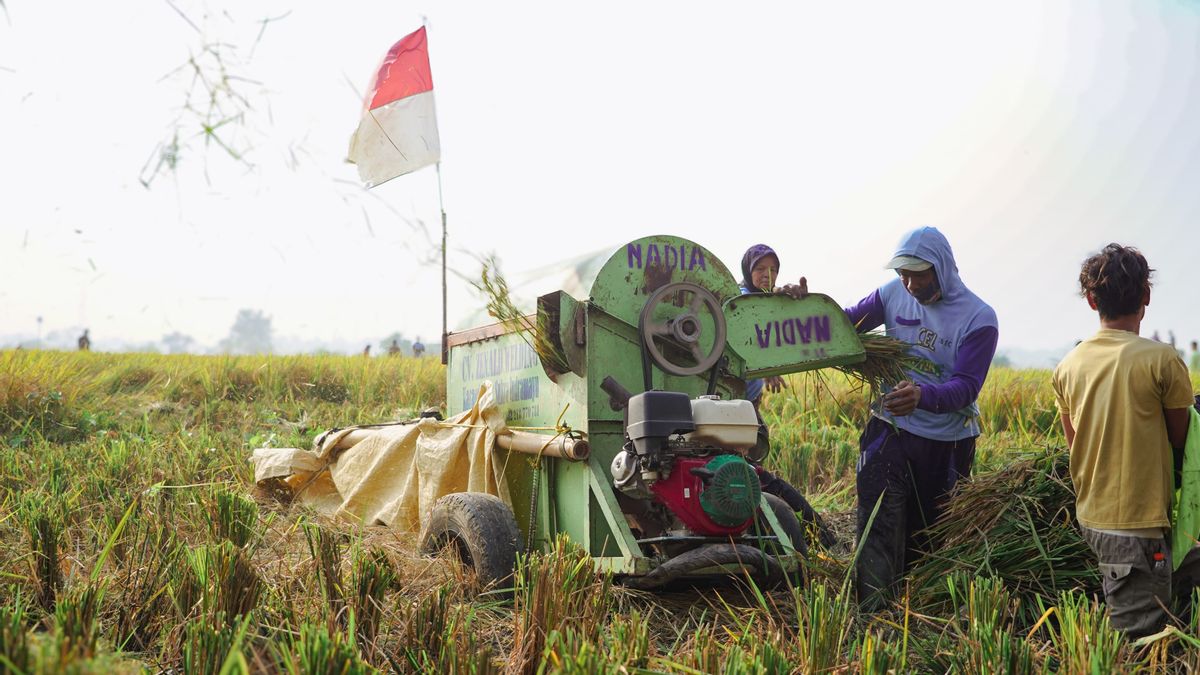


JAKARTA - The General Chairperson of the DPP Association of Indonesian Rice Milling and Rice Entrepreneurs (Perpadi), Sutarto Alimoeso, revealed that in the world of extortion, business actors often compete for raw materials.
It is hoped that the new policy that is being prepared by the government will be a solution to reorganize the national rice market mechanism.
"For example, fighting over raw materials in a way that often competes unhealthy. In this way (setting upper limit prices and quality classification), we hope that there will be no unfair competition to get raw materials," said Sutarto when contacted by VOI, Thursday, July 31.
Sutarto said the policy had been using two prices for premium and medium rice.
However, he continued, if the one-price system is implemented appropriately, it can strengthen market stability as well as provide certainty for business actors.
He also mentioned that the number of rice mills in Indonesia currently reaches around 169,000 units.
"When we talk about rice mining, the number of rice collectors is 169,000. But most of them are small rice collectors, which amount to approximately 161,000. Of these two, the results are different, the rice yields can be different," he explained. A total of 161,000 units of which are small rice mills. This scale difference has an impact on the quality of the rice produced.
"If we talk about rice mining, there are 169,000 rice collectors. But most of them are small rice collectors, which amount to approximately 161,000. Of these two, the results are different, the rice yields can be different," he explained.
A total of 161,000 units of which are small rice mills. This scale difference has an impact on the quality of the rice produced.
"If large rice mining is definitely what is produced, it can produce medium rice and premium rice. For small ones, the amount of rice is greater, generally those produced are medium rice. Some can be premium but not much. So most of it is medium rice produced," he said.
SEE ALSO:
-
 | EKONOMI
Lama Jadi Sengketa, Blok Ambalat Bakal Dikelola Pertamina dan Petronas
31 Juli 2025, 10:25
Pemerintah berencana menetapkan harga batas atas serta klasifikasi mutu untuk komoditas beras guna menciptakan pasar yang lebih adil dan efisien.
Kebijakan ini sedang dalam tahap pembahasan lintas kementerian dan lembaga terkait, termasuk Kementerian Pertanian, Kementerian Perdagangan, serta Badan Pangan Nasional.
SEE ALSO:
-
| EKONOMI
Lama Jadi Sengketa, Blok Ambalat Bakal Dikelola Pertamina dan Petronas
31 Juli 2025, 10:25
The government plans to set an upper limit price and quality classification for rice commodities to create a fairer and more efficient market.
This policy is currently in the stage of discussing cross-ministerial and related institutions, including the Ministry of Agriculture, the Ministry of Trade, and the National Food Agency.
The English, Chinese, Japanese, Arabic, and French versions are automatically generated by the AI. So there may still be inaccuracies in translating, please always see Indonesian as our main language. (system supported by DigitalSiber.id)
Most Popular Tags
#Prabowo Subianto #donald trump #2026 World Cup #Febrie Adriansyah #8791Popular


