

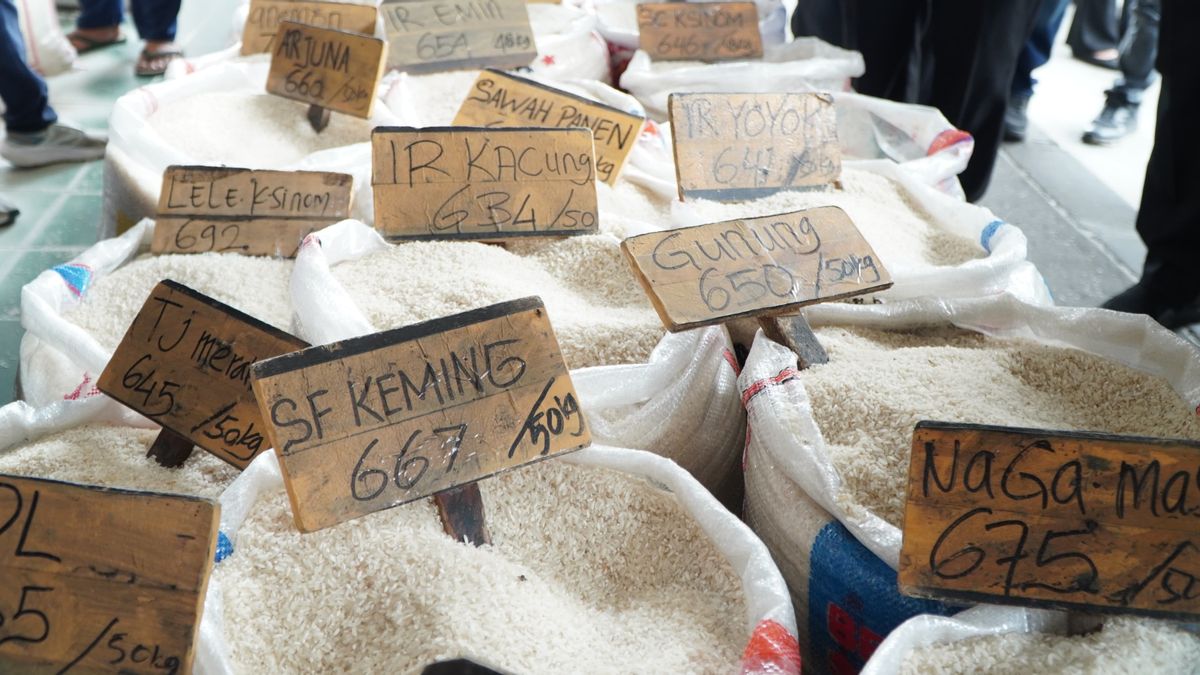


JAKARTA - The Indonesian Rice And Rice Entrepreneurs Milling Association (Perpadi) welcomes the government's plan to set an upper limit price and quality classification for rice commodities.
Chairman of the DPP Perpadi, Sutarto Alimoeso said, this step will improve market mechanisms while reducing the practice of unhealthy competition that often occurs in the field.
"The way one upper limit price will actually make it better so that unhealthy competition will decrease. Now the problem is only the upper limit," said Sutarto when contacted by VOI, Thursday, July 31.
He revealed that this unhealthy competition often occurs in the purchase of raw materials. If the quality classification policy and the price of the rice upper limit have been announced, it is hoped that this condition will be minimized.
"For example, fighting over raw materials in a way that often competes unhealthy. In this way (upper limit price settings and quality classification) we hope that there will be no unhealthy competition to get raw materials," said Sutarto.
Sutarto explained that the previous policy that used two prices for premium and medium rice had advantages and disadvantages. However, if the one-price system is implemented appropriately, it can strengthen market stability while providing certainty for business actors.
"In this way (setting upper limit prices and quality classification) we hope that there will be no unfair competition to get raw materials. Because there are indeed weaknesses, the two prices have weaknesses but there are also advantages. Yes, yesterday there were two prices, if premiums are different from medium," he continued.
Sutarto said, the number of rice mills in Indonesia currently reaches around 169,000 units, of which the majority, around 161,000 of which are small rice mills. This scale difference has an impact on the quality of the rice produced.
"If there are large rice mills, they can produce medium and premium rice. But for small ones, they generally produce medium rice. There are also those that can produce premium rice, but not much," he said.
In addition, Sutarto ensured that Perpadi as a forum for national extortion business actors was always involved in the process of formulating government policies, including in the plan to determine the upper limit price and classification of rice quality.
"Alhamdulillah, the government always invites Perpadi to provide input. Be it the Ministry of Food Coordinator, the Ministry of Agriculture, the Ministry of Trade, and the National Food Agency," he concluded.
SEE ALSO:



Sebelumnya, Kepala Badan Pangan Nasional (Bapanas) Arief Prasetyo Adi mengatakan, institusinya tersebut mendapatkan mandat untuk merumuskan klasifikasi mutu dan penetapan harga batas atas beras.
Kebijakan ini pun masih dalam pembahasan. Namun Menteri Pertanian (Mentan) Andi Amran Sulaiman menyebut bahwa kebijakan itu tak lama lagi akan diumumkan usai menggelar rapat koordinasi terbatas (rakortas).
SEE ALSO:
Previously, the Head of the National Food Agency (Bapanas) Arief Prasetyo Adi said that his institution had a mandate to formulate quality classification and set an upper limit on rice prices.
This policy is still under discussion. However, Minister of Agriculture (Mentan) Andi Amran Sulaiman said that the policy would soon be announced after holding a limited coordination meeting (Rakortas).
The English, Chinese, Japanese, Arabic, and French versions are automatically generated by the AI. So there may still be inaccuracies in translating, please always see Indonesian as our main language. (system supported by DigitalSiber.id)


