

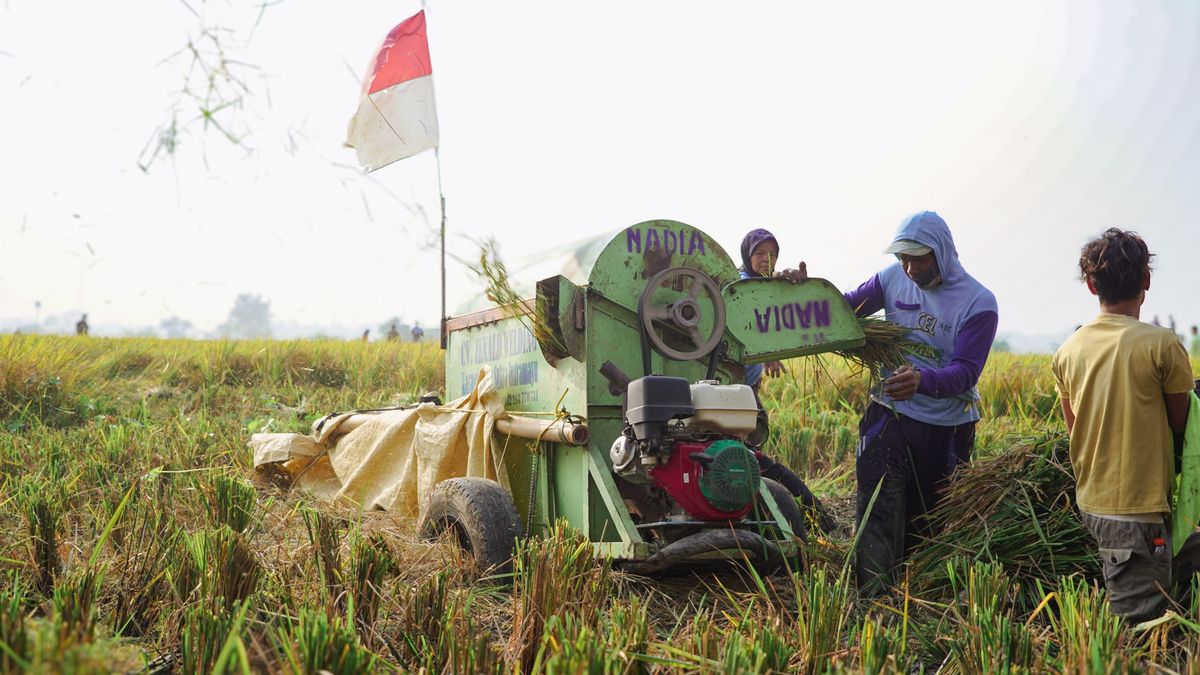


JAKARTA - Commission VI of the DPR RI emphasizes the importance of strengthening the national agricultural sector protection system in line with the entry of agricultural products from the United States (US) into the domestic market free of import duties, aka 0 percent tariff.
Member of Commission VI of the Indonesian House of Representatives, Abdul Hakim Bafagih, said that the trade policy must be balanced with strong and comprehensive domestic protection instruments.
He stated this in a bilateral meeting between Commission VI of the Indonesian House of Representatives and the National Policy Committee of the National Assembly of South Korea at the Parliament Complex, Senayan, Jakarta, Monday, July 28.
"The agricultural sector will not be allowed to deal directly without protection. Our Bulog strengthens it as an off-taker, ID FOOD as the operator of national distribution so that the people's farming results are still absorbed at a fair price," said the judge in his statement quoted from the DPR RI website.
Overcoming this, the Indonesian government has prepared anticipatory steps to deal with the surge in imported agricultural products, especially from America.
Strengthening the role of food SOEs such as Perum Bulog and ID FOOD is a concrete step in protecting local farmers and maintaining price stability.
He explained that the protection system currently being built includes various aspects ranging from capital support, cold chain infrastructure, data-based distribution, to market arrangement so as not to be overheld by imported products.
"We will make sure from farmers to consumers, our agricultural ecosystem is built independently and strongly. Not only resistant to imports, but also expansion," continued Hakim.
The judge said that Commission VI of the DPR RI also did not turn a blind eye to Indonesia's dependence on several imported agricultural commodities such as wheat and soybeans, most of which still came from Uncle Sam's country.
However, according to him, this condition does not mean weakening national agriculture. In fact, it is an impetus to accelerate food diversification and increase local production.
"There are several commodities that cannot be fulfilled from within the country, such as soybeans and wheat. But we have a long-term strategy to reduce them. Even for import substitutions such as sorghum, it has begun to be developed," he said.
Learning From South Korea
In the bilateral forum, Commission VI of the House of Representatives also expressed interest in studying South Korea's strategy in building an efficient and productive agricultural system, even though it is under pressure from land constraints.
SEE ALSO:
Menurutnya, kunci keberhasilan Korea Selatan terletak pada pemanfaatan teknologi serta kebijakan negara yang konsisten dalam melindungi sektor pertanian mereka.
Dalam era keterbukaan ekonomi global, Indonesia tetap harus memprioritaskan petani lokal, bukan hanya dengan subsidi, tetapi juga dengan memberikan kepastian pasar, pendampingan teknologi, dan dukungan infrastruktur memadai.
"Kita bukan menolak perdagangan terbuka, tapi kita juga harus berdiri di atas kepentingan petani kita," ujar politisi Fraksi PAN tersebut.
SEE ALSO:
According to him, the key to South Korea's success lies in the use of technology and consistent state policies in protecting their agricultural sector.
In the era of global economic openness, Indonesia still has to prioritize local farmers, not only with subsidies, but also by providing market certainty, technology assistance, and adequate infrastructure support.
"We do not reject open trade, but we must also stand in the interests of our farmers," said the PAN faction politician.
The English, Chinese, Japanese, Arabic, and French versions are automatically generated by the AI. So there may still be inaccuracies in translating, please always see Indonesian as our main language. (system supported by DigitalSiber.id)
Most Popular Tags
#Prabowo Subianto #donald trump #Febrie Adriansyah #8791 #giias 2026Popular


