

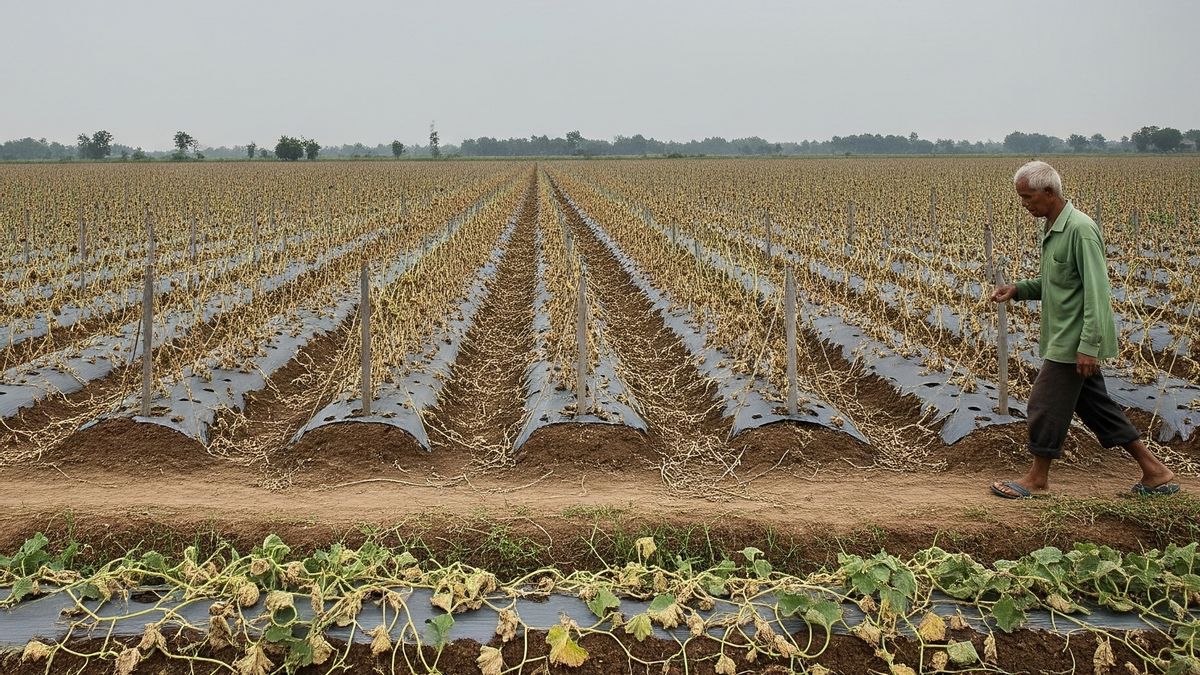


JAKARTA Farmers at the East Java production center were forced to stroke their chest during this year's melon planting season.
The reason is, plant performance due to uncertain weather and increasing virus attacks are the main problems that have a direct impact on crop yields.
In areas such as Nganjuk, Madiun, and Kediri, farmers complain about the drastically declining quality of fruit.
melon plants that usually grow optimally are now disrupted in the phase of the formation and enlargement of fruit.
The fruit looks smaller than the normal size, rough skin, and the color is less bright.
Even some of the fruit suffered cracks to imperfect shapes, thus failing to meet market standards.
"Usually we can harvest melon with good quality, but now there are many who don't deserve to sell. The fruit is small, hard, and some are broken before cooked," complained the melon farmer from Purwotengah Village, Kediri, Arif Nur Azis.
Arif explained, one of the main causes of this decline in quality is the attack of a rapidly growing plant virus in the midst of high humidity.
The high instability of temperature and rainfall make plants more vulnerable.
In line with Arif, Edi expressed his concern about the resilience of seeds.
"We need seeds that are more resistant to the virus. If the conditions are like this, we will continue to lose a lot. The planting capital alone is already high," he said.
This condition is also felt by fruit distribution business actors. The owner of the Saclar Buah Group Kediri Mujet revealed that the quality of the melon supply from farmers has decreased in recent months.
"If it's like this, we also have difficulties in the market. We hope that there will be assistance from the government regarding disease control and virus-resistant seeds. This concerns the sustainability of our business as well," said Mujet.
SEE ALSO:
-
 | EKONOMI
Semester I 2025, Penyaluran KUR Capai Rp131,84 Triliun ke 2,28 Juta Debitur
13 Juli 2025, 15:45
Responding to this, the East Java Agriculture Service has monitored and prepared further educational plans for farmers.
This education is focused on plant health management, pest and disease control, as well as the selection of superior varieties that are more resistant to climate change.
This situation is an important reminder that the horticultural sector, especially melon, requires a stronger adaptation strategy to extreme weather changes and potential virus attacks.
Collaboration between farmers, the government, and the private sector is urgently needed so that melon production remains sustainable amid the growing challenges.
The English, Chinese, Japanese, Arabic, and French versions are automatically generated by the AI. So there may still be inaccuracies in translating, please always see Indonesian as our main language. (system supported by DigitalSiber.id)
Most Popular Tags
#Prabowo Subianto #donald trump #Febrie Adriansyah #8791 #giias 2026Popular


